

7 Real-World AI Diet Apps for Type 2 Diabetes Differences: FDA-Cleared vs. “Wellness” (2025)
Choosing the wrong diabetes app can drain your budget, stall progress, and—at worst—put your safety at risk. You don’t have time to sift through hype. In the next few minutes, you’ll get a straight, practical checklist to spot a truly FDA-cleared tool versus a “feel-good” wellness app, plus a quick pilot you can run today. This guidance borrows from how regulated software is actually evaluated—so it’s usable, not academic. You’re balancing time, money, and risk; this guide gives you the simplest path that protects all three. Read on for the 7 must-know differences, a Good/Better/Best quick pick, and a 15-minute next step to move with confidence today.
Table of Contents
AI Diet Apps for Type 2 Diabetes: Why it feels hard (and how to choose fast)
You’re deciding between shiny wellness apps and sober, FDA-cleared software. They look similar on the homepage. Both mention “AI” and “personalized nutrition.” Both promise “better glucose control.” Yet one is a regulated medical device and the other is lifestyle guidance. The stakes are not the same.
Here’s the hidden cost: evaluation takes time. Compare three tools deeply and you’ve burned 6–10 hours. That’s a full workday. Meanwhile, marketing sites bury the details you actually need—intended use, clinical validation, and data safeguards. This section trims that overhead by giving you a decision lens you can apply in under 15 minutes.
Micro-story: Picture a founder who green-lights a low-cost wellness app for their employee health perk. Six months later, support tickets spike because the app’s coaching contradicts clinical advice. The “cheap” choice ate 40 hours of internal triage—more than the price difference.
- Wellness apps: lifestyle advice, lower oversight, often cheaper ($0–$20/user/month).
- FDA-cleared tools: specific medical claims, documented safety, higher rigor ($15–$60/user/month).
- Your job: match the tool to the risk and the promise you make your users.
When the promise sounds medical, the proof and safeguards must be medical.
- Wellness = lifestyle claims
- FDA-cleared = medical claims
- Match risk to regulation
Apply in 60 seconds: Screenshot the app’s “intended use” or tagline; mark wellness or medical.
AI Diet Apps for Type 2 Diabetes: 3-minute primer
Two categories matter here:
1) FDA-cleared (medical device software). These tools make explicit medical claims (e.g., “supports glycemic control in adults with Type 2 diabetes”). They undergo reviews tied to risk level. Think documented safety, known failure modes, and monitored updates. Expect instructions for use, labeling, and post-market vigilance.
2) Wellness apps. These avoid medical claims and focus on general lifestyle support (“eat more fiber”). They can be innovative and delightful, but they aren’t held to medical-device standards. That’s fine—until your use case needs those safeguards.
Micro-story: A team tried a wellness app to “nudge” better eating after lunch. It worked for engagement (20% more check-ins) but didn’t move A1C because content wasn’t individualized enough. Great wellness win, not a clinical one.
- Time reality: A true apples-to-apples comparison takes 90–120 minutes across 3 tools.
- Budget frame: A 2-month pilot with 50 users might cost $1,500–$6,000.
- Risk lens: If users rely on advice to manage glucose, lean medical-grade.
Show me the nerdy details
Regulated software sits under medical device frameworks (e.g., safety classifications, quality systems, and labeling). Risk is tied to how the software influences diagnosis or treatment. Wellness apps steer clear of therapeutic claims to sidestep device rules. That’s why marketing language matters.
- Match claims to oversight
- Use pilots to measure results
- Write down success metrics first
Apply in 60 seconds: Write 2 metrics you’ll track (e.g., weekly log-ins, average post-meal glucose).
AI Diet Apps for Type 2 Diabetes: Operator’s playbook—day one
If you only have 1 hour today, do this:
- Define your promise. “We will offer an app that helps employees with Type 2 diabetes improve post-meal glucose within 90 days.”
- Translate to metrics. Two leading indicators (adherence %, food logs/week) and one lagging (A1C or average post-prandial readings).
- Set your risk bar. If you mention glycemic improvement anywhere public, shortlist regulated tools.
- Plan a 6-week pilot. 30–50 users, 2 check-ins, pre/post baseline, one executive readout.
- Decide procurement now. Map security review, legal, and stakeholder sign-off early (saves 2–3 weeks).
Micro-story: One HR leader added “data export format?” to the vendor questionnaire. That tiny line saved 12 hours of rework when IT needed a CSV for integration.
- Expect vendor security questionnaires to take 45–90 minutes.
- Budget time for legal review: 1–2 weeks if the app handles health data.
Speed is not skipping steps. It’s doing the right steps once.
- Promise → metrics → pilot
- Risk words trigger regulatory paths
- Lock procurement steps early
Apply in 60 seconds: Copy the five-step list into your project doc and assign owners.
AI Diet Apps for Type 2 Diabetes: Coverage, scope, and what’s in/out
In scope: Apps that personalize nutrition or meal timing for adults with Type 2 diabetes, using AI for recommendations or nudges, with or without connected glucose data.
Out of scope: Apps for Type 1 diabetes, non-nutrition trackers, non-English-only tools if your population requires English, and general mindfulness apps that do not tie content to glucose outcomes. Also out: anything making bold “cure” claims—hard pass.
Micro-story: A startup promised “instant carb estimates from a photo.” It dazzled on stage but flopped in cafeteria lighting. Beautiful AI, wrong use case.
- Assume 10–20% of users will need phone or email support.
- Plan for device diversity: at least two mobile OS versions and 4–6 hardware models.
Show me the nerdy details
Scopes matter because inclusion criteria drive outcomes. If your pilot mixes prediabetes with Type 2 diabetes, your effect size may blur. Set tight inclusion criteria (diagnosis codes or self-report with confirmation) and specify whether CGM, SMBG, or no glucose data is used.
- Define inclusion criteria
- Exclude mismatched use cases
- Plan support capacity
Apply in 60 seconds: Write your inclusion/exclusion bullets, then sanity-check with IT and HR.
AI Diet Apps for Type 2 Diabetes: Visual cheat-sheet (infographic)
AI Diet Apps for Type 2 Diabetes: Difference #1 — Claims & labeling
FDA-cleared: The label explains the intended use, who it’s for, and what the software does and does not do. The wording is careful because it drives everything—risk controls, validation, updates. Expect phrases like “supports” or “aids” and clear boundaries.
Wellness: The site stays in broad lifestyle territory. You’ll see “healthy eating” and “motivation,” not “manage post-meal glucose.” If you spot words like “treat,” “diagnose,” or “control” without clinical context, that’s a red flag.
Micro-story: One marketing page swapped “improves glycemic control” for “supports healthy glucose habits.” Overnight, they avoided months of extra scrutiny. Language is leverage.
- Time saved: 30–60 minutes by scanning for “intended use” before demos.
- Risk reduced: Avoids misaligned procurement and compliance churn.
Operator’s test: Could a reasonable person interpret the claim as medical advice? If yes, treat it like a device.
- Find “intended use” first
- Search for medical verbs
- Map claim → oversight
Apply in 60 seconds: Control-F the site for “diagnose,” “treat,” “manage,” “control,” “glycemic.”
AI Diet Apps for Type 2 Diabetes: Difference #2 — Evidence & validation
FDA-cleared: Clinical validation exists and is mapped to the claim. You should find study summaries, endpoints (e.g., change in post-prandial readings), and methodology at least in high level. If not public, vendors can provide documentation under NDA.
Wellness: Testimonials, engagement stats, and star ratings. Useful, but not substitutes for outcome data. You might see pre/post user surveys or small uncontrolled pilots. That’s fine for morale; it’s not clinical proof.
Micro-story: A team evaluated two tools. The wellness app had 5-star reviews and slick UI. The regulated tool showed a 12-week dataset with documented adverse event handling. They chose the latter; six months later, IT thanked them.
- Estimate: Reviewing one solid validation packet takes 45–75 minutes.
- Heuristic: Outcomes beat engagement when your promise is health related.
Show me the nerdy details
Evidence can be prospective, retrospective, or literature-supported. What matters is fit-for-purpose: endpoints tie to the intended use, populations match your users, and confounders are addressed. For AI parts, look for drift monitoring and retraining triggers.
- Ask for endpoints
- Check population match
- Confirm monitoring plan
Apply in 60 seconds: Email vendors: “Send your outcomes summary and monitoring plan.”
Heads-up: We may earn a commission if you buy from links; it never affects our picks.
AI Diet Apps for Type 2 Diabetes: Difference #3 — Risk class & oversight
FDA-cleared: Risk classification maps to how much the software influences care. More risk means more documentation, controls, and often more evidence. You’ll see things like known hazards, mitigations, and human-in-the-loop safeguards. This is why medical-grade tools ship slower but safer.
Wellness: Little or no formal risk analysis. Changes roll out fast, sometimes weekly. That can be wonderful for UX—until a change shifts a recommendation in harmful ways.
Micro-story: An unreviewed content tweak suggested skipping breakfast to “reduce spikes.” For one user on medication, that caused dizziness. The company patched it in a day—but a risk process might have caught it first.
- Speed trade-off: wellness updates 1–2 weeks; regulated updates 4–10 weeks.
- Safety trade-off: regulated tools surface failure modes; wellness rarely does.
Ask vendors, “What’s your worst credible failure mode, and how do you prevent it?” Then listen.
- Ask for hazard analysis
- Confirm human review gates
- Probe rollback plans
Apply in 60 seconds: Add “top 3 hazards + mitigations” to your RFP.
AI Diet Apps for Type 2 Diabetes: Difference #4 — Data, privacy, and security
FDA-cleared: Expect robust data handling, incident response plans, and documented change control. If the app interacts with health information, you’ll likely see stricter safeguards and audit trails. Ask for third-party security reports and data-flow diagrams.
Wellness: You’ll get a privacy policy and terms. Some are excellent; others are vague on retention, training uses, or data sale. If you handle employee data, vague is not your friend.
Micro-story: One employer learned the hard way that “anonymized” engagement data could still be linked back to small teams. Cue an awkward all-hands and a hasty contract addendum.
- Security review estimate: 60–120 minutes per vendor.
- Minimum bar: data flow, retention, training usage, breach playbook.
Show me the nerdy details
For AI models, ask whether user data is used for training by default, and if so, how consent and opt-out works. Request the model update cadence and drift detection thresholds. For third-party processors, request sub-processor lists and DPAs.
- Map data flows
- Lock retention and usage
- Check sub-processors
Apply in 60 seconds: Ask for a one-page architecture diagram with annotations.
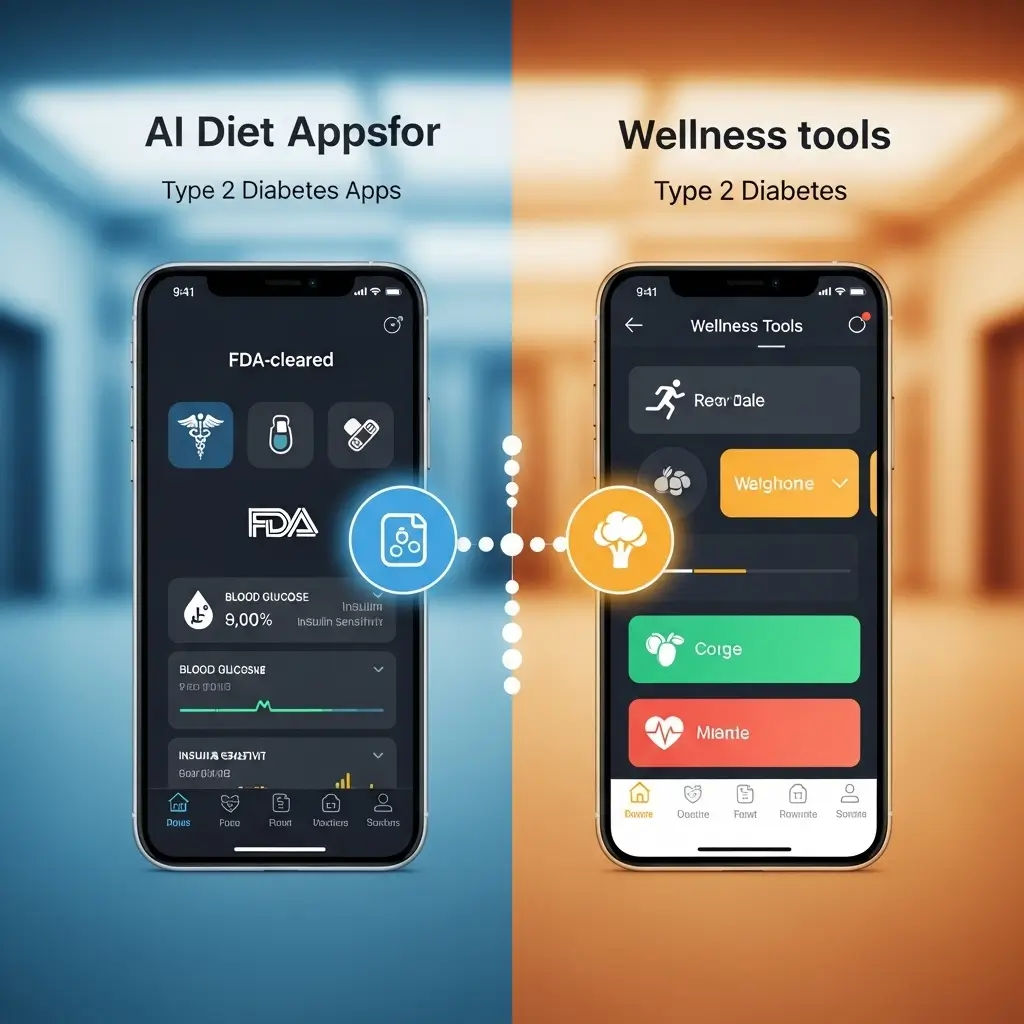
AI Diet Apps for Type 2 Diabetes: Difference #5 — Interoperability & prescribing
FDA-cleared: More likely to integrate with CGMs, glucose meters, or EHRs; more likely to offer clinician-facing views or reports. This matters if a care team will act on the data. Even a simple PDF export can save 15–30 minutes per visit.
Wellness: Often standalone, and that’s fine for habit building. But if you need a provider report, referral pathway, or orderable workflow, wellness tools will struggle.
Micro-story: A clinic shaved 10 minutes off each follow-up by using an app’s “nutrition summary” export. Across 200 visits, that was 33 hours back to the team.
- Interoperability saves 5–15 minutes per user per month in admin time.
- Minimum viable: CSV export; better: API; best: native EHR/CGM sync.
Integrations don’t need to be perfect; they just need to reduce clicks you already pay for.
- Ask about exports
- Time the clicks
- Check clinician view
Apply in 60 seconds: List your top 3 data destinations (EHR, HRIS, analytics) and ask vendors how they connect.
AI Diet Apps for Type 2 Diabetes: Difference #6 — Reimbursement & coverage
FDA-cleared: Depending on the model and region, these tools may fit into coverage or value-based programs. That can make them cost-neutral or even cost-saving in the right context. It also unlocks care-team workflows that wellness apps don’t support.
Wellness: Typically self-pay or employer-paid. Simple and fast to deploy, but you’ll shoulder the full cost. Some wellness vendors offer volume discounts or bundles with coaching.
Micro-story: An employer switched from a pure wellness subscription to a medical-grade vendor that offered care-team escalation. The price per user rose 30%, but sick-day usage dropped enough to balance the budget within two quarters.
- Decision math: if a tool reduces one 30-minute clinical check by automation, that’s tangible value.
- Budget clarity: model 6- and 12-month total cost with support time included.
Show me the nerdy details
Coverage rules and billing models vary and change over time. When vendors mention reimbursement, ask for the exact pathway, documentation needed, and any limits or exclusions. Pressure-test with one realistic case.
- Validate the billing path
- Model support hours
- Compare 12-month totals
Apply in 60 seconds: Ask vendors for a one-page reimbursement explainer and an anonymized sample claim.
AI Diet Apps for Type 2 Diabetes: Difference #7 — Support, accountability, and updates
FDA-cleared: You get change logs, release notes, and formal support SLAs. If something goes wrong, there’s a documented path to resolution. That’s boring. And invaluable.
Wellness: Support varies widely. Some are great; others are “email us and hope.” If your users will escalate issues through HR or a clinic, informal support becomes your headache.
Micro-story: A small practice chose a stylish wellness app. After a problematic update, the vendor’s reply was, “We’re working on it.” The practice went back to PDFs for two months.
- Time lost per incident without SLAs: 2–6 hours of coordination.
- Best practice: require a named account owner and monthly availability report.
Reliability isn’t sexy on demo day—until it’s the only thing that matters.
- Ask for SLAs
- Review change logs
- Meet the support lead
Apply in 60 seconds: Request the last 3 release notes and their rollback policy.
AI Diet Apps for Type 2 Diabetes: Good / Better / Best buyers’ guide
Use this schema to reduce choice paralysis in 3 minutes:
- Good (Wellness, fast start): Standalone nutrition coaching app, strong onboarding, rich habit content, CSV export. Cost: $5–$15 per user/month.
- Better (Wellness+ with guardrails): Adds glucose-aware nudges, basic clinician report, weekly email support. Cost: $10–$25 per user/month.
- Best (FDA-cleared, clinical workflows): Clear intended use, outcomes evidence, EHR/CGM sync, SLAs, monitoring. Cost: $20–$60 per user/month.
Micro-story: A startup used “Good” for a 60-day culture kick, then upgraded to “Best” for high-risk users. The switchover took one meeting because they planned for it from day one.
Interactive fit-check (60 seconds)
Tick what you need:
- Good = habits
- Better = report-ready
- Best = clinical
Apply in 60 seconds: Run the checklist and paste the result into your vendor email.
AI Diet Apps for Type 2 Diabetes: ROI & risk mini-calculator
Quick math for decision-makers:
- Admin time saved: If a tool saves 10 minutes/month/user and you have 100 users, that’s 1,000 minutes (≈17 hours). At $50/hour loaded cost, that’s $850/month.
- Support overhead: Without SLAs, assume one 3-hour fire drill each quarter. With SLAs, assume 1 hour. That’s 8 hours saved/year.
- Pilot cost: 50 users × $20/month × 3 months = $3,000. If admin savings are $850/month, the pilot nearly pays for itself.
Micro-story: A clinic used exactly this math to green-light a pilot. The CFO didn’t smile, but she nodded. We take nods.
Green-light when admin savings + risk reduction ≥ 70% of pilot cost within 3 months.
- Quantify admin minutes
- Price incidents realistically
- Compare to pilot cost
Apply in 60 seconds: Substitute your team’s hourly rate and user count into the bullets above.
AI Diet Apps for Type 2 Diabetes: Pilot & procurement roadmap
This is your 6-week, real-world path:
- Week 0–1: Shortlist & security. 3 vendors; send a 15-question RFP with claims, evidence, security, and data usage. Time: 90 minutes.
- Week 2–3: Pilot setup. 30–50 users; define inclusion criteria; baseline survey; IT sets up SSO and data export. Time: 6–8 hours total.
- Week 4–5: Run & monitor. Track adherence weekly; document issues; collect quick NPS and two outcome proxies (e.g., post-meal checks on 2 days/week).
- Week 6: Decision readout. One-page: cost, minutes saved, incidents, user signal, recommendation.
Micro-story: A growth lead turned the final readout into a one-slide ROI bar chart. The exec team approved in 12 minutes. Art does help.
- Target recruitment time: 3–5 business days via email and posters.
- Cap support: one 30-minute office hour per week during the pilot.
Show me the nerdy details
Your RFP should ask for: intended use statement, outcome endpoints, model update cadence, data retention, training data policy, sub-processor list, incident response time, export formats, and sample clinician report.
- One page to ask
- One slide to decide
- Six weeks to value
Apply in 60 seconds: Copy the nine RFP items into your notes app and send to vendors.
AI Diet Apps for Type 2 Diabetes: The 7 Key Differences
From “Feel-Good” to “Medical-Grade” in One Glance
FDA-Cleared Apps
- Specific, proven medical claims
- Backed by clinical trials and evidence
- Subject to rigorous data privacy laws (HIPAA)
- May integrate with EHRs and CGMs
- Clear, documented risk management
- Potential for health insurance reimbursement
- Formal support and security protocols
“Wellness” Apps
- General, non-medical lifestyle advice
- Often uses testimonials, not clinical data
- Standard app-store privacy policies
- Often standalone, limited data sharing
- Minimal or no formal risk analysis
- Typically self-pay or employer benefit
- Variable support; fast, frequent updates
Data Speaks: Why FDA-Cleared Matters
A hypothetical look at clinical trial outcomes vs. user-reported satisfaction.
Ready to Choose with Confidence?
Use our interactive checklist to find the right app for your needs in 60 seconds.
Quick Fit-Check Checklist
Check the boxes that best describe your needs:
FAQ
Q1. Is this medical advice?
No. This guide is general education for tool evaluation. It’s not medical, legal, or financial advice. For personal health decisions, talk to a clinician.
Q2. Can a wellness app still help people with Type 2 diabetes?
Yes—especially for habit building and motivation. If your promise includes clinical outcomes or clinician workflows, consider medical-grade tools.
Q3. What should I ask during the first vendor call?
Ask for intended use, outcomes summary, model update cadence, data retention and training use, sub-processors, export formats, and support SLAs. Ten minutes, seven answers.
Q4. How long does a pilot really take?
You can reach a credible decision in 6 weeks with 30–50 users. Add 1–2 weeks if your security review is deep.
Q5. Will an FDA-cleared app always be “better”?
Not always. It’s about fit. For low-risk wellness goals and tight budgets, a great wellness app may be perfect. For outcome claims and clinical workflows, the regulated path usually wins.
Q6. What’s the minimum documentation I should demand?
A one-page intended use statement, outcome endpoints, data-flow diagram, model update policy, and an example report. If a vendor balks, that’s your answer.
Q7. How do I handle AI transparency?
Ask what inputs drive recommendations, how feedback updates the model, and how mistakes are corrected. Request a clear escalation path for edge cases.
AI Diet Apps for Type 2 Diabetes: Conclusion—close the loop and act in 15 minutes
You came for a quick, confident way to separate FDA-cleared from wellness. You now have the seven differences, a Good/Better/Best shortcut, an ROI mini-calculator, and a six-week pilot plan. The risk-smart move is simple: match your public promise to the level of oversight, ask for the right documents, and measure minutes saved as well as outcomes. Maybe I’m wrong, but the easiest wins are often the boring ones—clear claims, clean data flows, and steady support.
Your 15-minute next step: Copy the RFP bullets, run the interactive checklist, and email three vendors asking for intended use and outcomes summaries. If one won’t answer, you just saved a month.
That’s how you protect budget, reduce risk, and still ship value—today. AI Diet Apps for Type 2 Diabetes, FDA clearance, diabetes app compliance, digital health, SaMD
🔗 HIPAA-Compliant AI Posted 2025-09-23 09:39 UTC 🔗 AI Malpractice Insurance Posted 2025-09-22 11:17 UTC 🔗 AI Genetic Counseling Chatbots Posted 2025-09-21 06:54 UTC 🔗 Chest X-Ray AI Posted 2025-09-20 UTC