
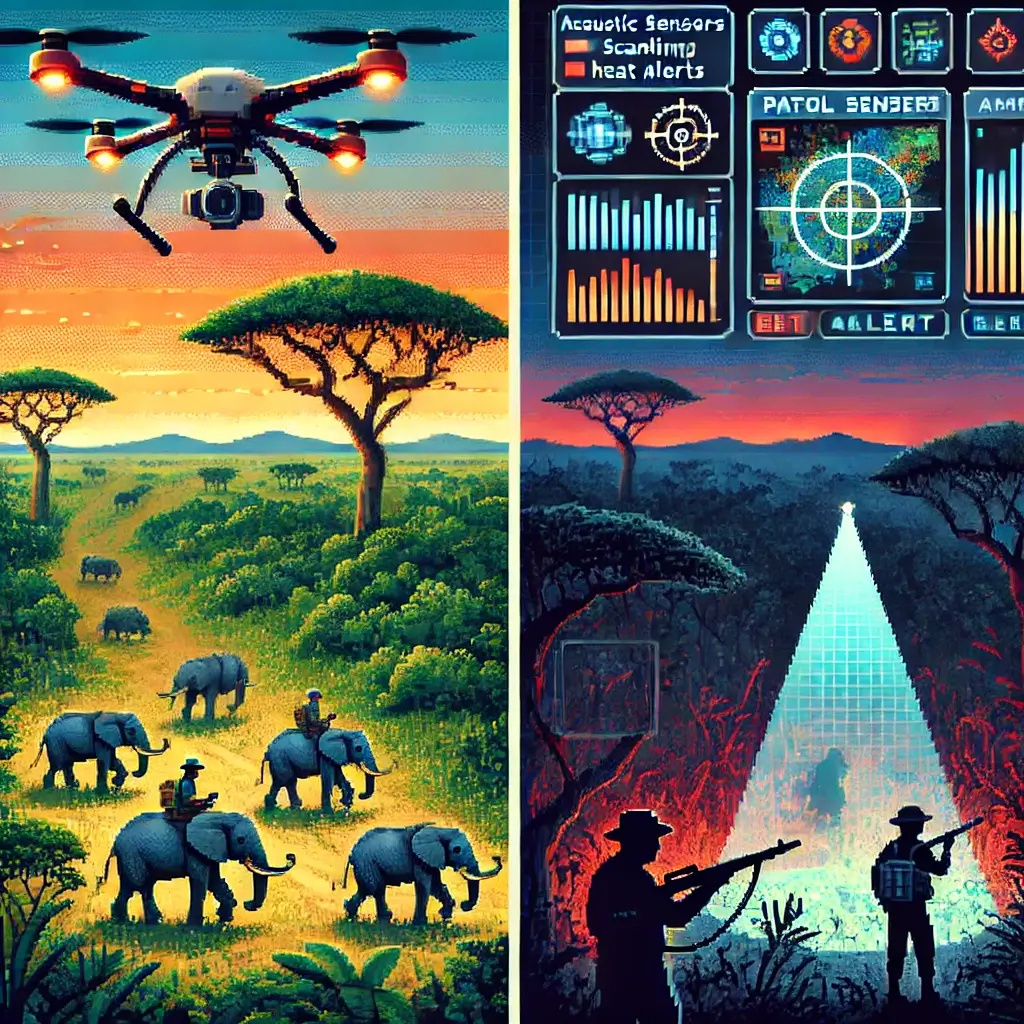
AI’s 7 Game-Changing Wins Against Poaching: A Roaring Success!
Hey there, wildlife warriors!
Have you ever looked at a majestic elephant or a powerful rhinoceros and felt that deep ache, knowing they’re under threat?
It’s a gut-wrenching feeling, isn’t it?
The illegal wildlife trade is a multi-billion-dollar industry, a dark shadow looming over our planet’s most incredible creatures.
But what if I told you there’s a new superhero in town, one that’s armed not with capes and superpowers, but with algorithms and data?
That’s right, we’re talking about Artificial Intelligence (AI) for detecting and preventing wildlife poaching, and believe me, it’s delivering some truly incredible results!
For years, conservation efforts felt like an uphill battle, a valiant but often outmatched fight against well-organized criminal syndicates.
But now, AI is stepping onto the scene, bringing a level of sophistication and foresight that’s frankly blowing traditional methods out of the water.
It’s not just a fancy buzzword; it’s a tangible, powerful tool that’s actually saving lives.
So, buckle up, because we’re about to dive deep into how AI is becoming the ultimate game-changer in the fight to protect our precious wildlife.
And trust me, the stories you’re about to hear will give you hope!
Table of Contents
The Grim Reality: Why We Need AI More Than Ever
Let’s be brutally honest for a moment.
The scale of wildlife poaching is staggering, almost unfathomable.
Think about it: every 20 minutes, a rhino is killed for its horn.
That’s like saying, by the time you finish reading this post, another one of these magnificent creatures could be gone forever.
Elephants are being slaughtered for ivory, pangolins for their scales, tigers for their bones.
It’s not just a few isolated incidents; it’s an organized crime network, often linked to other illicit activities like drug trafficking and arms dealing.
These criminals are cunning, well-funded, and adaptable.
They use sophisticated tools and tactics, often outmaneuvering traditional anti-poaching patrols.
For a long time, conservationists and rangers were essentially playing a game of whack-a-mole, constantly reacting to threats rather than proactively preventing them.
They faced vast, remote landscapes, limited manpower, and the constant danger of confrontation with armed poachers.
It was heartbreakingly clear that we needed something more, something revolutionary, to tip the scales in favor of the animals.
And that’s precisely where AI for detecting and preventing wildlife poaching steps in.
It’s not about replacing brave rangers – absolutely not.
It’s about empowering them with intelligence, giving them the upper hand, and making their dangerous jobs safer and infinitely more effective.
Imagine having an all-seeing eye, a tireless guardian constantly analyzing patterns, predicting threats, and alerting you to danger before it even fully materializes.
That, my friends, is the promise that AI is not just offering, but actually delivering.
AI’s Arsenal: 7 Incredible Ways It’s Fighting Poaching
Okay, let’s get down to the nitty-gritty.
How exactly is AI working its magic?
It’s not one single trick, but a whole suite of powerful tools, each addressing a different facet of the poaching problem.
Here are 7 groundbreaking ways AI for detecting and preventing wildlife poaching is making a tangible difference:
1. Predictive Analytics: Unmasking Poaching Hotspots Before They Ignite
Think of this as AI’s crystal ball.
Traditional patrols often rely on historical data and intuition.
But what if you could predict *where* and *when* poaching is most likely to occur?
AI algorithms crunch massive datasets – everything from weather patterns, moon phases, road networks, animal movement, past poaching incidents, and even socio-economic factors in nearby communities.
With this information, AI can identify patterns invisible to the human eye, predicting high-risk areas and times with astonishing accuracy.
This allows rangers to deploy their limited resources strategically, focusing their efforts where they’ll have the biggest impact, rather than just blindly patrolling.
It’s like having a super-smart strategist always on your side.
One fantastic example of this is the PAAWS Patrol System (Protection Assistant for Wildlife Security), developed by the University of Southern California’s Center for AI in Society (CAIS).
It’s a game-changer!
2. Acoustic Monitoring: Listening for Trouble in the Wild
Imagine miles of dense forest or vast savannas.
It’s impossible for humans to cover every inch.
But what if the forest could tell you when something was wrong?
AI-powered acoustic sensors are being deployed in remote areas, constantly listening for specific sounds: gunshots, vehicle engines, human voices, or even the distinct calls of distressed animals.
These sensors are connected to AI systems that can differentiate between natural sounds and anomalous, potentially poaching-related ones.
When a suspicious sound is detected, an alert is sent in real-time to rangers, directing them to the precise location of the disturbance.
This is essentially giving conservationists super-hearing!
Projects like Rainforest Connection’s Guardian System are using old cell phones equipped with custom software to detect logging and poaching activity, turning discarded tech into powerful protectors.
3. Drone Surveillance & Image Recognition: Eyes in the Sky
Drones have become indispensable tools for anti-poaching efforts, offering a bird’s-eye view of vast territories.
But flying them constantly and manually analyzing hours of footage is tedious and error-prone.
Enter AI.
Drones equipped with AI vision systems can autonomously patrol, identify, and track suspicious activity, whether it’s a vehicle entering a restricted zone, a group of people moving through dense bush, or even the presence of snares.
The AI can analyze thermal imaging for human heat signatures at night or identify specific animals, all while minimizing false positives.
It’s like having a vigilant, tireless sentry constantly scanning the horizon, only better, because it never gets tired or makes a mistake.
4. Satellite Imagery Analysis: Zooming In on the Big Picture
On an even larger scale than drones, satellite imagery provides a macro view of entire ecosystems.
AI is now being trained to analyze these vast amounts of satellite data to detect subtle changes that might indicate poaching activity or habitat destruction.
This could be new roads being carved through forests, changes in vegetation cover that suggest illegal logging, or even the presence of makeshift camps.
By flagging these anomalies, AI helps conservationists understand large-scale trends and direct ground efforts more effectively, tackling the root causes of habitat loss that often go hand-in-hand with poaching.
5. Facial Recognition for Wildlife: Individual Identification and Monitoring
This might sound like something out of a sci-fi movie, but it’s real and it’s powerful.
For species like elephants, rhinos, or even whales, individual animals have unique markings, ear notches, or patterns that are like their fingerprints.
AI-powered facial recognition (or pattern recognition) systems can catalog these unique features from camera trap photos or drone footage.
This allows researchers and rangers to track individual animals, monitor their health, behavior, and location, and quickly identify if an animal goes missing or if a new, unidentified animal appears in an unusual location.
It’s a truly revolutionary way to keep tabs on vulnerable populations and ensure every single animal counts.
6. Supply Chain Monitoring: Following the Illicit Trail
Poaching doesn’t end with the kill.
The illegal wildlife products then enter complex global supply chains, moving through various middlemen, markets, and online platforms.
AI is proving incredibly effective at disrupting these networks.
Algorithms can scour online marketplaces, social media, and shipping manifests for suspicious keywords, images of illegal products, or unusual trade patterns.
They can analyze financial transactions to uncover money laundering schemes related to wildlife crime.
This allows law enforcement agencies to intercept shipments, dismantle criminal organizations, and make arrests far beyond the actual poaching site.
It’s about cutting off the head of the snake, not just dealing with its tail.
Organizations like the Wildlife Crime Tech Challenge are supporting innovative solutions in this space.
7. Community Engagement & Reporting Platforms: Empowering Local Heroes
Last but certainly not least, AI isn’t just about high-tech gadgets; it’s also about empowering the people who live closest to the wildlife.
AI-powered platforms can facilitate anonymous reporting of suspicious activities by local communities.
These systems can analyze the reported data, verify its credibility, and integrate it with other intelligence streams to provide a more complete picture of poaching threats.
This builds trust, encourages participation, and recognizes that local communities are often the first line of defense against poaching.
It’s a crucial shift from top-down enforcement to collaborative protection, with AI acting as the bridge.
From Theory to Triumph: Real-World AI Success Stories
So, this all sounds great in theory, right?
But is AI for detecting and preventing wildlife poaching actually working on the ground?
You bet it is!
Let me tell you about some genuinely inspiring successes that illustrate the power of these technologies.
The MIRAI Project in Akagera National Park, Rwanda: A Model of Success
One of the shining examples is the MIRAI project in Rwanda’s Akagera National Park.
This initiative uses AI to analyze massive datasets, including ranger patrol routes, past poaching incidents, and environmental factors, to predict where poachers are most likely to strike.
Before MIRAI, rangers were often reacting to events.
With MIRAI, they’ve become proactive.
The results have been astounding: a significant reduction in poaching incidents and a demonstrable increase in wildlife populations.
The park has essentially transformed from a high-risk zone to a thriving sanctuary, proving that smart technology, combined with dedicated human effort, can achieve miracles.
Project PREDICT in Africa: Saving Elephants, One Algorithm at a Time
Another powerful example comes from various locations across Africa, where AI is being used in what’s known as “Project PREDICT.”
This involves deploying a network of acoustic sensors and AI analysis to detect gunshots and vehicle movements in real-time.
Imagine a vast national park.
When a gunshot rings out, instead of it being lost in the wilderness, an AI system immediately triangulates its location, sends an alert to the nearest ranger team, and even provides optimal routes for interception.
This rapid response capability has led to numerous successful interdictions, preventing poaching attempts and saving countless elephant lives.
It’s like equipping every tree with an invisible bodyguard!
SMART Software: A Global Standard Enhanced by AI
The Spatial Monitoring and Reporting Tool (SMART) has been a cornerstone of protected area management for years.
It helps rangers collect, store, and analyze patrol data.
Now, AI is being integrated into SMART, taking its capabilities to a whole new level.
AI algorithms can automatically identify patterns in the collected data that human analysts might miss, suggesting optimal patrol routes, identifying emerging threats, and even evaluating the effectiveness of different anti-poaching strategies.
It’s turning raw data into actionable intelligence, making conservation efforts smarter and more adaptive.
It’s a testament to how existing tools can be supercharged with AI.
You can learn more about SMART here: SMART Conservation Tools.
These aren’t just isolated incidents.
These are consistent, repeatable successes that demonstrate a fundamental shift in how we approach wildlife conservation.
AI isn’t just a nice-to-have; it’s rapidly becoming a must-have in our battle to save endangered species.
The Road Ahead: Challenges and Bright Futures for AI in Conservation
Alright, so AI is doing some amazing things, right?
But let’s be realistic for a moment.
No technology is a magic bullet, and AI for detecting and preventing wildlife poaching faces its own set of hurdles.
Overcoming the Hurdles: It’s Not Always Easy
Firstly, data, data, data!
AI thrives on vast amounts of high-quality data to learn and make accurate predictions.
In many remote conservation areas, collecting this data can be incredibly challenging due to limited infrastructure, rugged terrain, and security concerns.
Then there’s the cost factor.
Implementing sophisticated AI systems, deploying drones, sensors, and satellite technology, and training personnel requires significant financial investment.
Many conservation organizations operate on tight budgets, so securing funding for these cutting-edge solutions is a constant battle.
And let’s not forget the ever-present danger for the brave rangers on the ground.
While AI makes their job safer and more efficient, they still face very real threats from armed poachers.
Finally, there’s the adaptability of poachers.
As AI tools become more prevalent, criminal syndicates will inevitably try to find ways around them.
This means the AI systems themselves need to be constantly updated, refined, and made more robust, which is an ongoing process.
A Bright Horizon: The Future is Looking Up!
Despite these challenges, the future of AI for detecting and preventing wildlife poaching is incredibly bright.
As technology becomes more affordable and accessible, we’ll see wider adoption of these solutions.
Imagine AI-powered micro-drones that can patrol silently and tirelessly, or advanced sensor networks that can distinguish individual animals by their unique sounds or even heartbeats.
We’ll also see more integrated systems, where data from various sources (drones, sensors, patrols, community reports, satellite imagery) are fed into a central AI hub, creating a truly comprehensive and intelligent surveillance network.
This will allow for even faster, more accurate predictions and responses.
The ongoing research into advanced machine learning techniques, particularly in areas like reinforcement learning, could lead to AI systems that can learn and adapt to new poaching tactics in real-time, essentially playing a high-stakes game of chess with the criminals and always staying one step ahead.
It’s not a question of *if* AI will revolutionize conservation, but *how profoundly*.
And honestly, the possibilities are thrilling!
How YOU Can Join the AI Revolution in Wildlife Protection
Feeling inspired yet?
I hope so!
Because while AI is doing some heavy lifting, it’s not a magic bullet that works in isolation.
It needs our support, our passion, and our engagement.
You don’t need to be an AI expert or a safari ranger to make a difference.
Here are some concrete ways you can become a part of this incredible movement:
1. Support Organizations Leading the Charge
Many incredible organizations are at the forefront of deploying AI for detecting and preventing wildlife poaching.
By donating, even a small amount, you can directly contribute to funding research, deploying technology, and training rangers.
Look for organizations like WildAid, WWF, African Parks, and the mentioned Rainforest Connection or PAAWS.
Every dollar helps put more smart tools in the hands of those on the front lines.
2. Spread the Word: Be an Advocate!
Talk about it!
Share this information with your friends, family, and on social media.
The more people who understand the power of AI in conservation, the more support these initiatives will garner.
Awareness is a powerful weapon against apathy.
3. Demand Sustainable Products and Fight Illegal Trade
The demand for illegal wildlife products fuels poaching.
Educate yourself and others about which products to avoid (ivory, rhino horn, pangolin scales, certain exotic pets).
Report suspicious online sales or activities.
When the demand dries up, so does the incentive for poachers.
4. If You’re a Tech Whiz: Volunteer Your Skills!
Are you a data scientist, a software engineer, or an AI specialist?
Many conservation organizations are desperate for skilled volunteers to help them develop and refine their AI solutions.
Your expertise could literally save a species!
Check out platforms like Conservation Technology Alliance for opportunities.
The battle against wildlife poaching is far from over, but for the first time in a long time, we have a powerful ally in our corner: Artificial Intelligence.
It’s not just a fancy gadget; it’s a beacon of hope, a testament to human ingenuity, and a vital tool in ensuring that future generations can marvel at the incredible diversity of life on our planet.
Let’s stand with the AI revolution and help our wild friends roar another day!
Wildlife protection, AI conservation, anti-poaching technology, endangered species, intelligent surveillance