
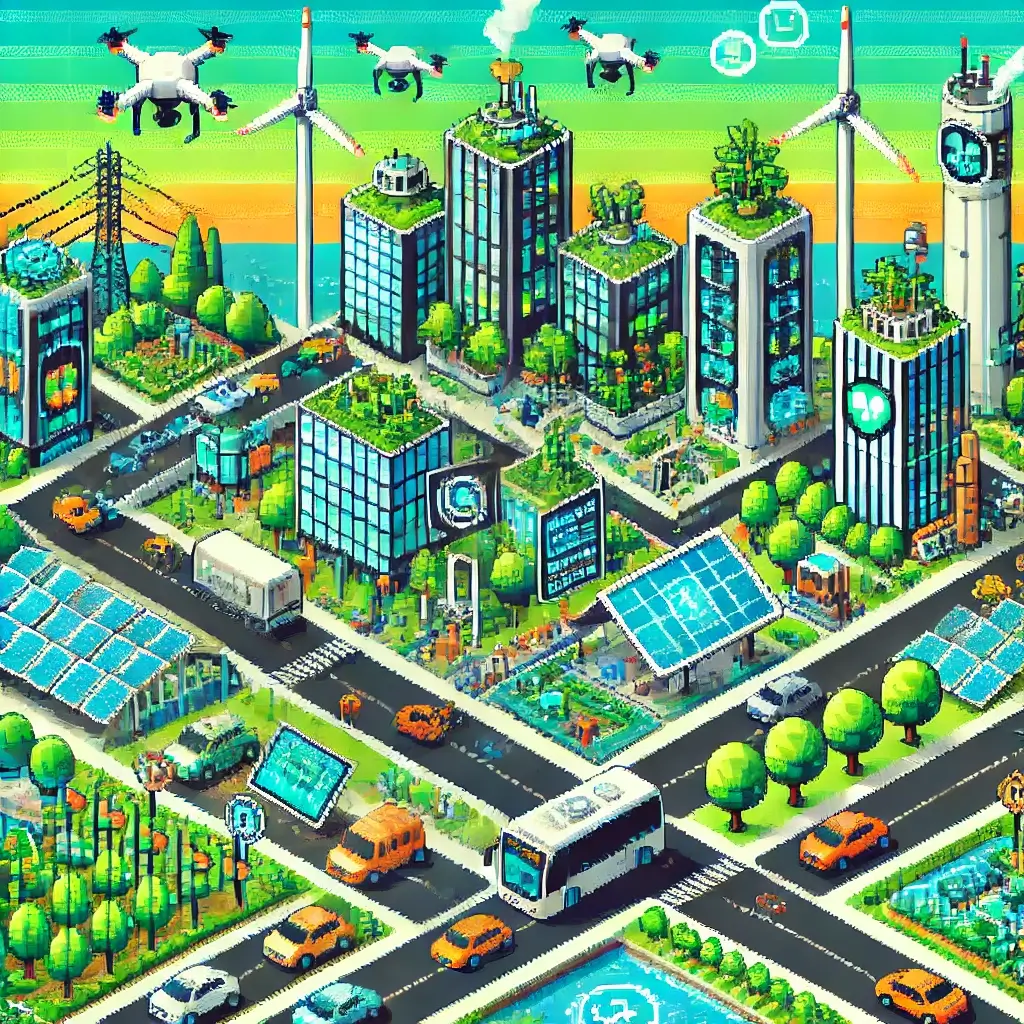
AI’s Urban Revolution: 3 Game-Changing Ways to Transform Megacities Sustainably!
Hey there, fellow urban enthusiasts and future gazers!
Have you ever found yourself stuck in traffic, gazing at a smoggy horizon, and wondering if our bustling megacities are on a collision course with an unsustainable future?
I know I have. Living in a densely packed urban jungle, the challenges of traffic, pollution, and resource scarcity are not just headlines; they’re our daily reality.
But what if I told you there’s a powerful ally emerging, capable of not just mitigating these issues but fundamentally redesigning our urban landscapes for the better?
Yes, you guessed it: I’m talking about Artificial Intelligence – or AI, as we lovingly call it.
Forget the dystopian sci-fi movies for a moment.
The AI I’m referring to is less about rogue robots and more about smart algorithms, data crunching, and predictive power, all aimed at one monumental goal: making our megacities truly sustainable.
It’s about creating urban environments where economic prosperity, social equity, and environmental health don’t just coexist but thrive in harmony.
Think about it: cities, these incredible hubs of innovation and culture, are also enormous consumers of resources and generators of waste.
They’re dynamic, ever-evolving organisms, but their growth has often outpaced our ability to manage them efficiently and sustainably.
The sheer scale of a megacity—we’re talking populations of 10 million or more, folks—makes traditional planning methods feel like trying to steer a supertanker with a paddle.
This is where AI steps onto the stage, not as a replacement for human ingenuity, but as a super-powered co-pilot, helping us navigate the incredibly complex seas of urban development.
It’s about turning mountains of data into actionable insights, predicting bottlenecks before they happen, and optimizing everything from energy grids to waste management.
So, buckle up! We’re about to dive deep into how AI is not just a buzzword but a tangible, transformative force for sustainable urban planning in our sprawling megacities.
We’ll explore how this incredible technology is helping us build smarter, greener, and more resilient cities for generations to come.
And trust me, it’s far more fascinating than you might imagine!
—
Table of Contents
—
Why AI is the Unsung Hero for Sustainable Megacities
Alright, let’s get down to brass tacks.
Why exactly is AI suddenly the darling of urban planners and sustainability experts?
Well, it’s not “suddenly.”
The truth is, the groundwork has been laid for years.
But the confluence of advanced algorithms, massive datasets (hello, Big Data!), and increasingly powerful computing capabilities has created a perfect storm for AI to truly shine in the urban context.
Imagine trying to optimize a city’s traffic flow without AI.
You’d have legions of traffic engineers, hunched over maps, trying to guess at patterns, making adjustments based on historical averages and their gut feelings.
It’s like trying to predict the stock market by reading tea leaves.
Effective, sure, but far from optimal.
Now, throw AI into the mix.
Sensors on every street corner, cameras feeding real-time data, public transport schedules, ride-sharing data—it all gets crunched by AI algorithms.
The AI can spot anomalies, predict congestion before it happens, and dynamically adjust traffic signals in milliseconds.
It’s like having a hyper-intelligent, omniscient traffic controller working 24/7.
And this isn’t just theory.
Cities like Singapore and Barcelona are already pioneering these approaches, turning data into smoother commutes and cleaner air.
The challenges facing megacities are multi-faceted and interconnected.
Traffic congestion isn’t just annoying; it leads to increased fuel consumption and higher emissions.
Inefficient energy use means more reliance on fossil fuels and a larger carbon footprint.
Poor waste management contributes to pollution and resource depletion.
These aren’t isolated problems; they’re parts of a complex urban ecosystem.
And that, my friends, is where AI really flexes its muscles.
It can analyze these complex interdependencies, identify hidden patterns, and propose solutions that human planners, limited by their cognitive biases and sheer processing power, might never discover.
It’s like getting a cheat sheet for urban planning, but one that actually works!
AI can run countless simulations, testing different scenarios and predicting their outcomes, all before a single brick is laid or a single policy is enacted.
This ability to model and predict is invaluable for long-term sustainable planning.
We’re talking about a paradigm shift from reactive problem-solving to proactive, data-driven optimization.
And frankly, for the sake of our planet and our quality of life, it’s a shift that couldn’t come fast enough.
—
AI for Smart Grids: Powering Our Cities Smarter, Not Harder
Let’s talk energy, because let’s face it, without it, our megacities would grind to a halt faster than you can say “blackout.”
Traditional energy grids are, well, a bit old-school.
They’re centralized, often reliant on fossil fuels, and pretty inefficient at responding to fluctuating demand.
It’s like having a single, massive tap for an entire city, and hoping everyone uses just the right amount of water at just the right time.
Enter AI-powered smart grids!
This is where things get truly exciting for sustainable urban planning.
Imagine an energy network that isn’t just a one-way street from power plant to home, but a dynamic, two-way conversation.
AI can analyze real-time energy consumption data from millions of sources—homes, offices, factories, even individual appliances.
It can then predict demand fluctuations with uncanny accuracy, optimize energy distribution, and even integrate renewable energy sources like solar and wind seamlessly.
Think about a hot summer day when everyone cranks up their AC.
Without AI, the grid operators might just fire up another fossil fuel plant to meet the surge.
But with AI, the system could identify areas of high demand, potentially nudge smart thermostats to slightly reduce consumption during peak hours, or even reroute power from a nearby solar farm that’s currently overproducing.
It’s about load balancing, demand response, and making every electron count.
AI also plays a crucial role in maintaining grid stability and preventing outages.
By constantly monitoring the network, it can detect anomalies, predict equipment failures before they happen, and even self-heal by rerouting power around damaged sections.
This isn’t just about efficiency; it’s about resilience, making our cities less vulnerable to disruptions.
And let’s not forget the massive environmental impact.
By optimizing energy usage and facilitating the integration of renewables, AI helps significantly reduce carbon emissions, moving us closer to a truly green urban future.
It’s like giving our cities a super-efficient, eco-friendly energy metabolism.
For more insights into smart grid technologies and their impact, you might want to check out resources from organizations dedicated to sustainable energy. For example, the **U.S. Department of Energy’s Smart Grid Initiative** offers a wealth of information:
Explore DOE Smart Grid Initiative
—
AI in Transportation: Unclogging the Urban Arteries
Ah, urban transportation.
The bane of many a city dweller’s existence, right?
Traffic jams, endless commutes, the frustrating search for parking—it all contributes to stress, wasted time, and a huge carbon footprint.
But what if I told you AI is stepping in to be our traffic cop, our public transport optimizer, and our urban mobility guru all rolled into one?
This is where AI truly shines in visible, tangible ways.
Imagine smart traffic lights that don’t just cycle through pre-programmed timings, but dynamically adjust based on real-time traffic flow, pedestrian crossings, and even emergency vehicle locations.
That’s AI at work.
It learns patterns, anticipates congestion, and keeps the flow moving.
It’s like having a symphony conductor for your city’s traffic, ensuring every instrument plays in harmony.
Then there’s public transportation.
AI can optimize bus routes, train schedules, and even ride-sharing services to reduce wait times, minimize empty vehicles, and get people where they need to go more efficiently.
By analyzing passenger demand, weather conditions, and special events, AI can create hyper-efficient transit networks that make public transport a genuinely attractive alternative to private cars.
Think about demand-responsive transit, where smaller shuttles or vehicles are dispatched based on real-time requests, making public transport accessible even in less dense areas.
This isn’t some far-off dream; it’s happening in pilot programs around the world.
And let’s not forget autonomous vehicles.
While still in their nascent stages, AI-powered self-driving cars, buses, and even delivery robots promise to revolutionize urban logistics.
Fewer human errors, optimized routes, and potentially shared vehicle fleets could drastically reduce the number of cars on our roads, freeing up valuable urban space and slashing emissions.
The impact on air quality alone could be revolutionary.
Fewer idling cars, smoother traffic flow, and a shift towards electric vehicles managed by AI all contribute to cleaner air for urban dwellers.
It’s not just about getting from A to B; it’s about making the journey itself part of a healthier, more sustainable urban fabric.
For a deeper dive into how AI is transforming urban mobility, check out reports and initiatives from organizations like the **World Economic Forum**, which often covers these advancements:
Discover WEF Insights on Urban Mobility
—
AI for Resource Management: From Waste to Wisdom
Now, let’s talk about something less glamorous but equally critical: our city’s resources.
Water, waste, even the air we breathe – managing these effectively is paramount for any sustainable megacity.
And just like with energy and transport, AI is proving to be an indispensable tool.
Consider water, the most precious resource.
Many aging urban water systems suffer from leaks, inefficient distribution, and wasted water.
AI can monitor water flow in real-time, detect leaks with incredible precision (sometimes even before they become visible), and optimize pressure zones to reduce water loss.
It’s like giving our city’s pipes a constant, thorough check-up, ensuring not a single drop goes to waste.
This is crucial in megacities, where water scarcity is a looming threat for millions.
Then there’s waste management.
Oh, the mountains of trash our cities produce!
Traditional waste collection can be inefficient, leading to overflowing bins and unnecessary truck emissions.
AI can optimize collection routes based on fill levels of smart bins, reducing fuel consumption and operational costs.
Beyond collection, AI is revolutionizing recycling.
Robots powered by AI are being developed to sort recyclables with far greater accuracy and speed than humans, recovering more valuable materials and reducing contamination.
It’s not just about throwing things away; it’s about turning waste into a resource, fostering a circular economy where materials are reused and recycled endlessly.
And don’t forget air quality.
AI can analyze data from air quality sensors across a city, identify pollution hotspots, and even predict future pollution events based on weather patterns and traffic forecasts.
This allows city planners to issue warnings, implement temporary traffic restrictions, or adjust industrial operations to mitigate health risks.
It’s like having a vigilant guardian watching over our urban environment, helping us breathe easier and live healthier lives.
The beauty of AI in resource management is its ability to find efficiencies and solutions that might otherwise be invisible.
It transforms what seems like an insurmountable problem into a manageable challenge, giving us the tools to build truly resilient and resource-efficient cities.
For more on how AI is impacting environmental management and resource optimization, you could explore reports from organizations like the **United Nations Environment Programme (UNEP)**:
Explore UNEP on AI and Environment
—
The Human Touch: Why AI Needs Us (And We Need It!)
Okay, before anyone starts picturing a world run by soulless algorithms and devoid of human input, let’s hit pause.
While AI is incredibly powerful, it’s not a magic bullet, nor is it meant to replace human intelligence and empathy.
Think of AI as the ultimate super-tool in our urban planning toolkit.
It can process vast amounts of data, identify complex patterns, and make highly optimized predictions that no human ever could.
But here’s the kicker: AI doesn’t understand context, it doesn’t feel the pulse of a community, and it certainly doesn’t have a sense of humor (yet!).
That’s where we come in, folks!
Human urban planners, policymakers, and citizens are absolutely essential in this equation.
We provide the vision, the ethical framework, and the understanding of what truly makes a city livable, vibrant, and equitable.
AI can tell us the most efficient way to route traffic, but it can’t tell us if that route disproportionately impacts a low-income neighborhood or if it destroys a beloved community park.
That’s a human decision, informed by human values and priorities.
Our role is to define the problems, set the objectives, and interpret the insights that AI provides.
We need to ask the right questions, ensuring that the AI is trained on diverse and unbiased data, and that its outputs align with our societal goals.
It’s a beautiful partnership, really.
AI handles the grunt work, the complex calculations, and the pattern recognition, freeing up human planners to focus on creativity, community engagement, and long-term strategic thinking.
It’s about augmented intelligence, not artificial dominance.
So, the next time you hear about AI transforming urban planning, remember it’s not about replacing us.
It’s about empowering us to build better, more sustainable cities than we ever thought possible, by leveraging the strengths of both human and artificial intelligence.
It’s like having a genius intern who never sleeps and never complains, but still needs your guidance and wisdom to make the truly impactful decisions!
—
The Bumps in the Road: Challenges on Our AI Journey
Now, I’d be remiss if I didn’t mention that this journey isn’t all smooth sailing.
Like any groundbreaking technology, the implementation of AI in urban planning comes with its fair share of hurdles.
And honestly, ignoring these would be like trying to drive a car with your eyes closed – not a great idea!
First up, and probably the biggest elephant in the room: Data, Data, Data!
AI thrives on data, and lots of it. But getting access to clean, reliable, and comprehensive urban data can be a monumental task.
Different city departments might collect data in disparate formats, privacy concerns loom large when dealing with citizen data, and there’s always the risk of data bias.
If our AI is trained on biased data, its decisions will reflect that bias, potentially exacerbating existing inequalities in our cities.
It’s like trying to bake a gourmet cake with rotten ingredients; no matter how good the recipe, the outcome won’t be pretty.
Then there’s the Ethical Minefield.
Who owns the data? How do we ensure transparency in AI’s decision-making processes? What about accountability if an AI-driven system makes a mistake that impacts human lives?
These aren’t just theoretical questions; they require robust ethical frameworks, clear regulations, and public discourse to navigate.
We need to build trust in these systems, and that trust is earned through transparency and accountability.
Another big one: Integration and Interoperability.
Our cities are complex tapestries of legacy systems, new technologies, and various stakeholders.
Getting different AI systems, sensors, and city departments to “talk” to each other seamlessly is a huge technical challenge.
It’s like trying to get dozens of different smartphone brands to all use the exact same charger – difficult, but essential for a smooth user experience.
Finally, there’s the human element of Skill Gaps and Public Acceptance.
We need a workforce trained not just in traditional urban planning, but also in data science, AI ethics, and human-AI collaboration.
And let’s not forget the public.
People often view AI with a mix of fascination and fear.
Building public acceptance requires clear communication, demonstrating the tangible benefits, and addressing legitimate concerns about privacy and control.
These challenges are significant, no doubt.
But they are not insurmountable.
They require concerted effort from governments, businesses, academia, and civil society to collaborate and innovate.
The prize—truly sustainable, livable megacities—is well worth the effort of navigating these bumps in the road.
—
The Crystal Ball: What Does the Future Hold for AI and Urban Planning?
So, what’s next for AI in our megacities?
If you ask me, we’re just scratching the surface of what’s possible.
The trajectory is clear: AI will become even more deeply embedded in the fabric of urban life, helping us build cities that are not just smart, but truly intelligent and responsive.
I envision a future where AI isn’t just optimizing individual systems, but operating at a **holistic, city-wide level**.
Think of a “digital twin” of an entire city—a virtual replica fed by real-time data from every sensor, camera, and citizen interaction.
This digital twin, powered by AI, could simulate policy changes, predict the impact of new infrastructure projects, and even respond to emergencies in real-time, all before a single physical action is taken.
It’s like having a giant, incredibly detailed sandbox to play in, with real-world consequences only applying after we’ve perfected our strategy virtually.
We’ll see **hyper-personalized urban services**.
Imagine your smart home communicating with the city’s energy grid to optimize your consumption, your personal mobility app seamlessly integrating public transit, ride-sharing, and even micro-mobility options like e-scooters based on your preferences and real-time city conditions.
Cities will become more adaptable and responsive to the needs of individual citizens, not just a collective whole.
And let’s talk about **climate resilience**.
As climate change continues to impact our urban environments, AI will be indispensable in developing adaptive strategies.
Predictive modeling for extreme weather events, optimizing emergency response, designing climate-resilient infrastructure (think flood barriers that adapt to real-time water levels), and even optimizing urban green spaces for maximum cooling effect – AI will be at the forefront of these efforts.
It’s about building cities that don’t just survive, but thrive in a changing climate.
Of course, this future isn’t a given.
It requires continued investment in research and development, robust ethical guidelines, and a collaborative spirit among governments, industry, and citizens.
But the potential to create truly sustainable, equitable, and vibrant megacities is within our grasp, largely thanks to the incredible power of AI.
It’s an exciting time to be an urban planner, or simply someone who cares deeply about the future of our incredible cities!
—
My Final Two Cents: Betting Big on AI for Better Cities
So, after all this talk about AI, data, and smart cities, what’s my takeaway?
It’s simple, really: **AI isn’t just a fancy tool; it’s rapidly becoming a non-negotiable partner in our quest for sustainable urban living.**
We’re living in an era where urban populations are skyrocketing, and the pressure on our cities’ resources and infrastructure is immense.
Frankly, we can’t afford to stick to old ways of thinking or planning.
The complexity of managing a megacity sustainably is just too vast for human ingenuity alone.
We need the computational muscle, the predictive power, and the optimization capabilities that only AI can provide.
But remember my earlier point about the human touch.
This isn’t a hand-off; it’s a handshake.
AI will provide the insights, the efficiency, and the foresight, but it’s up to us—the citizens, the planners, the policymakers—to infuse these technological advancements with our values, our ethics, and our vision for a truly humane city.
We need to be the wise shepherds guiding this powerful flock of algorithms, ensuring they serve the greater good.
The journey to sustainable megacities, powered by AI, is an incredibly exciting one.
It’s about transforming concrete jungles into thriving, green, and equitable ecosystems.
It’s about ensuring that future generations inherit cities that are not just functional, but truly flourishing.
So, let’s embrace this technological revolution with open minds and a strong ethical compass.
The future of our cities literally depends on it.
And hey, who knows, maybe one day your morning commute will be so smooth, you’ll actually *enjoy* it. A guy can dream, right?
—
Sustainable, AI, Megacities, Urban Planning, Smart Cities