
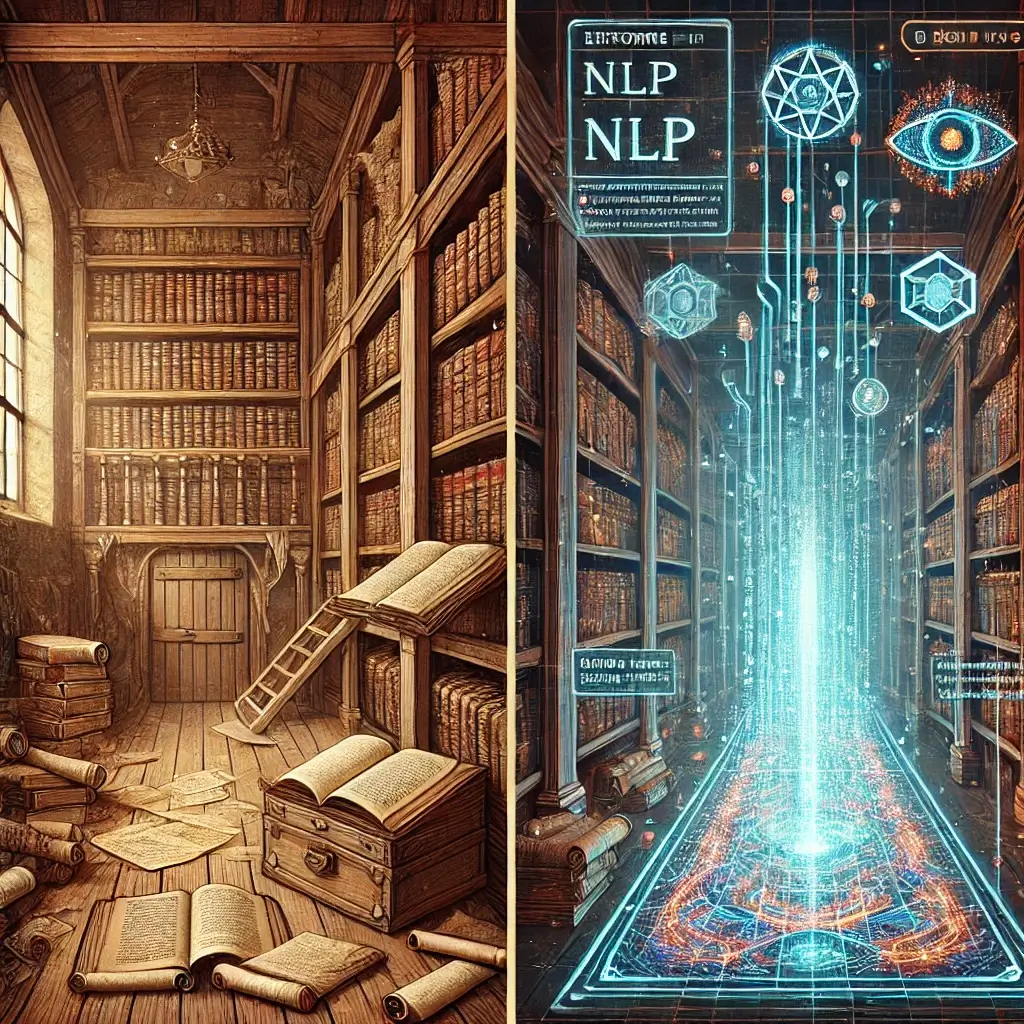
Unlocking 1000s of Years of History: NLP’s Jaw-Dropping Power for Historical Documents!
Table of Contents
Ever stared at a crumbling, ancient manuscript, its faded ink and archaic script almost taunting you with the secrets it holds?
It’s a feeling many historians and researchers know all too well.
For centuries, unlocking these hidden narratives has been a Herculean task, often requiring painstaking, manual deciphering, one word at a time.
But what if I told you there’s a technological superhero swooping in to save the day, capable of sifting through mountains of historical text with lightning speed and uncanny precision?
Enter Natural Language Processing (NLP), a field of Artificial Intelligence that’s not just transforming how we interact with computers, but revolutionizing how we understand our past.
It’s like giving historians a superpower, allowing them to extract insights from documents that were once considered too vast or too complex to tackle.
1. From Dusty Archives to Digital Goldmines: The NLP Revolution!
Remember those days, not so long ago, when researching history meant spending countless hours in dimly lit archives, surrounded by the faint scent of old paper and dust?
You’d meticulously pore over fragile documents, often handwritten, deciphering cryptic shorthand and trying to make sense of sprawling, often inconsistent, historical records.
It was a labor of love, certainly, but also a labor of immense time and effort.
Now, imagine a tool that could read those documents, not just interpret the words, but understand their context, identify key entities, and even trace relationships between individuals and events across centuries.
That’s not science fiction; that’s NLP.
It’s fundamentally changing the game for historians, archivists, and anyone with a passion for uncovering the stories embedded in our collective past.
We’re moving from a world where we sample historical data due to its sheer volume, to a world where we can analyze it at scale, uncovering patterns and narratives that were previously invisible.
Think about it: uncovering societal shifts, tracking propaganda, understanding economic trends, or even just identifying how everyday people lived – all buried in text, now made accessible through the magic of NLP.
2. The Challenge Accepted: Why Historical Documents Are a Tough Nut to Crack (But NLP Loves It!)
You might be thinking, “Well, text is text, right? NLP can handle modern news articles, so old documents should be a piece of cake.”
Oh, if only it were that simple!
Historical documents present a unique set of challenges that would make even the most seasoned NLP engineer scratch their head.
The Handwriting Headache & OCR’s Heroic Efforts
First off, much of historical text isn’t neatly typed.
It’s handwritten, and let’s be honest, some historical scribes had worse penmanship than my doctor’s prescription pad.
Optical Character Recognition (OCR) is our first line of defense here, converting those squiggly lines into machine-readable text.
While modern OCR is incredibly powerful, historical scripts, varying handwritings, faded ink, and damaged paper can make its job incredibly difficult.
Imagine trying to read a blurry photocopy of a note written in cursive by someone with shaky hands – that’s often what OCR faces.
Linguistic Time Travel: Old English to Modern English & Beyond!
Then there’s the language itself.
Language evolves, sometimes dramatically.
“Awesome” used to mean “awe-inspiring” in a much more serious, almost terrifying way, not “that pizza was awesome!”
Old English, Middle English, early modern English – they’re practically different languages to a modern NLP model trained on contemporary text.
Words change meaning, spellings vary wildly (think “colour” vs. “color” but amplified a hundredfold), and grammatical structures shift.
NLP models need to be specifically adapted or trained on historical corpora to handle these linguistic time shifts.
The Messy Reality of Historical Records: Inconsistencies & Gaps
Historical documents are rarely pristine.
They’re full of inconsistencies, missing data, abbreviations, non-standardized terminology, and often lack the structured format modern digital data boasts.
Imagine a census record where names are sometimes spelled out, sometimes abbreviated, and sometimes just listed by their first initial.
Or a series of letters where individuals are referred to by different nicknames.
These are the kinds of delightful puzzles NLP has to solve.
3. So, How Does NLP Actually Work Its Magic? A Peek Behind the Curtain.
Alright, enough with the challenges, let’s talk about solutions!
How does NLP, a technology primarily built on modern language, manage to untangle these historical knots?
It’s not some mystical force; it’s a brilliant combination of algorithms, statistics, and a whole lot of data.
At its core, NLP for historical documents often starts with making the text understandable to a machine.
Preprocessing: Cleaning Up History’s Act
This is the unsung hero of NLP.
It involves cleaning up the text: correcting OCR errors, normalizing variant spellings (e.g., converting “publick” to “public”), and standardizing abbreviations.
It’s like a digital spring cleaning for dusty old texts.
Imagine you’re trying to make sense of a recipe from the 17th century.
First, you’d probably try to figure out what “a goodly quantity” of flour actually means in modern terms.
Preprocessing does exactly that for historical text, making it palatable for the algorithms that follow.
Tokenization & Part-of-Speech Tagging: Breaking it Down, Labeling it Up
Next, NLP breaks down the text into smaller units, typically words or phrases, called “tokens.”
Then, it tags each token with its part of speech (noun, verb, adjective, etc.).
This might sound simple, but it’s crucial for understanding the grammatical structure and meaning.
Think of it like identifying the bricks, mortar, and timber in an old building before you can understand its architecture.
Named Entity Recognition (NER): Spotting the Who, What, Where, and When
This is where things get really exciting for historians.
NER identifies and classifies named entities in text – people, places, organizations, dates, and so on.
Imagine automatically extracting every person mentioned in a collection of civil war diaries, along with the dates and locations they appear.
This can build a massive, interconnected network of historical data.
It’s like having a hyper-efficient research assistant who can highlight all the important names and places in thousands of documents simultaneously.
Topic Modeling: Unearthing Hidden Themes
Ever wondered what the major themes were in a collection of political pamphlets from the 18th century?
Topic modeling algorithms can analyze vast corpora of text and identify abstract “topics” that run through them.
It’s not about finding specific keywords, but rather discovering clusters of words that tend to appear together, indicating underlying themes.
This can reveal societal concerns, political ideologies, or cultural trends that might not be immediately obvious from a casual read.
It’s like digging for gold and suddenly finding a rich vein of ore you never knew existed.
Sentiment Analysis: Reading Between the Historical Lines
Was public opinion generally positive or negative towards a certain policy or event in the past?
Sentiment analysis attempts to determine the emotional tone of a piece of text – positive, negative, neutral, or even specific emotions like joy or anger.
While it’s trickier with historical language due to changing nuances of expression, advanced models are increasingly adept at discerning the emotional pulse of historical discourse.
Imagine being able to quantify the public’s reaction to major events like the signing of the Declaration of Independence by analyzing newspaper editorials and personal letters.
This offers a new lens into the past, moving beyond just facts to feelings.
4. The Essential Toolkit: Key NLP Techniques for Historical Analysis.
Beyond the core functionalities, several specific NLP techniques are proving to be indispensable for historical research.
Historical OCR and Handwritten Text Recognition (HTR) Refinements
As mentioned, getting readable text from old documents is step one.
Recent advancements in HTR, driven by deep learning, are enabling us to transcribe even the most challenging handwritten historical texts with remarkable accuracy.
Projects like Transkribus are leading the charge, empowering researchers to train their own HTR models for specific historical handwritings.
It’s no longer a pipe dream; it’s a reality that’s opening up vast, previously unsearchable archives.
Word Embeddings and Contextual Understanding
Modern NLP models use “word embeddings” – numerical representations of words that capture their meaning and context.
Words that are used in similar contexts will have similar embeddings.
For historical analysis, this means that even if a word’s meaning subtly shifted over time, its surrounding words might provide enough context for the model to understand its historical usage.
Think of it as the model learning the “flavor” of words in different historical periods.
Diachronic Analysis: Tracking Language Evolution Over Time
This is where NLP truly shines for linguists and historians interested in language change.
By comparing word usage, semantic shifts, and grammatical patterns across different historical periods, NLP can reveal how language itself has evolved.
You can literally see words gaining or losing popularity, or how their connotations change from one century to the next.
It’s like time-lapsing the evolution of human communication.
Network Analysis: Mapping Relationships and Influence
When NLP identifies named entities (people, places, organizations) and relationships between them, you can build powerful networks.
Imagine mapping the social network of a revolutionary movement by analyzing their correspondence, or tracing the flow of ideas through academic papers.
This allows historians to visualize influence, power structures, and connections that would be impossible to discern manually from massive datasets.
It turns static data into dynamic insights.
5. Real-World Wonders: 3 Unforgettable Success Stories of NLP in Action!
Alright, enough theory. Let’s look at some real-world examples where NLP has genuinely made a difference, almost like flipping a switch and illuminating previously dark corners of history.
The “Digging into Data” Challenge: Uncovering Hidden Narratives
The “Digging into Data” Challenge, a multi-national grant program, has funded numerous projects that use computational methods, including NLP, to analyze large-scale humanities data.
One standout project involved analyzing thousands of historical newspapers to track the spread of information and ideas across different regions and time periods.
Imagine manually reading every newspaper from 1850-1900 across a dozen major cities – impossible, right?
NLP made it not just possible, but efficient, revealing how news, political discourse, and even cultural fads propagated, painting a much clearer picture of interconnected societies.
Decoding Diplomatic Cables: Unveiling International Relations
Think about the sheer volume of diplomatic cables exchanged between nations over centuries.
These documents are a treasure trove for understanding international relations, but their sheer volume makes comprehensive manual analysis a daunting task.
Researchers have employed NLP to analyze vast archives of diplomatic correspondence, identifying key actors, tracing alliances and rivalries, and even detecting subtle shifts in diplomatic tone and intent.
This provides an unprecedented, data-driven perspective on historical foreign policy decisions and their underlying motivations.
It’s like getting an X-ray of diplomatic history, revealing structures and connections you couldn’t see from the surface.
The Slavery Narratives Project: Giving Voice to the Voiceless
Perhaps one of the most profound applications of NLP is in giving voice to marginalized communities whose stories were often suppressed or overlooked.
Projects focused on analyzing historical slave narratives, such as those collected by the Library of Congress, use NLP to identify recurring themes, sentiment, and patterns of experience.
By analyzing these narratives at scale, researchers can gain a deeper understanding of the collective experiences, resilience, and resistance of enslaved people, offering invaluable insights into a crucial and often painful chapter of history.
This isn’t just about data; it’s about amplifying voices and ensuring their stories are heard and understood, even across centuries.
6. Benefits Beyond Belief: Why Every Historian Needs NLP.
So, why should you, a passionate historian, dedicated archivist, or curious student, care about NLP?
Because the benefits are nothing short of transformative.
Unprecedented Scale and Speed
This is the big one.
What would take a team of researchers decades to manually process, NLP can achieve in days or even hours.
Suddenly, analyzing entire archives, rather than just small samples, becomes feasible.
This means more comprehensive research, covering wider scopes and deeper dives into vast historical datasets.
It’s like upgrading from a shovel to an excavator for your archaeological dig.
Discovering Hidden Patterns and Connections
The human brain is amazing, but it has limits when it comes to processing massive amounts of unstructured text and identifying subtle, non-obvious patterns.
NLP algorithms are designed for this very task.
They can spot correlations, linguistic shifts, and entity relationships that a human eye might easily miss across thousands or millions of documents.
This leads to genuinely novel insights and the discovery of previously unrecognized historical trends or influences.
Enhanced Accessibility and Democratization of Research
By converting handwritten, fragile, or hard-to-access documents into searchable, structured data, NLP makes historical information far more accessible.
Researchers anywhere in the world, not just those with direct access to physical archives, can engage with these materials.
This democratizes historical research, opening it up to a broader range of scholars and enthusiasts.
Supporting Traditional Historical Methods
It’s important to stress that NLP isn’t replacing traditional historical methods; it’s augmenting them.
Think of NLP as a powerful assistant that helps you quickly identify relevant documents, flag key passages, and generate hypotheses.
The critical analysis, interpretation, and synthesis of these findings still rest firmly with the human historian.
It allows historians to spend less time on tedious data extraction and more time on high-level analysis and interpretation.
7. The Road Ahead: Overcoming Hurdles and Peering into NLP’s Future.
While NLP is incredibly powerful, it’s not a magic bullet.
There are still challenges, and the field is constantly evolving.
Data Quality and Annotation
The “garbage in, garbage out” principle applies.
If the OCR is poor, or if the historical language is too ambiguous, even the best NLP model will struggle.
Creating high-quality, annotated historical datasets for training NLP models is a huge, ongoing effort, often requiring manual expertise from historians.
Contextual Nuance and Historical Specificity
NLP models are getting better at understanding context, but truly grasping the subtle nuances of historical language, satire, irony, or highly specific cultural references from centuries ago, remains a complex task.
This is where human historical expertise remains irreplaceable.
Ethical Considerations and Bias
Like any AI technology, NLP models can reflect and amplify biases present in the data they are trained on.
If historical documents themselves are biased (e.g., reflecting colonial perspectives or patriarchal views), the NLP analysis might inadvertently perpetuate these biases.
Researchers must be mindful of these ethical considerations and actively work to mitigate them.
The Exciting Future: Multimodal and Beyond
Looking ahead, expect NLP to integrate even more seamlessly with other AI technologies.
Imagine combining NLP analysis of text with computer vision analysis of historical images and even audio recordings.
This “multimodal” approach promises an even richer, more holistic understanding of the past.
Furthermore, as models become more adept at handling low-resource languages and highly variable historical scripts, the scope of what we can analyze will expand exponentially.
8. Ready to Dive In? How to Get Started with NLP for Your Historical Research.
Feeling inspired? Curious to dip your toes into the NLP waters for your own historical adventures?
You don’t need to be a coding wizard to get started, though some basic programming knowledge (Python is your friend here!) will certainly help.
Explore Existing Tools and Platforms
Start by looking into user-friendly platforms and tools designed for digital humanities.
Many libraries and university labs offer access to or tutorials for tools that incorporate NLP functionalities without requiring you to write code from scratch.
Look for tools that offer features like text visualization, topic modeling, and named entity recognition.
A great place to start is exploring projects by the National Endowment for the Humanities (NEH), which often highlight digital humanities initiatives.
Learn the Basics of Python and NLP Libraries
If you’re feeling adventurous and want more control, learning the basics of Python is highly recommended.
Libraries like NLTK, spaCy, and Hugging Face Transformers offer powerful NLP capabilities.
There are tons of free online courses and tutorials specifically for NLP in Python.
Start small, maybe by analyzing a single historical speech or letter, and gradually work your way up.
Collaborate with Data Scientists or Digital Humanists
Don’t feel like you have to go it alone!
Many universities and research institutions have digital humanities centers or data science departments keen on interdisciplinary collaboration.
Partnering with someone who has technical NLP expertise can accelerate your research significantly and lead to fascinating joint discoveries.
Start with Digitized Collections
Many major archives and libraries have digitized vast collections of historical documents.
These are often already OCR’d and ready for computational analysis.
The Project Gutenberg and HathiTrust are fantastic resources for publicly available digitized texts.
9. The Final Word: History Reimagined, One Algorithm at a Time.
The world of historical research is undergoing a quiet but profound revolution, powered by the incredible advancements in Natural Language Processing.
It’s no longer about painstakingly piecing together fragments of the past by hand; it’s about leveraging intelligent algorithms to reveal entire tapestries of information that were once beyond our grasp.
From the whisper of ancient texts to the roar of historical archives, NLP is providing historians with an unprecedented ability to listen, analyze, and understand.
It’s exciting, a little bit daunting, and absolutely essential for the future of historical inquiry.
So, if you’re passionate about history, get ready to embrace this new era.
The past is waiting to tell its stories, and with NLP, we finally have the tools to truly hear them.
Natural Language Processing, Historical Documents, Text Analysis, Digital Humanities, AI in History