
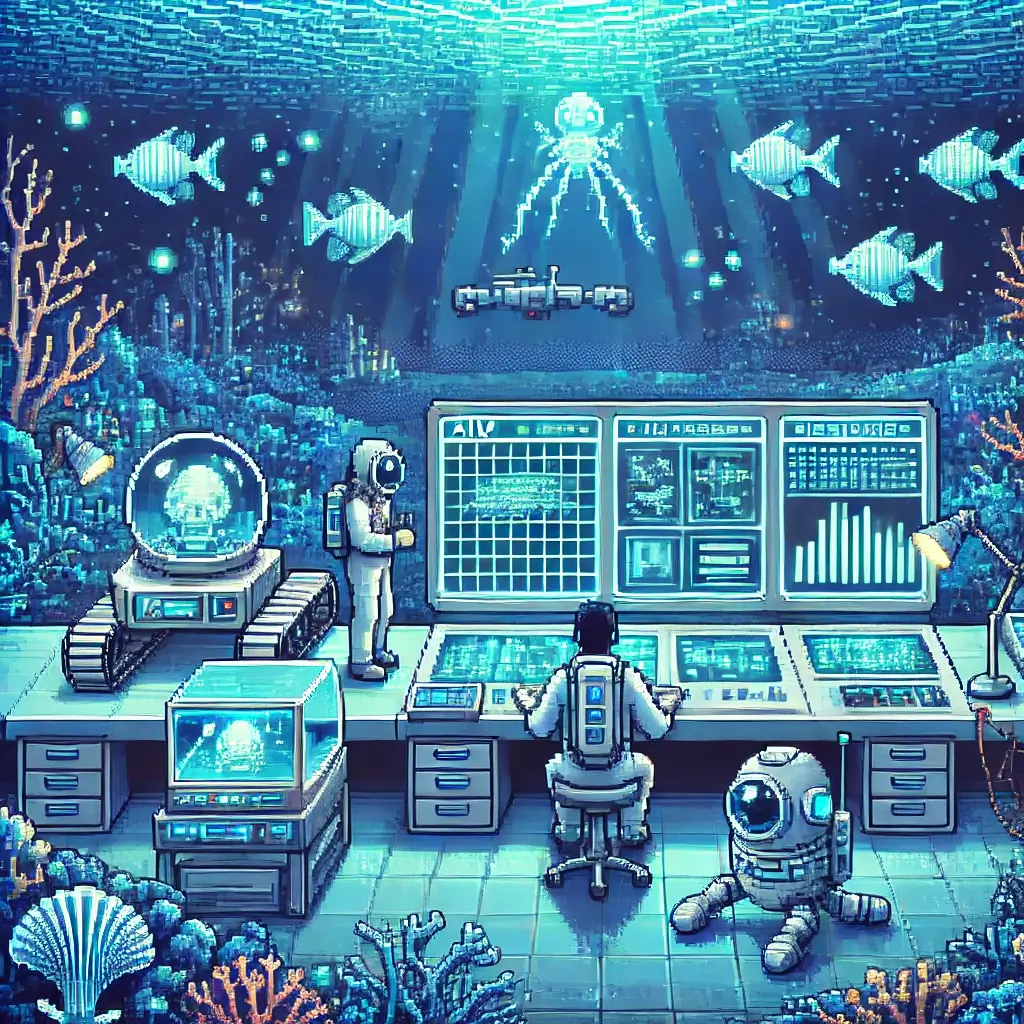
10 Mind-Blowing AI Tools That Are Finding Rare Deep-Sea Species 100x Faster
Have you ever stared into the endless blue of the ocean and wondered what secrets lie thousands of feet below?
I’m not talking about the friendly dolphins or the majestic whales we see on nature documentaries.
I’m talking about the truly bizarre, the bioluminescent, the alien-like creatures that live in a world of crushing pressure and eternal darkness.
For decades, finding and identifying these incredible, rare deep-sea species was a painstaking, often soul-crushing process.
Imagine watching thousands of hours of grainy, low-quality video footage, frame by frame, just hoping to catch a glimpse of a new species.
It was a real-life version of “Where’s Waldo,” but Waldo was a fish you’d never seen before, and the page was an endless, murky video file.
It was slow.
It was inefficient.
And frankly, it was a little crazy.
But everything changed with the arrival of computer vision.
We’re now living in a truly revolutionary time where AI is our co-pilot, our second pair of eyes, helping us explore a world we’ve barely scratched the surface of.
It’s a game-changer, and it’s happening right now.
This isn’t some far-off sci-fi fantasy.
The computers are already down there, doing the heavy lifting, spotting creatures we might have missed, and helping us unlock the mysteries of the deep faster than we ever thought possible.
So grab a cup of coffee and settle in, because we’re about to take a deep dive into how computer vision is totally transforming deep-sea exploration.
—
Table of Contents
—
The Old Way vs. The New Way: Remembering the Grind (and Why it’s Over)
Before we get into the cool stuff, let’s take a quick trip back in time.
Imagine you’re a marine biologist in the year 2005.
You’ve just returned from a month-long expedition to the Mariana Trench.
You and your team have collected hundreds of hours of video from a remotely operated vehicle (ROV).
Your mission?
Find and identify every single creature that appeared on screen.
Now, picture a massive, cavernous room filled with computers.
For months, you sit there, eyes glued to a monitor, with a fast-forward button that you barely ever use.
Every flicker of movement in the perpetual twilight could be a brand-new species, or it could just be a piece of marine snow.
You have to be a detective, a librarian, and a marathon runner all at once.
You pause.
You rewind.
You take a screenshot.
You meticulously log the timecode, the estimated size, and the description of a creature you might not even be able to name.
This was the reality.
It was a slow, tedious, and incredibly expensive process.
And the worst part?
You might still miss something.
Your eyes get tired, your focus wanes, and that one tiny, translucent jellyfish that drifted by in the corner of the frame might just be the most important discovery of the expedition.
The sheer volume of data was overwhelming, and the human capacity to process it was a major bottleneck.
Now, fast-forward to today.
The ROV footage comes back to the lab, and instead of a team of exhausted graduate students, the data is fed into a computer.
Within hours, not months, the computer can tell you exactly what it found, where it found it, and how many times it saw it.
It doesn’t get tired.
It doesn’t get bored.
It just crunches numbers and analyzes pixels with an unwavering focus.
The AI can spot a rare, tiny fish hiding in a patch of volcanic rock and flag it for a human to review, something a tired human might have missed in the 100th hour of footage analysis.
This is the core of the revolution.
It’s not about replacing humans; it’s about giving them a superpower.
It allows scientists to spend less time on monotonous tasks and more time on what they’re truly passionate about: understanding our planet and its incredible biodiversity.
Think of it like this: Before, we were trying to find a needle in a haystack with just a magnifying glass.
Now, we have a metal detector that can scan the entire haystack in seconds and tell us exactly where the needle is.
That’s the difference, and it’s absolutely staggering.
It has fundamentally changed the pace and scale of deep-sea science.
—
Peeking Under the Hood: How the AI Magic Happens
So, how does this “magic” actually work?
Don’t worry, I won’t get too deep into the weeds here.
I’ll explain it in a way that’s easier to digest than a deep-sea snail.
At its core, computer vision for marine life identification is a form of artificial intelligence that can “see” and interpret images.
It’s a bit like teaching a child to recognize different animals.
When you show a child a picture of a cat, you say, “This is a cat.”
Then you show them another cat, and another, all with different colors and in different positions.
Over time, the child learns to identify the key features of a cat: the ears, the whiskers, the general shape.
They learn to generalize from the examples you’ve given them.
Computer vision works in a very similar way, but on a massive scale and with incredible speed.
Scientists first create what’s called a **dataset**.
This is a huge collection of images or video frames of deep-sea creatures that have already been identified by human experts.
Each image is meticulously labeled—someone has to manually draw a box around the creature and tag it with its species name, like “Vampyroteuthis infernalis” (the vampire squid, which is just a perfect name, by the way).
This labeled dataset is the “teacher” for the AI.
Next, they use a special kind of AI called a **neural network**.
Think of a neural network as a series of interconnected digital “neurons” that are designed to process information in layers, much like our own brains.
You feed the neural network all those labeled images.
The network starts to learn the patterns and features that define each species.
It learns to recognize the subtle differences in fin shapes, the patterns on the skin, the size and the general posture of a creature.
This process is called **training**.
After the training is complete, you have a trained model.
This model is now ready to be put to the test.
You can give it a new, unlabeled video frame, and it will scan the image, locate any potential creatures, and classify them based on what it has learned.
The result is a bounding box drawn around the creature and a label that says, “I’m 98% sure this is a giant Pacific octopus.”
And if it finds something it doesn’t recognize—something truly new or rare—it flags it for a human expert to review.
This is called **object detection and classification**.
It’s powerful, it’s fast, and it’s why we’re now finding more things in the deep than ever before.
It’s a perfect example of a symbiotic relationship between human expertise and machine efficiency.
We give the AI a head start with our knowledge, and in return, it helps us expand that knowledge exponentially.
It’s a beautiful partnership.
—
Fighting the Deep: The Challenges of a Sunless World
Now, you might be thinking, “This sounds too easy. What’s the catch?”
And you’d be right to be skeptical.
The deep sea is not exactly an ideal environment for cameras or AI.
Training a computer to recognize a cat is one thing; teaching it to identify a translucent, gelatinous jellyfish in pitch-black water is a whole other kettle of fish.
The first and most obvious challenge is the **image quality**.
Deep-sea footage is often dark, grainy, and full of “marine snow”—the constant rain of organic detritus.
The lighting is artificial and often creates harsh shadows or blown-out highlights.
The water itself can be murky, distorting the images and making it difficult for the AI to get a clear picture.
Imagine trying to recognize a friend in a dark, foggy room with only a flashlight.
It’s a tough job for a human, and it’s even tougher for a computer.
Then there’s the **data problem**.
You can’t just Google “deep-sea creatures” and find a million high-quality, labeled images.
For many rare species, we might only have a handful of sightings ever recorded.
This creates a huge hurdle for training AI models, which typically require thousands, if not millions, of examples to become accurate.
How do you teach an AI to recognize a creature it’s only seen once?
This is a genuine, real-world problem that scientists are tackling head-on.
They’re using clever techniques like **transfer learning**, which means they take a model that’s already been trained on a massive dataset of general images (like the ones from your smartphone camera) and fine-tune it with the limited deep-sea data.
It’s like teaching an experienced chef a new recipe—they already know the basics of cooking, so it’s much faster than teaching a complete novice.
Another wild solution is **synthetic data generation**.
Using CGI and computer graphics, researchers can literally create thousands of fake but realistic images of rare creatures in deep-sea environments.
They can change the lighting, the water clarity, the creature’s pose—creating a rich, diverse dataset from scratch.
It’s a little bit like making a video game, but instead of for fun, it’s for the sake of scientific discovery.
And finally, there’s the **creature complexity**.
Deep-sea creatures are often soft-bodied, amorphous, and can change shape dramatically.
A jellyfish might look completely different when it’s swimming versus when it’s just drifting.
An octopus can camouflage itself or squeeze into an impossibly small space.
Teaching a computer to recognize these ever-changing forms is a monumental task.
But despite these challenges, the progress has been astonishing, thanks to the sheer ingenuity and determination of the people working on this.
They’re solving problems that many people once thought were unsolvable, pushing the boundaries of both technology and biology at the same time.
It’s an inspiring story of human resilience and creativity.
—
From Bytes to Biodiversity: 3 Incredible Success Stories
Okay, enough with the theory.
Let’s talk about some real-world wins.
These are the moments when all that hard work and data-crunching pay off, giving us a glimpse into a world we’re just beginning to understand.
These are the stories that make you go, “Wow, we really can do this.”
### **1. The MBARI Benthic Habitat Mapping Project**
The Monterey Bay Aquarium Research Institute (MBARI) is a pioneer in deep-sea exploration, and their use of computer vision is nothing short of legendary.
They’ve been using ROVs to film the deep-sea floor for years, and they have an incredible video archive.
To make sense of all that footage, they developed a system called **Benthic Habitat Mapping**.
Essentially, they’ve trained an AI to recognize different types of deep-sea habitats and the creatures that live there.
This isn’t just about finding a fish; it’s about understanding the entire ecosystem.
The AI can rapidly identify everything from giant crabs to brittle stars to the strange deep-sea corals that take hundreds of years to grow.
It’s a huge leap forward for conservation, as it allows scientists to quickly identify vulnerable habitats and monitor their health over time.
They can see how human activity or climate change is affecting these fragile environments without having to sift through every single frame of video manually.
It’s an incredible example of using technology to protect our planet.
Check Out MBARI’s Benthic Mapping Project!
### **2. The WHOI Mesobot Project**
The Woods Hole Oceanographic Institution (WHOI) has been at the forefront of deep-sea research for a long time.
They’ve developed an underwater robot called **Mesobot** that’s designed to explore the ocean’s “twilight zone”—the area between 200 and 1,000 meters deep.
This zone is home to creatures that make one of the largest migrations on Earth every single day, traveling from the depths to the surface and back again.
It’s a crucial but little-understood part of the ocean.
The challenge with studying these creatures is that they are incredibly sensitive to disturbance from traditional submersibles.
The bright lights and noise of an ROV can scare them away.
Mesobot uses an incredible computer vision system that can identify these creatures in real-time, allowing the robot to autonomously follow them without disturbing them.
The AI is trained on data from years of observations, and it can recognize the subtle movements and shapes of these twilight zone residents.
This allows scientists to get a true, undisturbed look at their behavior for the first time, giving us a much clearer picture of what life is like in this mysterious part of the ocean.
It’s like having a deep-sea wildlife photographer who knows exactly where to be and how to be quiet.
### **3. The NOAA Fisheries AI Initiative**
The National Oceanic and Atmospheric Administration (NOAA) is a giant in the world of ocean science, and they’ve been quick to adopt AI and computer vision to help with their mission.
One of their most important applications is in fisheries management.
Historically, monitoring fish stocks required a lot of manual labor, from observers on fishing boats to people manually counting fish from underwater cameras.
NOAA has developed computer vision tools that can automatically identify and count fish species from camera footage taken from research vessels and even fishing boats.
The AI can differentiate between different species of rockfish, cod, and other commercially important fish, providing incredibly accurate data on their populations.
This data is vital for setting fishing quotas and ensuring that we’re managing our marine resources sustainably.
It’s not just about finding a rare species; it’s about making sure that the fish we rely on for food are here for generations to come.
This is a perfect example of how this technology has a direct impact on our daily lives and the health of our planet.
Discover NOAA’s AI Fishery Science!
—
The Next Wave: What’s on the Horizon for Deep-Sea AI?
So what’s next?
The progress we’ve seen is just the tip of the iceberg, or should I say, the tip of the seamount.
The future of deep-sea exploration with computer vision is even more exciting than what we’ve accomplished so far.
One of the most thrilling developments is the concept of **real-time, on-board identification**.
Right now, most of the video analysis happens after the ROV has returned to the surface.
But imagine a world where the AI is running directly on the underwater vehicle itself.
The computer could instantly identify a rare, previously unknown species and autonomously make a decision.
It could say, “Whoa, that’s new! Let’s get a closer look” and adjust its course and camera angle to get better footage.
This would allow for more efficient and targeted exploration, ensuring that we never miss a once-in-a-lifetime discovery.
It’s the difference between taking a photo and developing it months later versus having an instant review on your camera screen.
Another exciting area is the integration of computer vision with **autonomous underwater vehicles (AUVs)**.
These are robots that can roam the deep without a human pilot.
With advanced computer vision, these AUVs could be programmed with specific mission goals, like “go find and count all the deep-sea corals in this region.”
They could navigate, collect data, and even make decisions on their own, all without a single human having to be on a ship for weeks on end.
This would dramatically reduce the cost and risk of deep-sea exploration, opening up vast, unexplored areas of the ocean to scientific inquiry.
It’s truly a game-changer for a field where ship time is incredibly expensive.
Finally, we’re seeing the rise of **citizen science** programs powered by computer vision.
Scientists are developing platforms where anyone with a computer and an internet connection can help label and identify creatures from deep-sea footage.
The AI acts as a smart assistant, guiding the human volunteers and learning from their input.
This not only helps train the AI models but also engages the public and gets them excited about ocean conservation.
It turns the tedious task of data analysis into a fun, collaborative project for everyone.
The future is a beautiful blend of human ingenuity and machine efficiency, and the deep sea is the perfect place to see this partnership in action.
—
Join the Crew: How You Can Be a Part of the Adventure
So, you’ve read all about the incredible work being done with computer vision in the deep sea.
Maybe you’re feeling inspired, or maybe you’re just curious about how you can get involved.
The good news is that you don’t need to be a marine biologist or a computer scientist to contribute.
There are a growing number of citizen science projects that are making it easier than ever for the public to get their hands dirty (metaphorically speaking, of course).
Projects like Zooniverse often have programs where you can help classify images from deep-sea expeditions.
It’s a way for you to contribute to real scientific research just by looking at pictures from your living room.
You might even be the one who spots a creature for the very first time and helps give it a name!
And for those of you who are more technically inclined, a quick search for “deep-sea computer vision projects” on a platform like GitHub will turn up a ton of open-source projects.
You can contribute code, help with data labeling, or even build your own small-scale model.
The possibilities are endless.
But even if you’re not a coder or a scientist, the best thing you can do is simply stay informed and spread the word.
The more people who know about the incredible life in the deep sea and the technology we’re using to study it, the more support there will be for conservation and future research.
The deep ocean is one of the last great unexplored frontiers on our planet.
We know more about the surface of Mars than we do about the deepest parts of our own oceans.
But thanks to the hard work of some incredibly brilliant people and the power of computer vision, that’s all changing.
We’re on the cusp of a new era of discovery, and it’s a thrilling thing to be a part of.
So, what are you waiting for?
Go ahead and dive in.
The deep sea is calling.
—
Deep-sea exploration, computer vision, rare species, marine biology, ROV
Neurodivergent Students & AI Explainable AI & Bias Auditing AI Genomics & Nutrition AI in Fraud Detection ML Strategy for Micro-Cap Stocks