
Tired of Crushing Energy Bills? 5 AI Secrets to Save Big and Live Smarter
Hey friends, let’s be brutally honest. Your energy bills are probably too high. Mine too. Every single month, that dreaded email lands in my inbox—subject line: “Your Utility Statement is Ready.” I hesitate, I click, and my jaw drops. Another number that makes me question if my kids secretly opened a crypto-mining farm in the basement. Sound familiar? Thought so.
We’ve all been there. Turning off lights like a maniac, unplugging the toaster that only gets used on Thanksgiving, even lowering the thermostat until we need socks in July. And yet, the bill keeps climbing. It feels like an invisible monster lives inside our walls, slurping up kilowatts like boba tea.
But here’s the good news: you don’t have to fight this alone anymore. There’s a new ally in the battle—artificial intelligence. Not the creepy robot kind. I’m talking about smart algorithms inside devices you already use (or should start using). They watch, they learn, and they make tiny adjustments that save you big bucks. Imagine a personal energy coach that never sleeps, never forgets, and doesn’t nag. That’s AI for energy optimization.
I’ve tested these tools myself, and they’re game-changers. One month, my summer bill dropped nearly 18%—without me changing a thing—because my AI-powered thermostat decided to outsmart both me and my utility company. Today, I’ll share five secrets (backed by data, stories, and real tips) to help your home become an energy-saving ninja dojo. Ready? Let’s dive in.
—
Table of Contents
—
What Even Is AI for Optimizing Energy Consumption?
Before we go too far, let’s clear up what “AI” means here. We’re not talking Skynet or a Terminator invasion. Think smaller—algorithms embedded in your devices. These digital brains quietly study your habits: when you wake up, when you leave, how you heat and cool your home. Then, without you lifting a finger, they fine-tune everything to waste less power.
Imagine having a coach obsessed with efficiency, but without the annoying whistle. This coach doesn’t sleep, doesn’t scroll Instagram, and doesn’t judge you for binge-watching Netflix at 2 a.m. Its only mission is to save you energy and money. The U.S. Department of Energy estimates smart thermostats alone can cut heating and cooling costs by about 10%. For many households, that’s hundreds of dollars a year. And that’s just one device. Multiply that across your whole home, and you’re looking at serious savings.
Here’s the kicker: AI doesn’t just react; it anticipates. If it knows you always come home at 6:30 p.m., it cools the house right before you arrive, not hours earlier. If a cold front is rolling in, it pre-heats when electricity is cheaper. It’s like a chess master playing against Mother Nature—and finally winning.
Now, let’s break down the five biggest secrets of how AI makes this happen, starting with the star player: the thermostat with a brain.
—
Secret #1: The Smart Thermostat that Learns Your Habits
Confession: my old thermostat was dumber than a bag of hammers. I’d set it at 72°F, and the system would run like crazy, overshoot, then cut off. Ten minutes later, the place felt like Antarctica, and the cycle started again. Wasteful and frustrating. If you’ve had one of those slider-style dinosaurs, you know exactly what I mean.
A smart thermostat, though, is different. Within a couple weeks, it learns your rhythms. Mine figured out that I like it cooler while sleeping and toastier when I’m writing in my office during the day. It knows I leave for the gym early Saturday mornings and don’t need the AC blasting then. Instead of running like a blunt instrument, it makes subtle adjustments that add up to real money.
One friend of mine, Sarah, told me she was skeptical about the hype. She bought a Nest Learning Thermostat when her utility company offered a rebate. After three months, her summer cooling bill was down $85 compared to last year. Not huge, but multiply that over a whole season and a few years, and it’s a vacation fund. She swears it feels like magic, but it’s just AI quietly optimizing behind the scenes.
Pro Tip: Many utility companies offer rebates (sometimes $50–$200) if you install a smart thermostat. It’s worth checking your provider’s website—you might get one nearly free.
—
Secret #2: Why Data is Your New Best Friend
Quick question: which of your appliances is the biggest energy hog? Most people guess “air conditioner” (and they’re right), but you’d be surprised at the runner-ups. Old fridges, gaming PCs, even that fish tank filter you forgot about can add a sneaky chunk to your bill.
Here’s where AI shines: smart plugs and sensors feed real-time data into your system. Suddenly, your energy use isn’t a mysterious monthly number—it’s a living dashboard. You can see exactly how much your old fridge is guzzling. Mine, for example, was eating 22% of my total bill before I finally replaced it. No joke, swapping that appliance saved me more than $300 a year.
AI doesn’t just report; it acts. If my TV and game console sit idle for an hour, my smart plug powers them down. When my washer finishes, it sends me a phone alert so I don’t forget a soggy load overnight. These little nudges prevent waste and add up over time. According to the International Energy Agency, digital optimization could cut global residential electricity demand by up to 20% by 2040. That’s massive.
And the best part? You don’t need a PhD in spreadsheets to benefit. The AI crunches the data and serves it up in plain English: “Your gaming PC cost you $15 last week in standby mode. Want me to turn it off automatically?” Yes, please.
Secret #3: Anticipating the Weather Like a Pro
You know how meteorologists sometimes get it wrong? Yeah, we’ve all planned a sunny picnic that turned into a mud bath. But here’s the kicker: your home’s AI doesn’t just check tomorrow’s forecast—it integrates hyper-local data and predictive models to keep your home one step ahead.
Take last summer for example. We had a brutal heatwave. My AI system knew it was coming and pre-cooled the house overnight when electricity was dirt cheap. By the time the sun was blazing, my home stayed comfortable without the AC running all day. My neighbor, meanwhile, was blasting his AC at 3 p.m. and texting me about his insane bill. I just smiled and handed him some iced tea.
Smart blinds are another underrated player here. My system automatically closes blinds at noon in July to block direct sunlight. In winter, it does the opposite—open blinds during the day to let in warmth, then close them at sunset to trap it. This kind of micro-adjustment adds up. According to the U.S. Department of Energy, properly managed window coverings can reduce heat gain by up to 77%. Pair that with AI scheduling, and suddenly your windows are as powerful as a new insulation system.
The bottom line? Your AI is like a chess master battling the weather. Always three moves ahead. And the result is comfort plus savings without you lifting a finger.
—
Secret #4: The Dynamic Pricing Game You Can Finally Win
Let’s talk money—because this one is sneaky. Utility companies love something called time-of-use pricing. Translation: they charge way more during “peak hours” (usually when everyone gets home and cranks up appliances) and way less during “off-peak” times like late night. If you’re not careful, you’re basically donating extra dollars to your utility company every month.
But here’s where AI comes in. Instead of you playing guessing games with timers, your system is plugged directly into the utility’s real-time pricing feed. That means your dishwasher waits until rates drop at midnight. Your EV charges when electricity is cheapest, not just when you plug it in. Your laundry finishes while you’re asleep—quietly saving you 30–40% on those tasks.
I learned this the hard way. Before AI, I once charged my EV at 6 p.m. during peak hours, and the bill that month was shocking. Now, my AI schedules charging automatically, even shifting mid-session if rates suddenly spike. Honestly, it feels like cheating—but it’s completely legit.
According to U.S. Energy Information Administration data, households using time-of-use optimization can cut annual costs by 15% or more. That’s not pocket change—it’s the equivalent of three or four months of internet bills covered, just for letting AI do the thinking.
And here’s my favorite part: I don’t have to remember a thing. The AI handles it all, quietly hustling in the background. It’s like having a financial advisor for your appliances—except this one doesn’t take a commission.
—
Secret #5: Why Integration is the Ultimate Superpower
Okay, thermostats and plugs are cool. But the real magic happens when all your smart devices talk to each other. Integration is the secret sauce. It’s the difference between a band of talented solo musicians and a full orchestra playing under a skilled conductor. That conductor is AI.
Picture this: You leave for work. Instantly, the system flips into “away mode.” The thermostat dials back, the lights shut off, the fridge enters eco-mode, and your smart strip kills power to the TV and game console. Meanwhile, your robotic vacuum quietly runs while electricity is cheap. Then, as you pull back into the driveway, GPS on your phone signals your return. By the time you open the door, the lights are on, the AC is humming at your favorite setting, and—yes—your coffee maker is already brewing. Welcome home.
Integration isn’t just a party trick. It’s efficiency multiplied. Instead of saving 10% here and 5% there, the whole system optimizes itself. The result? Lower bills, higher comfort, and less mental overhead. According to industry research, integrated smart homes can save up to 30% on overall energy costs compared to non-integrated systems.
When I first set this up, I felt like I was living in a sci-fi movie. But after a week, it just felt… normal. Now, when I visit friends without smart integration, I get frustrated watching them manually turn lights on and off. It’s like going back to dial-up internet after experiencing fiber-optic speeds.
—
Frequently Asked Questions (FAQ)
Q: Is AI for optimizing energy consumption expensive to set up?
A: Not necessarily. A smart thermostat is a great entry point and often pays for itself in 12–18 months. Many utility companies even offer rebates of $50–$200. If you add smart plugs and sensors later, you can build gradually instead of dropping thousands at once.
Q: Will it work with my older appliances?
A: Yes. You don’t need to replace everything overnight. Smart plugs turn almost any “dumb” device into a smart one. Even my 10-year-old coffee maker is part of my system now thanks to a $15 plug.
Q: Is my data safe with these systems?
A: Data privacy is a valid concern. Reputable brands use strong encryption and allow you to manage permissions. Stick to trusted names (Nest, Ecobee, Sense, etc.) and avoid suspicious bargain devices. Always read privacy policies before buying.
Q: What if I rent my home? Can I still use AI optimization?
A: Absolutely. Renters can start with portable devices like smart plugs, smart bulbs, and standalone energy monitors. They don’t require wiring changes and you can take them with you when you move.
Q: What’s the single biggest energy saver?
A: Heating and cooling dominate most households’ bills. Start with a smart thermostat for the biggest impact. After that, focus on major appliances like fridges, washers, and dryers.
Q: How much can I realistically save?
A: Results vary, but most households save between 10–30% annually with a combination of smart thermostats, plugs, and scheduling. For me, that was about $420 last year—without lifestyle sacrifices.
Q: Is this too complicated for non-techy people?
A: Honestly? No. Most devices are app-based and take less than 15 minutes to set up. My retired parents installed their own smart thermostat with just YouTube guidance—and they now brag about their lower bills more than their grandkids.
Q: Does AI optimization still work if my schedule is irregular?
A: Yes. The systems learn patterns, but they can also respond dynamically using phone GPS or motion sensors. Even if your hours change, the AI adapts quickly.
Q: Are there eco-benefits beyond saving money?
A: Definitely. Every kilowatt-hour saved is less fossil fuel burned. Multiply your savings across thousands of homes, and the carbon footprint reduction is massive. It’s good for your wallet and the planet.
Q: What if the power or Wi-Fi goes out?
A: Great question. Most devices fail gracefully, meaning your home simply reverts to normal “dumb” operation until the system comes back online. You won’t freeze or roast because of a short outage.
—
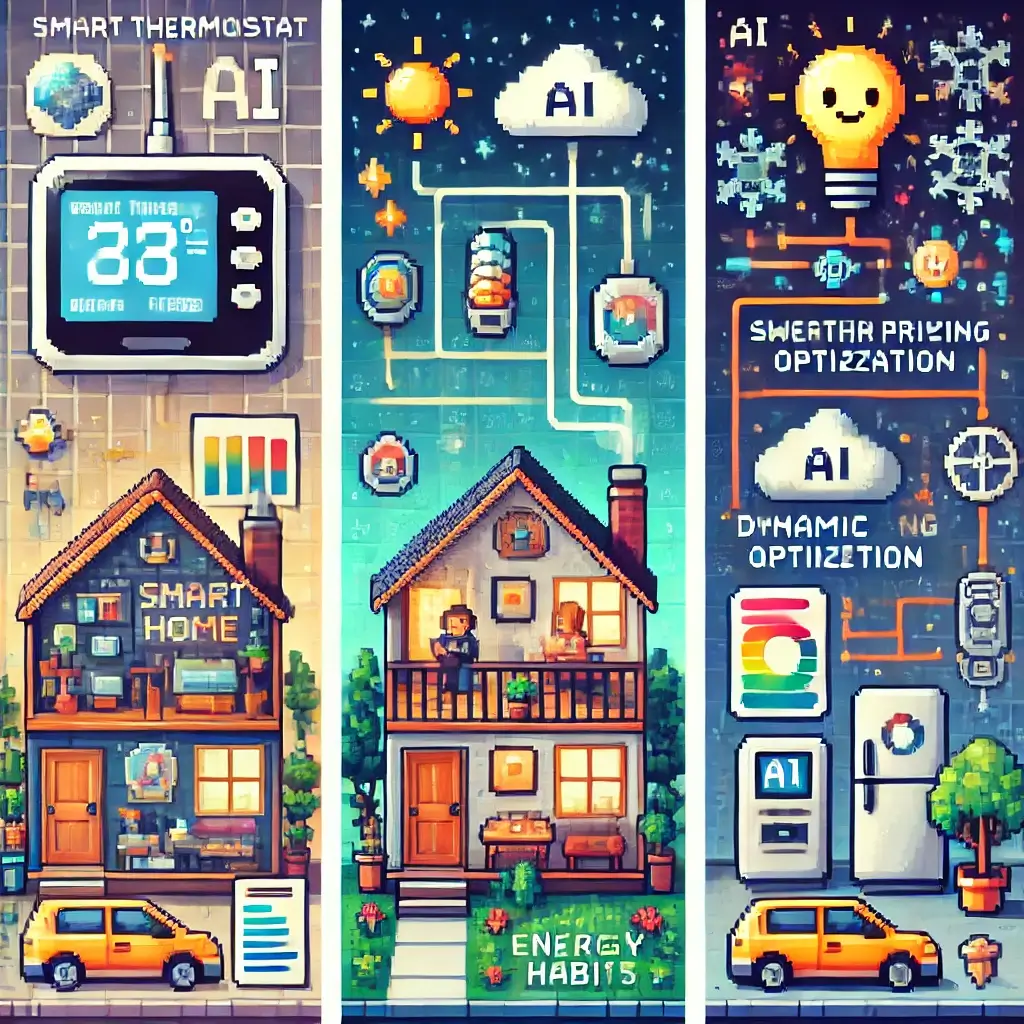
The Infographic: A Visual Guide to AI Energy Saving
Here’s a quick visual summary you can pin, share, or screenshot. It’s the cheat sheet for making your home smarter and greener with AI.
AI Energy Saving at a Glance
- 🏠 Smart Thermostats → 10–15% savings
- 🔌 Smart Plugs & Sensors → Identify hidden energy hogs
- 🌤 Weather Anticipation → Pre-cooling & smart blinds
- 💲 Dynamic Pricing → Shift usage to off-peak hours
- 🤝 Integration → 20–30% total household savings
Keep this in mind: the more pieces you connect, the bigger the payoff. AI isn’t about one gadget; it’s about the system working as a whole.
—
The Big Picture: More Than Just Saving Pennies
At first glance, AI-powered energy optimization looks like a money hack. But it’s bigger than that. It’s about control—knowing where your money goes and making sure your home works for you instead of against you. It’s also about comfort, convenience, and peace of mind.
I’ll be honest: when I first set this up, it felt like overkill. Did I really need my lights and AC synced to my phone? But after a few months, I realized the deeper impact. I wasn’t just saving $40 a month. I was part of something bigger. Less wasted energy means less environmental strain. My family’s choices, multiplied by millions of households, genuinely matter.
One of my favorite moments was visiting my parents last winter. They had installed a smart thermostat after my nagging. When I walked in, the house was warm, the energy dashboard showed off-peak usage, and my dad grinned like he’d discovered fire. “Guess how much we saved last month?” he asked. That’s when I knew—this isn’t just tech. It’s empowerment.
The future of our homes is clear: smart, integrated, AI-powered. It’s not about flashy gadgets or bragging rights. It’s about better living—for us, for our wallets, and for the planet.
So here’s my question for you: what’s the first step you’ll take? A thermostat? A plug? Or maybe you’re ready to go all in. Whatever it is, your next bill could be the moment you finally beat that energy-sucking monster hiding in your walls.
—
Keywords: AI for optimizing energy consumption, smart home energy, energy saving, smart thermostat, dynamic pricing
🔗 Machine Learning Independent Film Recommendation Posted 2025-08-21 08:23 UTC 🔗 Rare Disease Biomarkers Posted 2025-08-20 08:34 UTC 🔗 Bulletproof Critical Infrastructure Posted 2025-08-20 05:54 UTC 🔗 GitOps Implement ArgoCD Posted 2025-08-19 12:14 UTC 🔗 Incredible Powers Will Change Sustainable Fashion Posted 2025-08-19 UTC 🔗 The #1 Secret to Finding Your Next Opportunity Posted 2025-08 UTC