
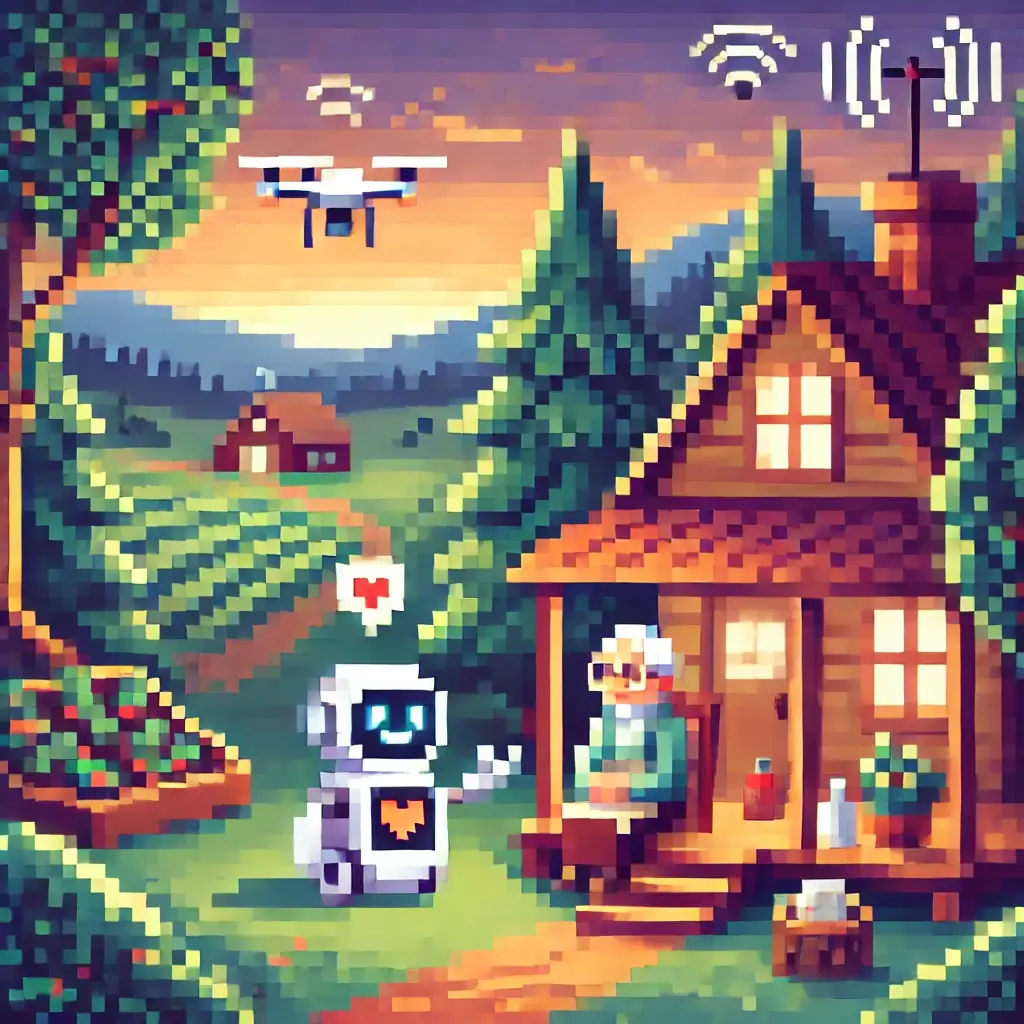
Revolutionizing Rural Elder Care: 3 AI and Robotics Breakthroughs That Will Astound You!
Hey there, folks!
Let’s chat about something that’s close to many of our hearts: elder care, especially for those living in the quieter, more serene corners of our world – rural areas.
You know, the places where the air is fresh, the stars shine brighter, and neighbors still wave as you drive by.
Beautiful as they are, these areas often face unique challenges when it comes to providing top-notch care for our beloved seniors.
But what if I told you there’s a revolution brewing, right on the horizon, that could change all of that?
A revolution powered by some of the most cutting-edge advancements of our time: **robotics and AI for elder care**.
Sounds like something out of a sci-fi movie, right?
Well, buckle up, because the future is here, and it’s far more human-centered than you might imagine.
Think about it: fewer doctors, longer distances to hospitals, and sometimes, just a pervasive sense of isolation that can creep in when you’re living far from the hustle and bustle.
These aren’t minor inconveniences; they’re significant hurdles that can impact the quality of life for our seniors.
That’s where **robotics and AI for elder care** step in.
No, we’re not talking about replacing human connection – far from it.
Instead, imagine these technologies as incredible tools, extensions of our care and compassion, designed to fill gaps, provide support, and enhance independence.
They’re like that super helpful neighbor who’s always there when you need a hand, but they also happen to have a PhD in advanced algorithms and a knack for precise movements.
This isn’t just about cool gadgets; it’s about dignity, safety, and allowing our elders to age gracefully in the comfort of their own homes, surrounded by the familiar sights and sounds they cherish.
It’s about making sure that geographical distance doesn’t equate to a deficit in care.
So, come along with me as we explore how these incredible innovations are not just theoretical concepts, but practical, life-changing solutions making a real difference right now.
We’re going to dive deep into three mind-blowing breakthroughs that are already transforming rural elder care.
Trust me, you won’t look at technology the same way again.
—
Table of Contents
—
The Rural Dilemma: Why Elder Care is a Tough Nut to Crack in the Countryside
Before we dive into the cool tech, let’s get real about the challenges facing elder care in rural areas.
It’s not just about romantic notions of tranquil living; there are concrete issues that make consistent, high-quality care a real uphill battle.
Imagine this: you live in a charming little farmhouse, miles from the nearest town.
You love your peace and quiet, but as you get older, simple tasks become harder.
Maybe you need help remembering your medications, or you’re a bit wobbly on your feet and worry about falling when no one’s around.
Now, try to get a home health aide to visit regularly.
They might have to drive an hour or more, battling bad roads or winter weather.
It’s costly for the agency, time-consuming for the aide, and often, there just aren’t enough qualified professionals willing or able to make those long commutes.
This is the core of the problem: a severe shortage of healthcare professionals and caregivers in rural areas.
It’s a tale as old as time, but with our aging population, it’s becoming an emergency.
And let’s not forget the sheer geographical isolation.
Emergencies can become critical much faster when the nearest hospital is an hour’s drive away.
Social isolation is another silent killer.
When friends and family are scattered, and community centers are few and far between, loneliness can take a serious toll on mental and physical health.
It’s a tough situation, one that requires out-of-the-box thinking.
This is precisely where **robotics and AI for elder care** come into play.
They offer solutions not by replacing human interaction, but by augmenting it, providing crucial support where traditional care models simply can’t reach.
We’re talking about tools that can extend the reach of caregivers, provide immediate assistance, and even offer companionship when human presence isn’t possible.
—
Breakthrough #1: Companion Robots – More Than Just a Cute Face
Alright, let’s kick things off with something that might sound straight out of a Pixar movie: companion robots.
But don’t let the “robot” part scare you.
These aren’t menacing machines; they’re designed to be, well, companionable.
Think of them less as C-3PO and more like a high-tech, always-there friend.
One of the biggest challenges in rural elder care, as I mentioned, is loneliness and social isolation.
When you’re living miles from the nearest neighbor, and family visits are infrequent, the days can feel long and empty.
Enter companion robots, a truly heartwarming application of **robotics and AI for elder care**.
These aren’t just toys; they are sophisticated pieces of technology powered by advanced AI that can engage in conversations, play games, remind individuals about appointments or medications, and even help with simple tasks.
Take, for instance, PARO, the therapeutic robot seal.
It looks like an adorable baby harp seal, responds to touch and voice, and has been scientifically proven to reduce stress and anxiety in elderly patients, including those with dementia.
It’s an interactive, calming presence that offers a sense of connection without demanding anything in return.
Then there are more conversational robots, like ElliQ from Intuition Robotics.
This little gem isn’t just about reminding you to take your meds; it actively engages in conversation, suggests activities, plays music, and even connects you with family and friends through video calls.
It learns your preferences, your routines, and your moods, offering personalized interactions that genuinely combat loneliness.
Imagine your loved one having a daily chat with a friendly voice that remembers their favorite stories, encourages them to stay active, and gently nudges them towards healthier habits.
It’s not a replacement for human interaction, but a fantastic supplement, especially when human caregivers aren’t physically present.
This technology is already making waves, offering a consistent, non-judgmental presence that can be incredibly comforting.
It’s about bringing a little piece of the outside world, a friendly face, right into the home, combating that pervasive feeling of being alone.
It’s truly a game-changer for enhancing emotional well-being.
To learn more about therapeutic robots and their impact, you can check out this resource:
—
Breakthrough #2: Smart Monitoring Systems – AI That Sees All (Without Being Creepy)
Now, let’s talk about safety and peace of mind, especially for families worried about their loved ones living alone in rural settings.
This is where smart monitoring systems, powered by advanced AI, become absolute superheroes in the realm of **robotics and AI for elder care**.
Forget the old “I’ve fallen and I can’t get up” pendants.
While those are still useful, today’s systems are far more proactive and subtle, designed to provide comprehensive oversight without feeling intrusive or like Big Brother is watching.
These systems utilize a combination of sensors – motion sensors, pressure sensors, even radar-based technology – discreetly placed around the home.
The AI then analyzes patterns of activity, learning the senior’s normal routines.
Is Mom usually in the kitchen by 7 AM?
Does Dad typically go to bed around 9 PM?
The system learns these habits.
Here’s where it gets truly amazing: if there’s a deviation from the norm, the AI flags it.
If Mom hasn’t moved from her bed by noon, or if Dad has been in the bathroom for an unusually long time, or even worse, if a fall is detected, the system immediately alerts designated family members or caregivers.
Imagine the relief of knowing that if your elderly parent falls in their rural home, an alert is sent instantly, allowing for a much faster response time than if someone had to discover them hours later.
These systems can also monitor vital signs through wearable tech or even contact-less sensors embedded in furniture, providing continuous health data that can be shared with healthcare providers remotely.
This proactive approach can prevent minor issues from escalating into major emergencies.
And the “not creepy” part?
Many of these systems avoid cameras, focusing instead on anonymous data collection from motion and environmental sensors.
It’s about tracking activity and well-being, not invading privacy.
It’s about peace of mind for everyone involved, knowing that there’s a vigilant, non-intrusive guardian looking out for your loved one.
This is crucial for rural living, where immediate human presence might be scarce.
It essentially extends the “eyes and ears” of caregivers, ensuring that help is on the way before a situation becomes critical.
For more insights into smart home technology for seniors, check out:
AARP: Smart Home Tech for Seniors
—
Breakthrough #3: Telehealth & Telerobotics – Bridging the Distance with a Click
Okay, this is where things get really exciting, especially for rural populations where access to specialized medical care can be a nightmare.
We’re talking about telehealth and its fascinating cousin, telerobotics.
These are truly transformative applications of **robotics and AI for elder care**.
Telehealth, in its simplest form, is healthcare delivered remotely.
Think video calls with your doctor instead of a long, arduous drive to the clinic.
For seniors in rural areas, this is an absolute lifesaver.
No more worrying about bad weather, finding transportation, or exhausting trips for routine check-ups or follow-up appointments.
With a tablet or a computer, seniors can connect with their physicians, specialists, and even mental health professionals from the comfort of their living room.
AI plays a crucial role here by helping analyze patient data collected from various sensors (like those smart monitoring systems we just discussed), flagging potential issues for doctors to review, and even assisting with preliminary diagnoses based on symptoms.
This streamlines the consultation process, making it more efficient and often, more effective.
But let’s elevate this a step further into the realm of telerobotics.
This is where robots become the remote “hands” of a healthcare professional.
Imagine a scenario where a specialized nurse, operating from a city hospital, can remotely control a robot in a rural senior’s home to perform a simple procedure, like checking a wound, taking a blood pressure reading with precision, or even assisting with physical therapy exercises.
The robot acts as an extension of the caregiver, guided by their expertise from afar.
This is especially critical for tasks requiring a delicate touch or precise measurements that might be difficult to convey over a simple video call.
The robot can be equipped with cameras, sensors, and even manipulators to interact with the patient and their environment, all under the direct control of a qualified professional.
It’s like having a highly skilled professional teleported into the room, without the logistical nightmare.
This significantly reduces the need for seniors to travel, bringing specialized care directly to their doorstep, regardless of how remote that doorstep might be.
It dramatically expands access to care, making quality healthcare a reality for those who previously had limited options.
This blend of telehealth and telerobotics is a truly remarkable step forward, ensuring that geography is no longer a barrier to receiving essential medical attention.
It’s about leveling the playing field and ensuring that everyone, regardless of where they live, has access to the care they deserve.
For more information on the growing field of telehealth and its benefits for seniors, you can explore:
—
Overcoming the Hurdles: Making It Happen in the Real World
Okay, I know what some of you might be thinking.
“This all sounds great, but what about the practicalities?”
And you’d be absolutely right to ask!
Implementing **robotics and AI for elder care** in rural settings isn’t without its challenges, but thankfully, we’re seeing incredible progress in overcoming them.
One of the biggest hurdles is, inevitably, cost.
Advanced robots and AI systems aren’t cheap, at least not yet.
However, as technology advances and production scales up, prices are steadily coming down.
Moreover, we need to look at the long-term cost savings.
Preventing falls, reducing hospital readmissions, and enabling seniors to stay in their homes longer often translate to significant savings compared to the spiraling costs of institutional care.
Governments and healthcare providers are increasingly recognizing this and exploring subsidies and reimbursement models to make these technologies more accessible.
Then there’s the issue of digital literacy.
Not all seniors are tech-savvy, and expecting them to navigate complex interfaces is simply unrealistic.
This is where design matters immensely.
The best **robotics and AI for elder care** solutions are those that are intuitive, voice-activated, and incredibly user-friendly.
Think “push one button to call your daughter” simplicity, not “navigate three menus to adjust settings.”
Training and ongoing support for seniors and their families will also be crucial.
Another major concern, especially in rural areas, is internet connectivity.
Many advanced AI and robotics systems rely on stable, high-speed internet.
This is a fundamental infrastructure challenge that needs to be addressed through continued investment in rural broadband expansion.
Without it, even the most cutting-edge tech is just a fancy paperweight.
Finally, there’s the psychological aspect: acceptance.
Some seniors, and even their families, might be hesitant to embrace robots or AI in their homes, fearing a loss of human connection or privacy.
This is why emphasizing that these technologies are *supplements*, not *replacements*, for human care is so important.
It’s about empowering seniors and extending the reach of care, not isolating them further.
Successful implementation requires careful, empathetic communication and demonstrations of how these tools can truly enhance quality of life.
Despite these hurdles, the momentum is undeniable.
The benefits of **robotics and AI for elder care** in rural settings are too significant to ignore, and innovators are tirelessly working to make these solutions practical and accessible for everyone.
—
The Human Touch: Still Irreplaceable
Before anyone starts worrying that we’re heading towards a future where robots are tucking our grandparents into bed, let’s get one thing straight.
As revolutionary as **robotics and AI for elder care** are, they are not, and never will be, a substitute for the human touch.
Think about it: can a robot offer a comforting hug when you’re feeling down?
Can AI truly understand the nuance in a beloved anecdote or share a knowing glance across a dinner table?
Absolutely not.
What these technologies do is free up human caregivers – nurses, aides, family members – from the more routine, repetitive, or geographically challenging aspects of care.
This allows human caregivers to focus on what they do best: providing empathy, emotional support, direct physical assistance where it’s truly needed, and that invaluable human connection that no machine can replicate.
Imagine a world where a home health aide doesn’t have to spend two hours driving to check on a senior, but can instead spend that time providing personalized care to someone who needs direct, hands-on assistance, or simply engaging in meaningful conversation.
The robots handle the medication reminders, the vital sign monitoring, the fall detection, and the basic companionship, ensuring a baseline of safety and engagement.
This synergy, this powerful partnership between human and machine, is where the true magic happens.
It’s about optimizing resources, extending the reach of compassion, and ensuring that our seniors in rural areas receive the best possible care, a blend of cutting-edge technology and irreplaceable human warmth.
It’s about enhancing, not replacing, the profound bond that forms between caregiver and cared-for.
The future of **robotics and AI for elder care** isn’t a cold, metallic one; it’s a future where technology empowers us to be *more* human in our care, not less.
—
The Future Is Now, And It Looks Brighter Than Ever
So, there you have it.
We’ve journeyed through the challenges of rural elder care and discovered how **robotics and AI for elder care** are stepping up in truly incredible ways.
From providing much-needed companionship and combating loneliness to offering vigilant smart monitoring for safety and bridging vast distances with telehealth and telerobotics, the advancements are not just futuristic concepts; they are tangible solutions impacting lives today.
The vision is clear: to create a world where geographical location doesn’t dictate the quality of care our seniors receive.
A world where our elderly loved ones can continue to live independently, safely, and with dignity in their cherished rural homes, surrounded by the tranquility they love.
This isn’t just about innovation for innovation’s sake.
It’s about compassion, practicality, and leveraging the best of human ingenuity to solve some of our society’s most pressing challenges.
The collaboration between humans and these intelligent machines isn’t just a possibility; it’s becoming a beautiful reality.
As these technologies become more refined, affordable, and widely adopted, we can look forward to a future where rural elder care is not just adequate, but exceptional.
A future where the golden years truly shine, no matter where you call home.
It’s an exciting time to be alive, witnessing this profound transformation.
What are your thoughts?
Are you ready for the future of elder care?
Let’s keep this conversation going!
—
Elder care, Rural areas, Robotics, AI, Telehealth