
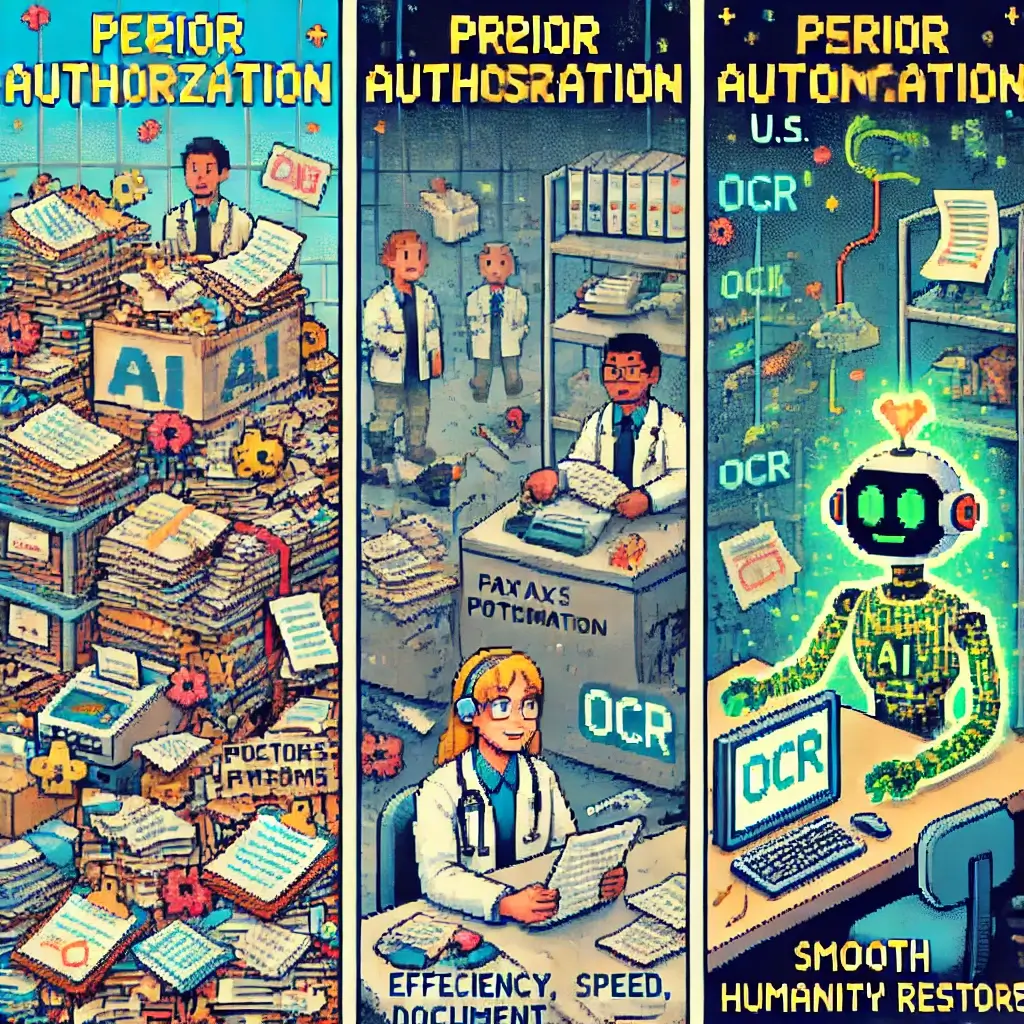
Prior Authorization, Rebuilt: A Three-Part Field Guide to AI, Workflows, and Results
This guide assembles a complete, testable path from manual intake and scattered portals to a measured, auditable flow that emphasizes clarity, speed, and accountability. It is constructed for payer operations leaders, utilization management teams, clinical review leads, data engineers, and product managers who want a plan they can apply in weeks, not years.
The approach is pragmatic. Start by stabilizing intake and document handling, then connect evidence to policy, then orchestrate decisions with explicit reasons and clean handoffs to people. Wherever automation is applied, the goal is repeatability and explanation: the ability to show inputs, rules, and outcomes without drama. In that spirit, AI-powered prior authorization automation is presented here as a set of small, verifiable building blocks rather than a single monolithic promise.
Table of Contents
Part I — Current State, Failure Modes, and Design Principles
Prior authorization is a coordination problem that sits at the boundary between benefit design and clinical practice. Volume growth has accumulated across imaging, specialty pharmacy, post-acute services, home health, durable medical equipment, and selected surgical lines. Most organizations still operate a patchwork: web portals with distinct credentialing, fax attachments, emailed PDFs, phone calls, batch files, and electronic transactions that are only partially implemented. Friction does not originate from one team; it is created by the sum of many small mismatches that compound across channels, systems, and handoffs.
Typical intake requires demographic verification, member eligibility, plan and product matching, rendering and requesting identifiers, diagnosis and procedure coding, place of service, documentation of previous therapy steps, risk factors, and justification references. Each of these fields can arrive malformed or missing. Every missing element forces a resubmission, a hold, or an outbound clarification. Cumulative friction appears as endless phone trees, repeated portal logins, and re-keying the same values into different screens. The predictable result is staff exhaustion, delayed starts of therapy, and a loss of confidence for providers who are doing their best to submit complete information.
Common failure modes are repeatable. First, documents arrive as images with low resolution; text is barely legible and manual re-keying introduces new errors. Second, decision criteria live in separate PDFs or internal wikis, so reviewers must toggle across sources instead of reading the request in context. Third, portal timeouts, duplicate IDs, and inconsistent eligibility snapshots restart the process. Fourth, attachments move without clear traceability, making it hard to prove what was reviewed and when. Fifth, reasons for decision are not specific enough to guide a clean resubmission. None of these failures are dramatic; they are small leaks that sink the ship by repetition.
To reduce these failure modes, a system must adopt a few non-negotiables: single-pass intake that validates essential fields before queueing; deterministic normalization of codes and units; machine reading of documents to reduce transcription; explicit mapping between a policy and the evidence supplied; clear reasons for decision with links to the missing element; and line-of-sight metrics that reach leadership every week. When these guarantees are present and verified, AI-powered prior authorization automation becomes an operational accelerator rather than a black box.
Design principles for reliability are small interfaces, high observability, and reversible changes. Small interfaces mean that each step accepts and emits well-defined artifacts instead of ad hoc bundles. High observability means that every transformation records inputs, outputs, and the rules applied so a reviewer can replay a decision. Reversible changes mean that a human can roll back a decision or reroute a request to a specialized queue without losing context. The same principles govern safety: automate reading, matching, and routing; do not automate clinical judgment; and always make it simple to overrule a suggestion with a documented reason.
Infographic 1 — CMS-0057-F: Decision Timeframes & Compliance Dates (Standard: 7 days, Expedited: 72 hours; Ops from 2026, APIs by 2027). CMSPrior Authorization Decision Timeframes — CMS-0057-F
Expedited: 72 hours · Standard: 7 calendar days · Denial notices include specific reasons.
Expedited Decision
Urgent requests
Standard Decision
Non-urgent requests
Compliance Timeline
Operational policies (decision timeframes & denial reasons): From Jan 1, 2026
APIs (Patient/Provider/Payer-to-Payer/Prior Auth API): By Jan 1, 2027
Plan sequencing tip: lock operations first, then wire APIs.Seven Scenes From the Front Line
- Intake receives a six-page fax where page four is rotated and page five is a second capture of page three. The queue stops while someone corrects orientation and page order.
- A request includes two diagnosis codes that conflict with the documented symptoms. A reviewer catches it after a long hold with the provider office; the resubmission resets the clock.
- A specialty pharmacy request arrives without weight-based dosing details; the nurse calls back to confirm, the clinic nurse is in another procedure, and the window to approve today closes.
- A policy update published last quarter is not yet reflected in the intake script, so reviewers toggle between the previous and current version, causing inconsistent decisions.
- A provider uses a portal where attachments are capped per file; supporting labs are split into multiple uploads; one of them never renders in the payer viewer.
- A back-end system strips leading zeros from IDs; downstream matching fails; the case disappears from the worklist until a reconciliation task exposes the mismatch.
- A member changes plan mid-month; the request is valid for the prior plan but not for the new plan; the office expects continuity, the payer must follow the new benefits, and both sides escalate.
Each scene is ordinary. The fix is not theatrical; it is a set of small guarantees that absorb variance. The repeated solution is AI-powered prior authorization automation applied to capture, validate, normalize, and route information so that reviewers spend time comparing evidence against criteria instead of repairing documents and locating identifiers.
Part II — System Architecture, Data Mapping, and Governance
Architecture starts at intake and ends at a clear decision plus a record that another reviewer could replay. A practical reference model includes five layers: channel adapters, document intelligence, policy and rules, decision orchestration, and reviewer experience. The same model works for small pilots and for scaled operations as traffic grows because each layer can be swapped or scaled independently.
Layer 1 — Channel Adapters
Requests arrive through portals, batch files, electronic transactions, email inboxes, and fax lines. Channel adapters unwrap the request, extract metadata, and convert input to a single canonical envelope. The adapter enforces size limits, file type safety, deduplication, and identity checks. The objective is to make all channels look the same to the rest of the pipeline so that AI-powered prior authorization automation can process them uniformly.
Layer 2 — Document Intelligence
Images and PDFs are converted into structured text and tables. Optical character recognition with layout analysis captures headings, footers, tables, and handwriting approximations. Named entity recognition detects member names, dates of birth, provider identifiers, plan numbers, diagnosis and procedure codes, medication names, dosage, and prior therapy steps. Confidence scoring and quality gates reject unreadable scans and request an updated attachment with a simple message that lists exactly what must be provided and in what format.
Layer 3 — Policy and Rules
Policy content is expressed as rules with thresholds, prerequisites, and alternative pathways. For example, a policy can define first-line therapies, contraindications, required labs, imaging intervals, conservative management durations, or specialist consultation notes. The rules engine maps evidence from the request to each clause. Missing elements are collected as actionable gaps. This mapping is the core of AI-powered prior authorization automation: it turns a long PDF into checkable steps with traceable outcomes.
Layer 4 — Decision Orchestration
Decision orchestration coordinates status changes, queues, and notifications. Simple requests that satisfy all rules can be marked as ready for approval and routed to a human for final sign-off. Requests with partial matches are routed to a specialized queue with a summary that lists the unmatched clauses and the evidence that partially matches them. Edge cases are flagged for supervisory review with a note that a new rule variant may be required. Every transition emits a compact event that powers dashboards and alerts, so operations teams always see the state of the system rather than discovering problems days later.
Layer 5 — Reviewer Experience
The reviewer view presents a single screen with the member, provider, requested service, supporting documents, extracted facts, matched rules, and open gaps. Key interactions are simple: approve with reasons, deny with specific reasons, request information with a prefilled list, route to another queue, or escalate. Keyboard shortcuts, quick filters, and saved views reduce clicks. Explanations link reasons to evidence so that another reviewer can understand the decision without re-reading the entire case. The objective is to convert attention into outcome without friction.
Infographic 2 — AMA 2024: Burden Snapshot (Delayed care 94%, negative outcomes 93%, serious adverse event 24%, treatment abandonment 82%). American Medical Association +1Prior Authorization Burden — AMA Survey (2024)
Calibration and Safety
Calibration aligns automation with reviewer expectations by sampling recent decisions, measuring agreement, and tuning thresholds where disagreements concentrate. This is where AI-powered prior authorization automation earns trust: it presents explanations, highlights borderline clauses, and learns which ambiguities should always route to humans.
Safety is enforced through layered gates, rate limits for changes, and automatic fallbacks to manual processing. When a rule update behaves unexpectedly, AI-powered prior authorization automation must degrade gracefully, keep complete logs, and notify supervisors without interrupting care.
Provider Experience
Provider experience improves when messages are specific, short, and tied to the requested service. By reducing guesswork and clarifying formats for attachments, AI-powered prior authorization automation lowers the number of phone calls required to finish a case.
Data Quality
Data quality improves when normalization is explicit and reversible. The ability to show original values next to the standardized form builds confidence and reduces disputes, and AI-powered prior authorization automation benefits directly from this transparency.
Scalability
Scalability follows from stateless workers, idempotent operations, and queues that can expand without deadlocking. Because each layer can scale independently, AI-powered prior authorization automation can grow with volume while maintaining predictable performance.
Interoperability
Interoperability is practical when payloads are consistent and mappings are documented. A payer, intermediary, or provider system that shares these contracts will exchange requests and reasons cleanly, and AI-powered prior authorization automation will operate across boundaries without rework.
Data Mapping
Data fields include person and coverage identifiers, dates, contact points, care setting, diagnosis and procedure descriptors, medication details, relevant measurements, and references to prior steps of therapy. Normalization handles synonyms, units, abbreviations, and versioned code sets. The mapper also manages the difference between what a provider sends and what a plan needs: when a field is absent, the system can suggest a default, ask a targeted question, or route the case to a human. Clean mapping shortens cycles and simplifies training because reviewers see consistent layouts across lines of business.
Observability
Observability means that every decision is tied to inputs and rules. Logs retain the input envelope, the extracted facts, the policy version, the rules evaluated, and the outcome. Metrics expose throughput, queue growth, average time in state, resubmission rate, gap categories, reviewer variance, and reasons used for decisions. With observability, AI-powered prior authorization automation scales without losing the ability to explain how a conclusion was reached, and audits convert from detective work to verification.
Governance
Governance defines who can change rules, how changes are tested, and how evidence is curated. A change request includes a rationale, sample cases, and expected impact. A small subset of traffic is shadow-evaluated to validate that the change improves the match ratio and reduces rework. Human review remains the final checkpoint for approvals and denials. Access controls, encryption, and redaction limit exposure of sensitive information. Retention policies and export tools allow audits without stalling operations. Governance is successful when reviewers trust that changes are deliberate, documented, and reversible.
Infographic 3 — Interoperability Flow: FHIR PAS with optional X12 278 conversion and X12 275 attachments. build.fhir.org +1 X12 CMSFHIR PAS → Intermediary → Payer (with X12 integration)
Tip: keep a single canonical envelope so any channel (fax → OCR, portal, EHR) produces the same payload.
prior authorization automation software
- CAQH CORE — Prior Authorization & Referrals Operating Rules
- CMS — Interoperability & Burden Reduction
- AHIP — Electronic Prior Authorization (Fast PATH)
prior authorization API for payers
- CMS — Interoperability & Prior Authorization Final Rule (Fact Sheet)
- CMS — Interoperability & Prior Authorization FAQs
FHIR PAS prior authorization API
X12 278 prior authorization transaction
X12 275 clinical attachment standard
- X12 — 275 Clinical Attachment Standard
- CMS — X12 275 Companion Guide (esMD)
- UnitedHealthcare — 275 Companion Guide (Payer Example)
CMS prior authorization final rule 2026
- CMS — Final Rule Landing Page (CMS-0057-F)
- Federal Register — Final Rule Publication
- CMS — Final Rule Overview Slides
CMS-0057-F compliance checklist
- CAQH CORE — Implementing CMS-0057 Requirements (Guide)
- CMS — Interoperability & Prior Authorization FAQs (Compliance & Timing)
Part III — Case Notes, ROI Math, RFP Checklist, FAQ, and Glossary
Case Notes — Before and After
Imaging Request: A clinic used to submit a multipart form plus scanned notes. Intake staff re-keyed identifiers and dates. A rules view did not exist; reviewers kept personal spreadsheets to mirror policy steps. After adopting AI-powered prior authorization automation, the intake screen validates IDs, the document reader collects prior studies and indications, and the rules engine marks what is satisfied versus missing. The reviewer opens a single screen, confirms the match, and uses a standard template to request a specific missing element when needed. The outcome is consistent decisions that are explained in the same format every time.
Specialty Pharmacy: Previously, weight, dose, and step therapy were scattered across chart notes and portal fields. AI-powered prior authorization automation extracts weight and prior therapies, normalizes dose to a standard unit, and maps the line of therapy. The approval summary lists exactly which prerequisites were met. If something is missing, the request for information cites the absent field and gives the format required. The cycle time becomes predictable, and the clinic aligns scheduling with expected decisions instead of guessing.
Post-Acute Services: Requests that involve multiple providers previously required repeated eligibility checks and phone calls. Intake now binds coverage to a single snapshot; any mismatch triggers an automated check that suggests the correct subscriber link. The reviewer sees one timeline that merges all attachments by date with labels for labs, imaging, consults, and therapy sessions. AI-powered prior authorization automation reports specific reasons for denials so that providers can respond with the exact note or test required. The resubmission success rate improves because messages are concrete.
Infographic 4 — CMS-0057-F Compliance Checklist (interactive, client-side only). CMSCompliance Checklist — Ready for 2026 / 2027
Note: this demo only shows front-end behavior. Connect to your task system for persistence.
ROI — A Simple Calculator
Use the calculator to estimate monthly time and cost saved by reducing manual steps. Enter conservative numbers first, then re-run after a pilot. The purpose is not to chase a perfect forecast but to create a baseline that can be verified.
RFP Checklist — Twelve Questions
- Which channels are supported at intake, and how are they normalized into a single envelope?
- How are documents read, and what accuracy is observed on low-quality scans?
- How are policies expressed as rules, and who controls versioning and approvals for changes?
- What explanations are produced for approvals, denials, and requests for information?
- How are edge cases routed to human review without losing context?
- What metrics and logs are retained for audits, and how are they exported?
- What access controls and redaction features limit exposure of sensitive information?
- How are code sets, synonyms, and units normalized and updated?
- How is model drift detected, and how are alerts surfaced to operations?
- What is the fallback plan during outages, and how is data integrity preserved?
- How long does a pilot take, and what milestones define success?
- What does a roll-back look like if a change degrades outcomes?
FAQ
Does automation replace clinical judgment? No. Automation assembles facts, checks policy clauses, and proposes outcomes. Clinical reviewers retain final authority and must record reasons that link evidence to decisions.
How are ambiguous or rare cases handled? They move to a specialized queue where reviewers see matched and unmatched clauses, traceable evidence, and a summary that explains why the case did not meet criteria. The summary becomes training data for rules or models.
Is it necessary to automate the entire process at once? No. Start with capture and validation, then expand to policy mapping for high-volume services, then add orchestration and dashboards. This ladder avoids risk and builds confidence.
How are providers informed when information is missing? Messages cite the exact fields or documents required and outline the acceptable formats. Clear messages reduce resubmission cycles.
What transparency is available to executives? Dashboards show throughput, turn-around time by category, reasons used for decisions, gap distribution, and rework trends. Weekly trends matter more than a single daily snapshot.
What about data security? Access is limited by role; audit logs track every read and change; encryption protects data in motion and at rest; and exports are redacted where appropriate. Security is treated as part of the design, not as an afterthought.
Infographic 5 — “Before/After” Cycle Time Bar (plug in your data; defaults show a realistic demo).Cycle Time — Before vs After Automation (Demo)
9.4d
3.9d
Replace demo values with your measured TAT. Keep the same layout for quick visual comparisons in reports.
Glossary
- Attachment: supporting material submitted with a request.
- Audit trail: a record that shows inputs, rules, and outcomes for a decision.
- Canonical envelope: a normalized container for requests, attachments, and metadata.
- Case: a single authorization request with its documents and history.
- Channel adapter: a component that converts an input path into a standard envelope.
- Clinical criteria: policy rules that describe indications and prerequisites.
- Coverage snapshot: the set of benefits and eligibility at a point in time.
- Decision orchestration: coordination of queues, statuses, and notifications.
- Denial reason: specific explanation that maps a rule to missing or mismatched evidence.
- Document intelligence: reading and structuring information from images and PDFs.
- Edge case: a request that does not match rules and requires deliberate review.
- Eligibility: confirmation of member coverage and plan association.
- Evidence mapping: linking facts from the request to policy clauses.
- Extracted fact: a data element obtained from a document or field.
- Gap: a missing element required by a policy clause.
- Governance: control of changes, testing, and access to sensitive information.
- Human-in-the-loop: a checkpoint where people review and decide.
- Intake: the first step that receives and validates a request.
- Log: a record of events and transformations emitted by the system.
- Metric: a quantitative measure of throughput, time, or quality.
- Normalization: transforming codes, units, and synonyms into a standard form.
- Notification: a message that informs a provider about status or missing items.
- Observability: the ability to explain how a decision was reached.
- Outcome: the final status of a request and the reasons provided.
- Pilot: a limited rollout used to validate outcomes before scaling.
- Policy version: the specific edition of criteria used for a decision.
- Queue: a worklist that groups similar requests for processing.
- Redaction: removal or masking of sensitive fields in a document.
- Request for information: a message that lists what is missing and how to supply it.
- Reviewer variance: differences in decisions across people that require calibration.
- Rule: a machine-readable clause that evaluates a piece of evidence.
- Rule match: a condition where evidence satisfies a clause.
- Shadow evaluation: testing changes on a sample without affecting real outcomes.
- Snapshot: a stable capture of data used to make a decision.
- Step therapy: documented sequence of treatments required before approval.
- Throughput: count of cases processed in a period.
- Timeline: a merged view of attachments and events ordered by date.
- Turn-around time: elapsed time from receipt to decision.
- Unit normalization: standardization of measures such as mg, mL, kg.
- Worklist: a view that shows what is ready to be reviewed.
Applied Patterns — Micro-Patterns That Reduce Rework
- Validate identifiers at intake so that mismatches are resolved before queueing; this is a reliable entry point for AI-powered prior authorization automation.
- Reject unreadable scans with a targeted message and an upload link; this tight feedback loop suits AI-powered prior authorization automation.
- Normalize codes and units on arrival and record the original values; transparent transforms strengthen AI-powered prior authorization automation.
- Map every policy clause to explicit evidence with a yes/no/unknown state; structured gaps energize AI-powered prior authorization automation.
- Attach reasons for decision to an itemized list; clear explanations stabilize AI-powered prior authorization automation.
- Route edge cases to a specialist queue with a summary of unmatched clauses; precise routing accelerates AI-powered prior authorization automation.
- Snapshot eligibility at decision time to prevent shifting context; stable snapshots anchor AI-powered prior authorization automation.
- Emit compact events on each transition so dashboards never lag; fresh telemetry tunes AI-powered prior authorization automation.
- Offer quick filters by service line, place of service, and policy version; ergonomic tools multiply AI-powered prior authorization automation.
- Prefill request-for-information templates with specific missing fields; targeted outreach enhances AI-powered prior authorization automation.
- Version every rule and keep examples with expected outcomes; testability matures AI-powered prior authorization automation.
- Shadow-evaluate proposed rule changes before production; safe rollout protects AI-powered prior authorization automation.
- Redact nonessential fields in reviewer screens; minimal exposure aligns with AI-powered prior authorization automation.
- Auto-classify attachments by type and date; organized timelines clarify AI-powered prior authorization automation.
- Expose reviewer variance and calibrate with side-by-side comparisons; calm calibration guides AI-powered prior authorization automation.
- Pin frequently used policies at the top of the rules view; fast access supports AI-powered prior authorization automation.
- Cache provider contact options and hours to avoid failed calls; smooth outreach complements AI-powered prior authorization automation.
- Use keyboard shortcuts for the five most common actions; fluent control speeds AI-powered prior authorization automation.
- Provide a one-click packet that includes the reason for decision; complete packets conclude AI-powered prior authorization automation.
- Track resubmission cycles and reduce them with better messages; closed loops improve AI-powered prior authorization automation.
- Surface policy exceptions with explicit approvals and expirations; controlled exceptions discipline AI-powered prior authorization automation.
- Publish weekly digests with trend lines and outliers; shared visibility sustains AI-powered prior authorization automation.
Thirty, Sixty, Ninety — A Compact Roadmap
Day 1–30: Normalize intake channels, implement document reading for high-volume services, and publish a single reviewer screen that replaces scattered portals. Instrument logs and metrics from day one.
Day 31–60: Express top policies as rules; enable reasons for decision templates; and add a specialized queue for ambiguous cases. Expand provider messages to include precise gaps and formats.
Day 61–90: Add dashboards for executives, calibrate reviewer variance through side-by-side views, and refine routing based on observed bottlenecks. Document governance procedures for rule changes and audits.
The payoff is not theoretical. When intake validates fields, when documents are machine-readable, when rules map evidence to criteria, and when reviewers see a single coherent page, the system is calmer and faster. With those foundations in place, AI-powered prior authorization automation becomes a durable capability that frees people to apply judgment where it matters most.
-
CMS Interoperability & Prior Authorization Final Rule — Overview
Channel: American Medical Association | Useful for executive briefings on decision timeframes and transparency requirements.
Open on YouTube -
HL7 Da Vinci: Interoperability & Prior Authorization Final Rule Explained
Channel: HL7 Da Vinci Project | Deep dive into how PAS, CRD and ecosystem pieces fit together.
Open on YouTube -
Da Vinci Burden Reduction: Automating Prior Authorization (PAS)
Channel: HL7 community session | Practical run-through of PAS workflow and implementation notes.
Open on YouTube -
CAQH CORE: Phase V Prior Authorization Operating Rules
Channel: CAQHVideo | Operating rule set that standardizes PA data exchange and connectivity.
Open on YouTube -
X12 & CAQH CORE: Introduction to the 278 Transaction
Channel: CAQHVideo | Business context and essentials for 278 healthcare services review transactions.
Open on YouTube