
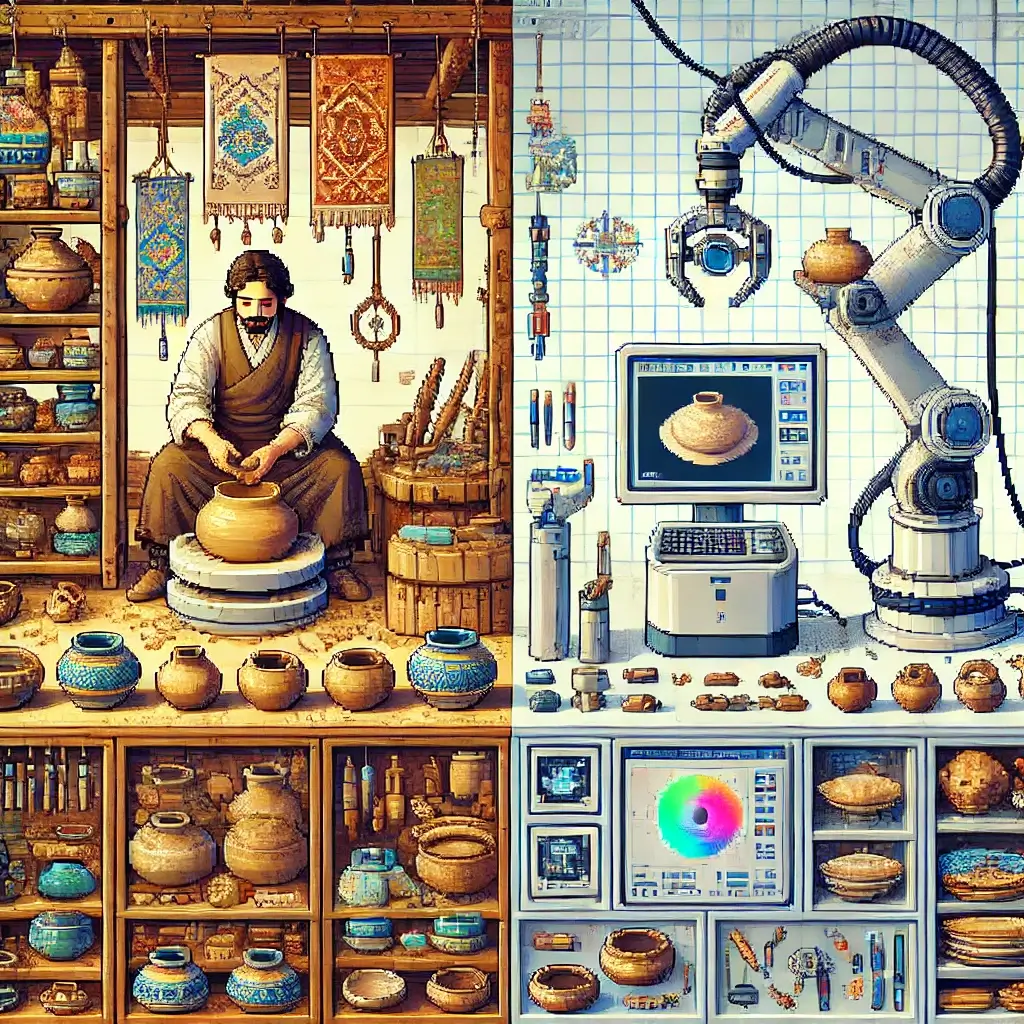
10X Quality Boost: Computer Vision Revolutionizes Artisanal Crafts!
Hey there, fellow craft enthusiasts and tech curious minds!
Have you ever held a beautifully handcrafted piece – maybe a ceramic vase, a hand-woven tapestry, or a meticulously carved wooden sculpture – and just marveled at the skill, the dedication, the sheer human artistry poured into it?
I know I have. There’s something truly magical about artisanal crafts, isn’t there?
Each piece tells a story, often carrying the legacy of generations of craftsmanship.
But let’s be real, even the most skilled artisan isn’t a robot (thank goodness!).
And that means inconsistencies, slight imperfections, or even significant flaws can sometimes slip through the cracks.
Traditionally, quality control in these fields has been a deeply human endeavor, relying on the keen eyes and experienced hands of master craftspeople.
It’s a vital, albeit often slow and labor-intensive, part of the process.
But what if I told you there’s a game-changer on the horizon, one that’s not about replacing human ingenuity but empowering it?
Enter **computer vision for quality control** – a technology that’s quietly, yet powerfully, stepping into the world of artisanal crafts.
It’s not just a fancy buzzword; it’s a practical, revolutionary tool that’s poised to elevate the quality, consistency, and even the very definition of “perfection” in handmade goods, all while preserving their unique charm.
Stick with me, because we’re about to dive deep into how this incredible tech is making waves, addressing some tough challenges, and opening up a whole new realm of possibilities for artisans worldwide.
It’s a fascinating blend of old-world charm meets cutting-edge innovation, and trust me, you won’t want to miss what’s coming next!
Computer Vision, Quality Control, Artisanal Crafts, AI in Manufacturing, Craftsmanship —
Table of Contents
—
**The Heart of Craftsmanship: Why Quality Control Matters**
Alright, let’s get down to brass tacks.
Why is quality control such a big deal in the world of handmade goods?
It’s more than just catching a wonky stitch or a chipped edge, believe me.
When you buy an artisanal product, you’re not just purchasing an item; you’re investing in the artisan’s reputation, their story, and often, a piece of cultural heritage.
Imagine this: you’ve saved up for a stunning, hand-knitted merino wool blanket from a small, independent artist you admire.
You unwrap it, excited, only to find a significant snag right in the middle, or an uneven tension that makes one section feel thin and flimsy.
Disappointing, right?
Not only does it mar your enjoyment, but it also casts a shadow on the artisan’s brand.
For artisans, every piece they create is a direct reflection of their skill and dedication.
A few subpar products can quickly erode trust, lead to negative reviews, and ultimately, hurt their livelihood.
And let’s not forget the sheer waste of materials and time if a flawed product isn’t caught before it reaches the customer.
This isn’t just about monetary loss; it’s about the soul of the craft.
Maintaining high quality ensures that the art form itself is respected and valued, encouraging future generations to pick up the tools and continue the tradition.
It also allows artisans to command fair prices for their unique creations, because customers know they’re getting something truly special and well-made.
Think about it like this: a master chef doesn’t just throw ingredients together.
They meticulously select, prepare, and taste at every stage to ensure the final dish is perfect.
Quality control in crafts is no different.
It’s the final critical step that ensures the passion and precision poured into each piece truly shines through.
Computer Vision, Quality Assurance, Craftsmanship Standards, Artisan Reputation, Material Waste —
**Traditional QC: The Good, The Bad, and The Beautifully Human**
So, how has quality control traditionally been handled in the artisanal world?
Well, it’s a story as old as craftsmanship itself: the human touch.
For centuries, artisans have relied on their highly trained eyes, sensitive fingers, and profound understanding of their materials and techniques to ensure quality.
And honestly, there’s something incredibly beautiful about that.
Imagine a potter running their hand over a newly fired ceramic piece, feeling for the slightest bump or fissure.
Or a weaver meticulously inspecting each row of a tapestry, checking for consistent tension and color accuracy.
This hands-on approach offers unparalleled nuance.
A human can discern subtle variations in texture, recognize the artistic intent behind a seemingly “imperfect” brushstroke, or understand the inherent quirks of natural materials that a machine might miss.
It’s subjective, yes, but often deeply informed by years of experience and an almost intuitive connection to the craft.
However, let’s not sugarcoat it.
This traditional method, as romantic as it sounds, comes with its own set of challenges.
First off, it’s incredibly **time-consuming**.
Every single piece has to be individually inspected, often multiple times throughout the creation process.
For an artisan producing a limited number of high-value items, this might be manageable.
But what about those who are scaling up, or trying to meet growing demand?
Secondly, it’s **prone to human error**.
Even the most diligent artisan can have an off day. Fatigue, distraction, or simply the sheer volume of work can lead to flaws being overlooked.
We’re only human, after all!
Thirdly, it lacks **consistency across different inspectors or even over time for the same inspector**.
What one artisan deems acceptable, another might reject.
This subjectivity can make it difficult to maintain uniform quality standards, especially in a workshop with multiple hands at work.
And finally, it’s **resource-intensive**.
It ties up valuable skilled labor in a task that, while critical, might not be the most creative or value-adding part of their day.
So, while the human element in traditional QC is invaluable for its nuanced judgment and artistic understanding, its scalability, consistency, and efficiency are undeniable bottlenecks.
This is precisely where technology steps in, not to replace the artist, but to free them up to do what they do best: create.
Manual Inspection, Human Error, Craft Tradition, QC Challenges, Artisan Skill —
**Unveiling Computer Vision: A New Pair of Eyes for Artisans**
Okay, let’s talk about the star of our show: **Computer Vision**.
Sounds futuristic, right?
Like something out of a sci-fi movie where robots are taking over the world.
But trust me, the reality is far more grounded and, frankly, incredibly helpful, especially for our beloved artisans.
At its core, computer vision is a field of artificial intelligence (AI) that enables computers to “see” and interpret images and videos in much the same way humans do.
Think of it as giving a machine a highly sophisticated pair of eyes and a brain to understand what those eyes are seeing.
Instead of just seeing a collection of pixels, a computer vision system can identify objects, recognize patterns, detect defects, and even measure dimensions with astounding accuracy and speed.
For artisans, this translates into a truly powerful ally in quality control.
Imagine a camera system scanning every inch of a hand-thrown pottery piece, not just looking for obvious cracks, but also checking for subtle unevenness in the glaze, variations in wall thickness, or even microscopic air bubbles that might compromise its integrity down the line.
Or picture it meticulously inspecting an intricate piece of embroidery, verifying stitch consistency, thread color accuracy, and alignment, far faster and more consistently than any human eye could.
The beauty of computer vision in this context lies in its **objectivity and tireless nature**.
It doesn’t get tired, it doesn’t get distracted, and it applies the same rigorous standards to the first piece of the day as it does to the thousandth.
This means unprecedented consistency in quality output, which is a massive win for artisans looking to scale their operations while maintaining their brand’s reputation for excellence.
It’s like having an unblinking, super-perceptive assistant who never complains, always shows up on time, and spots things even the most experienced human might miss after a long day.
This technology isn’t about draining the soul from craftsmanship; it’s about freeing the artisan from the repetitive, often tedious, task of minute inspection, allowing them more time for the truly creative, soul-satisfying work of bringing their visions to life.
That’s a partnership I can certainly get behind!
AI, Image Recognition, Automated Inspection, Precision, Consistency —
**How Does This Magic Work? Under the Hood of Computer Vision**
Okay, I know what you’re thinking.
“This all sounds great, but how does a computer actually *see* a defect in a handmade item?
Does it just, like, know?”
Good question! It’s not quite magic, but it certainly feels like it sometimes.
Let’s peek under the hood and see how this incredible technology works.
At its heart, computer vision relies on a combination of **cameras, powerful algorithms, and a whole lot of data**.
Here’s a simplified breakdown:
**1. Image Acquisition: The Eyes of the System**
First, the system needs to “see” the object. This is done using high-resolution cameras, often combined with specialized lighting (think fancy LED setups or even UV lights) to highlight specific features or potential flaws.
For example, if you’re inspecting a piece of ceramic, you might use structured light to detect subtle surface irregularities or specular lighting to emphasize glaze imperfections.
Multiple cameras might even be used to capture different angles or 3D data.
**2. Image Preprocessing: Cleaning Up the View**
Once an image is captured, it’s not immediately ready for analysis.
It needs to be “cleaned up” – think of it like adjusting the focus and brightness on your phone before taking a perfect shot.
This step involves techniques like noise reduction, contrast enhancement, and correcting for any distortions caused by the lens or lighting.
The goal here is to make the important features and potential defects stand out clearly.
**3. Feature Extraction: What to Look For**
Now, the real intelligence kicks in. The system begins to identify and extract relevant “features” from the image.
This could be edges, corners, textures, shapes, or even color gradients.
For instance, if we’re checking a knitted fabric, the system might extract information about the size and regularity of each loop, the straightness of the rows, or the uniformity of the yarn thickness.
This is where deep learning, a subset of AI, often comes into play.
Neural networks, particularly Convolutional Neural Networks (CNNs), are trained on vast datasets of “good” and “bad” examples of the artisanal product.
This training allows the network to learn the intricate patterns that differentiate a perfect piece from one with a flaw.
It’s like showing a child thousands of pictures of cats and dogs until they can tell the difference themselves – but on an infinitely more complex scale!
**4. Defect Detection and Classification: The Decision Maker**
Once features are extracted, the system compares them against predefined quality standards or the learned patterns of “acceptable” variations.
If something deviates significantly, it flags it as a potential defect.
The system can then classify the type of defect (e.g., a crack, a warp, a discoloration, a missing part) and even its severity.
It might even be trained to differentiate between a unique, intentional artistic flourish and an unintentional flaw.
For example, it can identify a hairline fracture in a delicate glass sculpture or a subtle color bleed in a hand-painted tile that a human eye might struggle to consistently spot.
**5. Reporting and Action: What Happens Next?**
Finally, the results are presented to the artisan.
This could be a simple pass/fail notification, or a more detailed report highlighting the exact location and type of defect on a digital image of the product.
The system can even be integrated into the workflow to automatically sort defective items, send alerts, or trigger further inspection by a human expert.
The key here is that the machine does the grunt work of consistent, high-speed inspection, flagging items that need human attention.
This saves immense time and ensures nothing major slips by, allowing artisans to focus their precious human judgment on the truly nuanced cases or on the creative process itself.
It’s not magic, but it feels pretty close when you see it in action, tirelessly ensuring that every piece that leaves an artisan’s workshop is a testament to their dedication to quality.
Deep Learning, Neural Networks, Image Analysis, Automated Sorting, Quality Metrics —
**Challenges and Triumphs: Integrating Computer Vision in a Human-Centric World**
Now, I know what some of you might be thinking: “This sounds great for a factory, but artisanal crafts are different! They’re not mass-produced, uniform items. How can a rigid machine possibly understand the nuances of a handmade piece?”
And you’d be absolutely right to ask that!
Integrating computer vision into the delicate, often wonderfully irregular world of artisanal crafts isn’t without its hurdles. It’s not a simple copy-paste from industrial automation.
Let’s talk about some of these challenges and, more importantly, how innovators are triumphing over them.
**The Unpredictable Nature of Handmade Goods:**
This is arguably the biggest elephant in the room. Unlike a perfectly identical screw or a standardized circuit board, no two handmade items are ever truly identical.
Variations in texture, slight differences in shape, unique brushstrokes, and the inherent inconsistencies of natural materials (think wood grain, unspun fibers, or natural dyes) are part of their charm.
A traditional computer vision system might incorrectly flag these unique artistic expressions as “defects.”
The **Triumph**: This is where advanced AI, particularly **deep learning** and **machine learning**, truly shines.
Instead of rigid rules, these systems are trained on vast datasets that include both perfect and “intentionally imperfect” examples.
Artisans can even train the system with their own specific aesthetic criteria, teaching it to recognize what constitutes an acceptable variation versus a true flaw.
It learns the “signature” of a specific artisan’s work or a particular craft style, becoming incredibly nuanced in its judgment.
**Data Scarcity for Training:**
Industrial applications often have millions of images of defects to train their AI models.
For unique artisanal products, especially those from small workshops, such vast datasets simply don’t exist.
The **Triumph**: Researchers are employing techniques like **transfer learning** (where a pre-trained model is fine-tuned with a smaller, specific dataset) and **data augmentation** (creating new variations of existing images) to overcome this.
Additionally, collaborative efforts between artisans and tech developers can help build specialized datasets over time, creating a shared resource for the community.
**Cost and Accessibility:**
High-end computer vision systems can be expensive, putting them out of reach for many small-scale artisans or collectives.
The **Triumph**: The cost of cameras and computing power is steadily decreasing.
Furthermore, cloud-based AI services are emerging, offering powerful computer vision capabilities as a service, reducing the need for expensive upfront hardware investments.
Simplified, user-friendly interfaces are also being developed, making these tools accessible even to those without a strong tech background.
**Integration into Existing Workflows:**
Artisanal workshops are often bespoke environments, not assembly lines.
Introducing new technology needs to be seamless and non-disruptive.
The **Triumph**: The focus is on creating flexible, modular systems that can be easily integrated at specific points in the crafting process, rather than requiring a complete overhaul.
Think of portable scanning stations or handheld devices that can be used exactly where and when an artisan needs them, much like an additional tool in their toolkit.
What’s truly exciting is that artisans aren’t just passive recipients of this technology; many are actively collaborating with developers, providing invaluable insights into their craft, helping to refine the algorithms, and ensuring the tools truly serve their needs.
It’s a beautiful dance between tradition and innovation, where the goal isn’t to standardize creativity, but to empower it, ensuring that every meticulously crafted piece truly reflects the artisan’s vision, free from unintentional flaws.
Deep Learning Challenges, AI Integration, Artisan Collaboration, Cost-Effective AI, Workflow Optimization —
**Real-World Wonders: Where Computer Vision is Making a Difference in Artisanal Crafts**
Alright, enough with the theory!
You’re probably wondering, “Is this actually happening? Are there real-world examples of computer vision being used to inspect my favorite handmade goods?”
And the answer is a resounding YES!
While still an emerging field in the artisanal space, incredible innovations are already taking root, quietly transforming how quality is maintained in various crafts.
Here are a few exciting examples:
**1. Ceramics and Pottery: Spotting the Invisible Flaws**
This is a natural fit for computer vision. From small cracks and pinholes to glaze inconsistencies and warping during firing, ceramics can have a myriad of subtle flaws.
Companies are developing systems that use high-resolution cameras and structured light to create 3D scans of pottery pieces.
These scans can then be analyzed by AI to detect deviations from the intended form, identify glaze defects that might be invisible to the naked eye, or even predict potential weaknesses that could lead to breakage later on.
Imagine a potter placing a freshly fired batch onto a rotating platform, and within seconds, getting an accurate report on any subtle imperfections, saving them the heartache of a piece failing unexpectedly after sale.
This is not just about detecting flaws; it’s about understanding the firing process better and refining techniques to minimize future defects.
**2. Textiles and Weaving: The Eye for Detail**
Hand-woven fabrics, intricate embroidery, and artisanal textiles are incredibly beautiful but can be prone to inconsistencies like skipped stitches, varying thread tension, color bleeds, or minor weaving errors.
Computer vision systems equipped with specialized cameras can meticulously scan large areas of fabric, identifying these tiny discrepancies that would take a human eye hours to find, if at all.
Think about a company producing luxury hand-knitted sweaters.
A vision system can quickly check for uniform stitch density, ensuring that every sweater feels consistent in quality and drapes perfectly.
This helps maintain the reputation of high-end brands while improving efficiency in their quality assurance processes.
**3. Woodworking and Furniture: Precision in Natural Materials**
Wood is a living material, and its natural variations (knots, grain patterns, subtle warping) are part of its appeal.
However, defects like cracks, inadequate joinery, or inconsistencies in finishes need to be caught.
Computer vision is being used to analyze wood surfaces, detect hairline cracks, identify areas of improper sanding or finishing, and even verify the precision of intricate carvings and joints.
For custom furniture makers, this means a higher guarantee of structural integrity and aesthetic perfection, without compromising the unique character of each piece of wood.
**4. Jewelry and Metalwork: The Sparkle of Perfection**
In fine jewelry and intricate metalwork, even microscopic flaws can significantly devalue a piece.
Computer vision, often combined with microscopy, can inspect the smallest details: the precision of a diamond setting, the presence of scratches or tool marks on highly polished surfaces, or the integrity of delicate filigree.
This allows jewelers to ensure every facet sparkles as intended and every connection is secure, upholding the highest standards in a craft where precision is paramount.
**5. Hand-Painted Items and Art: Preserving Artistic Intent**
This is perhaps the most fascinating and challenging application.
How does a machine differentiate between a deliberate artistic imperfection and an accidental flaw?
Through advanced training with human experts, computer vision systems can learn an artist’s specific style, recognizing their intentional brushstrokes, unique textures, and acceptable variations.
It can then be used to detect unintended smudges, foreign particles, or significant inconsistencies that truly detract from the artistic vision, while respecting the unique handmade quality.
Imagine a ceramic artist who intentionally uses a certain glaze technique that leaves subtle, organic variations.
The system can be trained to accept these as part of the desired aesthetic, while still flagging a true defect like a pooling of glaze in an undesirable spot.
These aren’t just theoretical possibilities; they are becoming tangible realities, enabling artisans to uphold and even elevate the renowned quality of their work.
It’s about making the process smarter, not sacrificing the artistry.
Textile Inspection, Wood Defect Detection, Jewelry Quality, Ceramic Flaw Detection, Artisanal Applications —
**The Future is Bright (and Flawless!): The Road Ahead for Computer Vision in Crafts**
So, what’s next for computer vision in artisanal crafts?
If you thought what we’ve discussed so far was exciting, buckle up, because the future holds even more incredible possibilities!
This isn’t just a fleeting trend; it’s a foundational shift that promises to redefine “handmade quality” in the 21st century.
**1. Democratization of Technology: AI for Every Artisan**
As the technology matures and becomes more affordable, we’ll see a massive expansion of its accessibility.
Imagine small workshops and individual artisans having access to powerful, user-friendly computer vision apps on their smartphones or tablets.
They could simply scan their latest creation, and the app would provide instant, intelligent feedback on its quality, pointing out areas for improvement or confirming perfection.
This will empower countless artisans who currently lack the resources for advanced QC.
Think about a pottery student, for instance, getting real-time feedback on their pieces that helps them rapidly improve their technique.
**2. Predictive Quality Control: Preventing Flaws Before They Happen**
Right now, computer vision primarily *detects* defects.
But the next frontier is **predictive quality control**.
By analyzing data from various stages of the crafting process (e.g., kiln temperatures for ceramics, tension settings on a loom, humidity levels in a woodworking shop), AI can begin to identify patterns that lead to defects *before* they manifest.
Imagine a smart kiln that warns a potter if the firing schedule is likely to cause cracking based on the specific clay body and shape, allowing them to adjust parameters proactively.
This shifts from reactive defect detection to proactive defect prevention, saving immense time and materials.
**3. Augmented Reality (AR) for Real-time Guidance:**
Picture this: an artisan is working on a complex piece, and an AR headset overlays visual cues directly onto their workpiece, highlighting potential inconsistencies or suggesting optimal tool angles for precision.
This could be revolutionary for training new apprentices or for master artisans tackling incredibly intricate designs.
It’s like having an invisible mentor guiding your hands, without interfering with the creative flow.
This could even extend to complex tasks like carving, where the AR can show the exact depth and angle needed for a particular cut.
**4. Enhanced Customer Trust and Transparency:**
Artisans could potentially provide a “digital quality certificate” with each piece, generated by the computer vision system, showcasing its flawless inspection.
This adds an unprecedented layer of trust and transparency for consumers, solidifying the value proposition of handmade goods in a competitive market.
Imagine scanning a QR code on a ceramic mug and seeing a visual report confirming its structural integrity and glaze consistency.
How cool would that be?
**5. Customization and Personalization at Scale:**
As computer vision gets smarter at understanding specific artistic styles and acceptable variations, it could even facilitate highly personalized production.
Customers could request specific stylistic nuances, and the system could help guide the artisan to achieve those while still ensuring overall quality, blurring the lines between mass customization and true handcrafted uniqueness.
The beauty of this future is that it’s not about industrializing art; it’s about intelligently supporting it.
It’s about empowering artisans to achieve new heights of consistency and perfection, freeing them to innovate and create, and ensuring that the cherished traditions of craftsmanship continue to thrive, stronger and more reliable than ever before.
The human touch remains paramount, but it will be amplified by the precision and insights of intelligent machines.
Artificial Intelligence Future, Predictive Maintenance, Augmented Reality in Crafts, Digital Quality Certificate, Personalized Production —
**A Personal Touch: Why This Matters to All of Us**
You might be reading all this and thinking, “Okay, interesting tech, but what does it mean for *me*?
I’m not an artisan, and I don’t run a workshop.”
Well, let me tell you, it matters to you more than you might realize!
First and foremost, as consumers, it means we’re going to get even **higher quality artisanal products**.
Imagine purchasing a piece, knowing that it has been meticulously inspected not just by a human eye, but also by an unblinking, hyper-accurate digital one.
It adds a layer of assurance, doesn’t it?
You’re less likely to be disappointed, and your investment in handmade goods becomes even more secure.
Secondly, it helps **preserve and elevate traditional crafts**.
By making the production process more efficient and quality control more robust, artisans can sustain their businesses more effectively.
This ensures that ancient techniques and beautiful art forms don’t just survive but thrive in the modern world.
It helps them compete in a global marketplace, ensuring that the unique character of handmade items isn’t lost in a sea of mass production.
Thirdly, it’s about **empowerment**.
For the artisans themselves, this technology isn’t a threat; it’s a liberator.
It frees up their valuable time from repetitive, often tedious inspection tasks, allowing them to focus more on creativity, innovation, and pushing the boundaries of their craft.
It means more time to experiment, to teach, and to connect with their community – things that truly fuel the artistic spirit.
Think of it as a brilliant assistant that handles the tedious parts, leaving the artisan to enjoy the fulfilling, artistic work.
And finally, it’s a beautiful testament to how **technology and humanity can work hand-in-hand**.
It’s not about replacing the artisan’s soul or the unique imperfections that give handmade items their charm.
Instead, it’s about leveraging the best of both worlds: the unparalleled creativity and nuanced judgment of the human, combined with the tireless precision and analytical power of artificial intelligence.
It’s a partnership that leads to more beautiful, more reliable, and ultimately, more cherished handcrafted treasures in our lives.
So, the next time you admire a stunning piece of handmade art, take a moment to appreciate not just the artisan’s skill, but also the silent, digital guardian that might have played a part in ensuring its perfection.
It’s an exciting time to be alive, isn’t it, where even the oldest traditions are finding new wings through innovation!
Thank you for joining me on this journey into the fascinating intersection of computer vision and artisanal crafts. I hope you found it as insightful and inspiring as I did! Learn more about Computer Vision in Manufacturing!
Explore the Future of AI in Operations!
Discover the Enduring Appeal of Handmade Crafts!
Consumer Benefits, Craft Preservation, Artisan Empowerment, Technology Partnership, Handmade Quality