
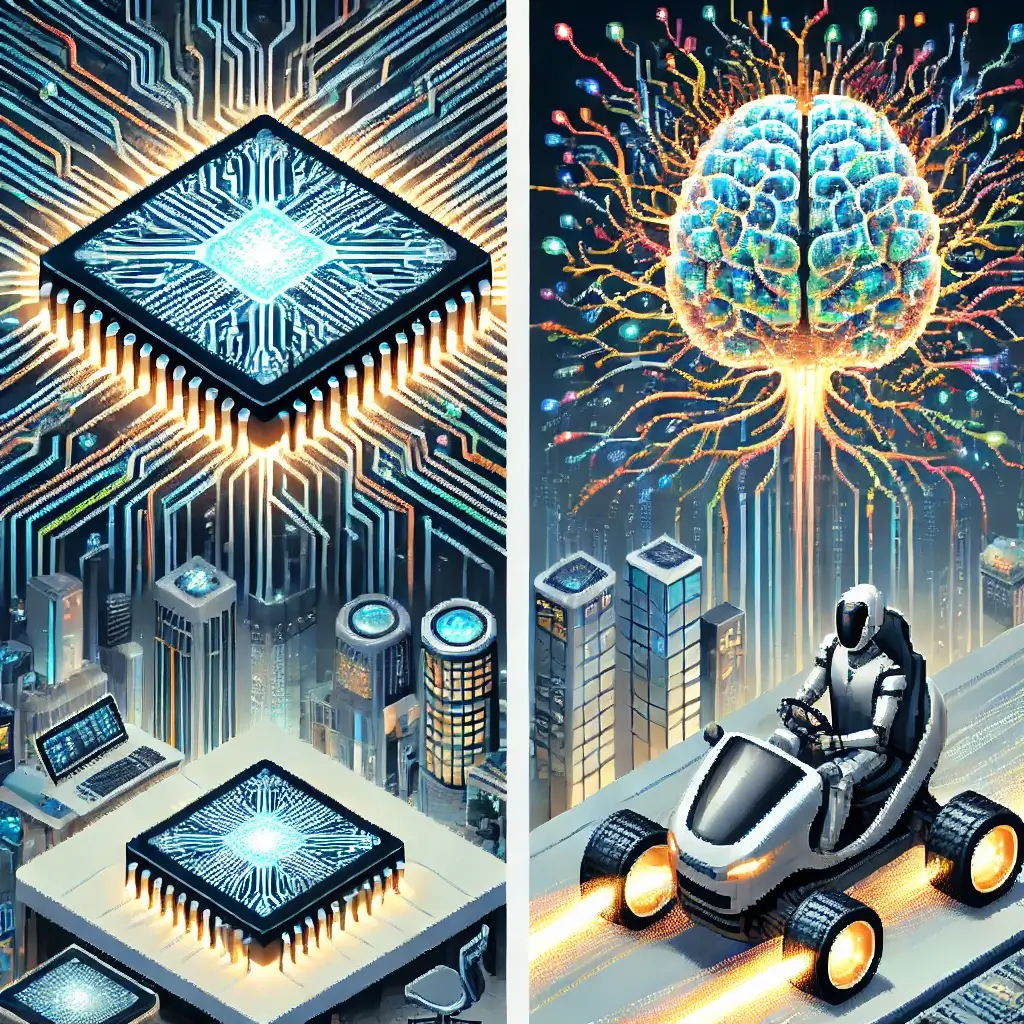
Unleashing 7X Edge AI Power: Neuromorphic Computing’s Insane Revolution!
Hey there, tech enthusiasts and fellow adventurers on the digital frontier!
Are you ready to talk about something truly mind-blowing, something that sounds like it’s ripped straight from a sci-fi novel but is, in fact, very real and happening right now?
We’re diving deep into the world of neuromorphic computing and its insane potential to revolutionize edge AI devices.
Forget everything you thought you knew about traditional computing.
We’re talking about systems designed to mimic the human brain – yes, that squishy, incredible organ responsible for all your brilliant thoughts and questionable life choices!
And when we talk about bringing that power to the very “edge” of our networks, right to your smart devices, your robots, and even your autonomous cars, well, that’s where things get really, really interesting.
Imagine your smart doorbell not just recognizing a face, but *understanding* the intent behind the knock, all in real-time, with minimal power.
That’s the kind of magic neuromorphic computing promises.
It’s not just about making things faster; it’s about making them smarter, more efficient, and truly autonomous.
So, buckle up, because this is going to be a wild ride! —
Table of Contents
—
What in the World is Neuromorphic Computing Anyway?
Alright, let’s start with the basics, because “neuromorphic” sounds like something you’d find in a complex medical textbook, right?
But really, it’s quite simple and elegant in its concept.
Imagine trying to teach a computer to recognize a cat.
With traditional computers, you’d feed it millions of cat pictures, and it would process them sequentially, doing a lot of calculations, consuming a lot of power, and probably needing a big, noisy fan to keep cool.
Now, think about how your brain recognizes a cat.
It doesn’t go through a checklist of features one by one.
It sees the cat, and bam!
It just *knows*.
This is because your brain operates in a fundamentally different way.
It uses neurons and synapses, firing signals only when necessary, processing information in parallel, and learning from experience.
It’s incredibly efficient.
Neuromorphic computing aims to emulate this biological efficiency.
Instead of the traditional von Neumann architecture, where processing and memory are separate (leading to the infamous “memory bottleneck”), neuromorphic chips integrate them.
They have artificial “neurons” and “synapses” that communicate with each other, much like our brain cells.
This means they can process information in a massively parallel fashion, with events (like a neuron “firing”) driving computation.
It’s less about brute-force calculation and more about pattern recognition and learning, which is exactly what AI needs, especially at the edge.
Think of it this way: traditional computers are like a meticulously organized library where you have to go fetch each book individually.
Neuromorphic computers are like a super-smart librarian who already knows what you need before you even ask, because all the books are connected and talking to each other in a dynamic, fluid way.
Pretty cool, right? —
Why Edge AI Devices Are Practically Begging for a Brain Upgrade
So, you’ve got your smart speakers, your smart cameras, your wearables, and soon, probably your smart socks.
These are all edge AI devices.
They’re right there with you, at the “edge” of the network, gathering data and trying to make sense of the world.
But here’s the rub: traditional AI, the kind that runs on big data centers in the cloud, is incredibly powerful, but it comes with baggage.
Imagine your smart security camera trying to detect an intruder.
With traditional methods, it captures video, sends it all the way to a faraway cloud server for analysis, waits for the server to process it, and then gets a response back.
This introduces **latency** – that annoying delay that makes real-time decisions impossible.
For something like an autonomous car, even a millisecond of delay can mean the difference between a smooth ride and, well, a very bad day.
Then there’s **power consumption**.
Running complex AI models on tiny, battery-powered devices is a nightmare.
They chew through power like nobody’s business, meaning constant recharging or bulky batteries.
And let’s not forget **privacy and security**.
Sending all your personal data, from voice commands to facial scans, up to the cloud raises some serious eyebrows.
What if that data gets intercepted?
What if a server goes down?
This is where neuromorphic computing swoops in like a superhero.
By processing data locally, on the device itself, it slashes latency, dramatically reduces power consumption (because it’s only “firing” when necessary, remember?), and keeps your sensitive data right where it belongs – with you.
It’s like giving each edge device its own miniature, super-efficient brain, allowing it to make intelligent decisions on the spot, independently, and without constantly calling home for instructions.
This isn’t just an improvement; it’s a paradigm shift for how we interact with our smart world. —
The Secret Sauce: How Neuromorphic Chips Work Their Magic
Okay, let’s pull back the curtain a bit and see what makes these neuromorphic chips tick.
It’s not just about shrinking down a regular computer; it’s a completely different philosophy of computation.
At the heart of it are two key components: **spiking neurons** and **synapses with memory**.
Unlike traditional digital circuits that send continuous streams of data, spiking neurons in neuromorphic chips only “fire” (send a signal, or “spike”) when a certain threshold of input is reached.
This is called **event-driven computation**.
Think of it like a light switch that only turns on when enough pressure is applied, rather than being constantly on and just dimming or brightening.
This on-demand processing means incredible energy efficiency.
Then there are the synapses.
In your brain, synapses are the connections between neurons, and their strength changes over time based on how often they’re used.
This is how learning happens.
Neuromorphic chips mimic this with **in-memory computing**.
The memory and processing units are tightly integrated, often with resistive random-access memory (RRAM) or other novel memory technologies acting as synapses.
This allows for massive parallelism and eliminates the need to constantly move data back and forth between separate processing and memory units, a huge bottleneck in traditional systems.
Companies like Intel with their **Loihi chip** and IBM with their **TrueNorth** are at the forefront of this.
Intel’s Loihi, for example, is designed to be highly configurable and scalable, allowing researchers to explore different neural network architectures.
It’s not just about running existing AI models faster; it’s about enabling entirely new types of AI that learn and adapt in real-time, just like biological brains.
Imagine a small device that can learn a new task on the fly, without needing to be re-programmed or connected to a massive cloud infrastructure.
That’s the promise of this cutting-edge hardware. —
Real-World Wonders: Neuromorphic Computing Applications at the Edge
Okay, enough with the technical jargon!
Let’s talk about how neuromorphic computing is actually going to make our lives better, safer, and more efficient in the wild, wild world of edge AI devices.
This is where the rubber meets the road, folks, and it’s exciting!
Autonomous Vehicles: The Ultimate Brain on Wheels
Imagine self-driving cars that can react to unexpected situations with the speed and nuance of a human driver, but with superhuman consistency.
Neuromorphic chips are perfect for this.
They can process sensor data (from cameras, lidar, radar) in real-time, detecting pedestrians, other vehicles, and road hazards almost instantaneously.
Because they’re so power-efficient, they can be deployed directly in the vehicle, making decisions without relying on constant cloud connectivity.
This isn’t just about faster reaction times; it’s about enabling safer, more reliable autonomous navigation, especially in complex urban environments.
It’s like giving the car its own lightning-fast, highly intuitive brain.
Robotics: Smarter, More Agile Companions
From industrial robots on the factory floor to personal assistant robots in our homes, the demand for more intelligent and adaptable robots is exploding.
Neuromorphic computing allows robots to learn new tasks on the fly, adapt to changing environments, and interact more naturally with humans.
Imagine a robot arm that can pick up a delicate object it’s never seen before without crushing it, or a domestic robot that learns your habits and proactively assists you.
Their energy efficiency means smaller batteries and longer operating times, making them more practical for real-world deployment.
It’s about moving from programmed movements to truly intelligent, reactive behavior.
Smart Homes and IoT: A Truly Intelligent Environment
Your smart home devices are about to get a serious upgrade.
Think beyond just turning lights on and off with voice commands.
With neuromorphic capabilities, smart sensors can analyze subtle patterns in your home – changes in air quality, unusual sounds, or even the way you move – to anticipate your needs and provide proactive assistance.
For example, a smart security camera could not only detect a person but also analyze their gait and behavior to distinguish between a family member and a potential threat, all without sending video data to the cloud.
This vastly improves privacy and responsiveness.
It’s creating a truly responsive and intuitive living space, where devices anticipate your needs, rather than just reacting to your commands.
Healthcare Wearables: Your Personal Health Guardian
Wearable health monitors are already common, but imagine ones that can detect subtle anomalies in your heart rhythm or brain activity in real-time, without draining their battery in hours.
Neuromorphic chips can power these devices, enabling continuous, low-power monitoring and immediate alerts for critical health events.
They can learn your unique physiological patterns and flag deviations, providing truly personalized health insights and potentially life-saving interventions.
This is about transforming reactive healthcare into proactive wellness management.
Industrial Edge Analytics: Smarter Factories, Safer Workplaces
In manufacturing and industrial settings, machines generate a colossal amount of data.
Neuromorphic computing can be used for real-time anomaly detection, predictive maintenance, and quality control directly on the factory floor.
Imagine sensors on machinery that can detect a subtle change in vibration or sound indicating an impending failure, long before it happens.
This not only prevents costly downtime but also improves safety for workers.
It’s about optimizing operations and turning raw data into immediate, actionable insights, right where the action is.
These are just a few examples, but the possibilities are truly endless.
The ability of neuromorphic computing to bring sophisticated AI capabilities to small, power-constrained devices opens up a whole new world of innovation at the edge. —
Speed, Power, and Privacy: The Unbeatable Trio Neuromorphic Computing Delivers
So, we’ve touched upon these benefits, but let’s really hammer home why neuromorphic computing is such a game-changer for edge AI devices.
It’s not just an incremental improvement; it’s a foundational shift that addresses the core limitations of traditional AI at the edge.
Blazing Speed (Low Latency)
Remember that security camera example?
No more sending data halfway across the globe just to figure out if that’s a squirrel or a burglar.
With neuromorphic chips, processing happens right on the device.
This means **ultra-low latency**, almost instantaneous decision-making.
For applications like autonomous vehicles, medical devices, or real-time industrial control, this isn’t just a nice-to-have; it’s absolutely critical.
Imagine a robot on an assembly line detecting a fault in a product and correcting it within milliseconds, preventing an entire batch from being flawed.
That’s the kind of speed we’re talking about.
Unbelievable Power Efficiency
This is arguably the most compelling benefit for edge devices.
Traditional AI chips consume a lot of power, generating significant heat and requiring substantial cooling.
This is why your laptop fan kicks in when you’re doing something intensive, and why data centers look like giant air conditioners.
Neuromorphic chips, by design, are incredibly energy-efficient.
Because they only “fire” (perform computation) when there’s an event, they spend most of their time in a low-power state.
This means tiny batteries can power complex AI tasks for extended periods.
Think about smart sensors deployed in remote locations, powered by a small solar panel, performing sophisticated analysis for months or even years without human intervention.
This opens up entirely new possibilities for pervasive, intelligent sensing.
Enhanced Privacy and Security
This is a huge one in our increasingly data-conscious world.
When data is processed locally on the device, it doesn’t need to be sent to the cloud.
This significantly reduces the risk of data breaches, unauthorized access, or surveillance.
Your smart speaker can recognize your voice commands and process them without ever sending your voice recordings to a remote server.
Your security camera can identify faces without transmitting sensitive facial data over the internet.
This **on-device processing** keeps your personal information private and secure, building trust in AI technologies.
It’s a huge win for consumer confidence and regulatory compliance.
These three benefits – speed, power, and privacy – form a powerful trifecta that makes neuromorphic computing not just an interesting academic pursuit, but a critical technology for the future of edge AI. —
The Nitty-Gritty: Challenges We Need to Tackle on This Exciting Journey
Alright, let’s be real.
No revolutionary technology comes without its hurdles, and neuromorphic computing is no exception.
While the potential is absolutely astounding, there are some significant challenges we, as researchers, engineers, and enthusiasts, need to tackle to bring this tech to its full glory.
Software, Software, Software!
This is perhaps the biggest elephant in the room.
We’ve been programming traditional computers for decades, and we have a vast ecosystem of tools, languages, and frameworks built for them.
Neuromorphic chips operate on a completely different paradigm.
Think about it: how do you program a chip that works by “spikes” and “synaptic weights” instead of traditional clock cycles and memory addresses?
Developing new programming models, algorithms, and software tools that can effectively leverage the unique architecture of neuromorphic hardware is a massive undertaking.
We need to figure out how to translate our existing AI models (which are often designed for traditional parallel processing) into formats that neuromorphic chips can understand and execute efficiently.
It’s like learning a whole new language from scratch, but for computers!
Scalability and Manufacturing
While current neuromorphic chips are impressive, scaling them up to truly brain-like complexities (billions of neurons and trillions of synapses) is a monumental task.
Manufacturing these chips with high precision and yield is also a challenge.
These aren’t your everyday silicon wafers; they often involve novel materials and intricate designs to mimic biological structures.
Getting them to mass production levels economically is still a hurdle that requires significant research and investment.
Benchmark and Performance Evaluation
How do you compare a neuromorphic chip’s performance to a traditional GPU or CPU?
It’s not as simple as comparing FLOPS (floating point operations per second) because they operate so differently.
We need new benchmarks and metrics that accurately capture the efficiency and intelligence of these brain-inspired systems, especially for real-world tasks at the edge.
It’s like trying to compare a marathon runner to a drag racer – both are fast, but in entirely different contexts.
Hybrid Architectures and Integration
It’s unlikely that neuromorphic chips will completely replace traditional processors overnight.
More likely, we’ll see **hybrid architectures** where neuromorphic components handle specific AI tasks (like pattern recognition or anomaly detection) while traditional processors handle other general-purpose computations.
Integrating these different architectures seamlessly and efficiently is another complex challenge that requires careful design and optimization.
Learning and Training Paradigms
While neuromorphic chips excel at learning on-device, developing effective training algorithms that leverage their unique spiking nature is an ongoing area of research.
Many current deep learning algorithms are optimized for traditional, backpropagation-based training, which doesn’t map directly to event-driven architectures.
New approaches to **spiking neural network (SNN) training** are crucial for unlocking their full potential.
Despite these challenges, the progress being made is incredibly encouraging.
Research labs and tech giants are pouring resources into overcoming these obstacles, and every day brings us closer to a future where neuromorphic computing is as commonplace as the smartphones in our pockets. —
The Future is Now: What to Expect Next from Neuromorphic Computing
So, where are we headed with this incredible technology?
The trajectory for neuromorphic computing in edge AI devices is nothing short of explosive, and frankly, a bit mind-bending.
We’re not just talking about incremental improvements; we’re on the cusp of fundamentally changing how our devices perceive, process, and interact with the world.
Ubiquitous Intelligent Sensors
Imagine a world where every sensor – from the traffic light camera to the environmental monitor in your local park – has its own embedded intelligence, making real-time decisions without needing to constantly connect to a central server.
These sensors will be incredibly energy-efficient, allowing for deployments in remote or previously inaccessible locations, providing continuous, localized insights.
This means smarter cities, more efficient agriculture, and unprecedented levels of environmental monitoring.
Truly Adaptive and Self-Learning Edge Devices
The real magic of neuromorphic computing is its inherent ability to learn and adapt on the fly.
Expect to see edge devices that can learn from their experiences in the real world, without needing to be re-trained or updated from the cloud.
This means robots that get better at tasks over time, smart appliances that truly learn your preferences, and autonomous systems that continuously improve their performance as they encounter new situations.
It’s the closest we’ve come to giving our machines common sense and intuition.
Novel Applications We Haven’t Even Dreamed Of
Just as the internet sparked applications no one could have predicted, the unique capabilities of neuromorphic computing will undoubtedly lead to entirely new categories of edge AI applications.
Perhaps highly personalized, real-time augmented reality systems that anticipate your needs based on subtle cues, or intelligent prosthetics that truly integrate with the human nervous system.
The low-power, high-speed, and on-device learning capabilities will unlock innovation in ways we can barely imagine today.
Closer to Brain-Inspired AI
As research progresses, we’ll see neuromorphic architectures get even closer to mimicking the complexities of biological brains.
This could lead to breakthroughs in areas like general artificial intelligence, enabling machines to understand context, reason, and even exhibit creativity in ways that are currently beyond our grasp.
It’s an exciting, albeit challenging, path toward building truly intelligent machines.
The future isn’t just about faster computers; it’s about building smarter, more intuitive, and ultimately, more human-like intelligence into the devices that surround us.
Neuromorphic computing is leading that charge, and it’s going to be an exhilarating journey! —
Wrapping It Up: Your Brain, But for Your Devices
Phew!
We’ve covered a lot of ground today, haven’t we?
From the fundamental principles of brain-inspired silicon to the incredible real-world applications and the exciting, yet challenging, road ahead, one thing is clear: neuromorphic computing is not just another buzzword.
It’s a foundational technology that’s poised to redefine the landscape of edge AI devices, and indeed, our entire digital world.
Think about it: for decades, our computers have been brilliant at crunching numbers, but they’ve struggled with the kind of intuitive, real-time, low-power intelligence that our own brains perform effortlessly.
Neuromorphic computing closes that gap, bringing unprecedented efficiency, speed, and privacy to the very devices we interact with every single day.
It’s like giving your devices a piece of that incredible, complex, and energy-efficient brain of yours.
The journey is still ongoing, with brilliant minds around the globe working tirelessly to overcome the remaining hurdles.
But the promise of truly intelligent, autonomous edge AI, powered by brain-like chips, is far too compelling to ignore.
So, keep your eyes peeled, because the next generation of smart devices isn’t just coming; it’s going to be thinking, learning, and reacting in ways we could only dream of before.
And that, my friends, is a future worth getting excited about!
Want to dive deeper into the world of neuromorphic computing? Check out these incredible resources!
Explore Intel’s Neuromorphic Research
Learn About IBM’s Neuromorphic Vision
Dive into Neuromorphic Research Papers (Nature)
Neuromorphic computing, Edge AI, Spiking Neural Networks, Low Latency, Power Efficiency