
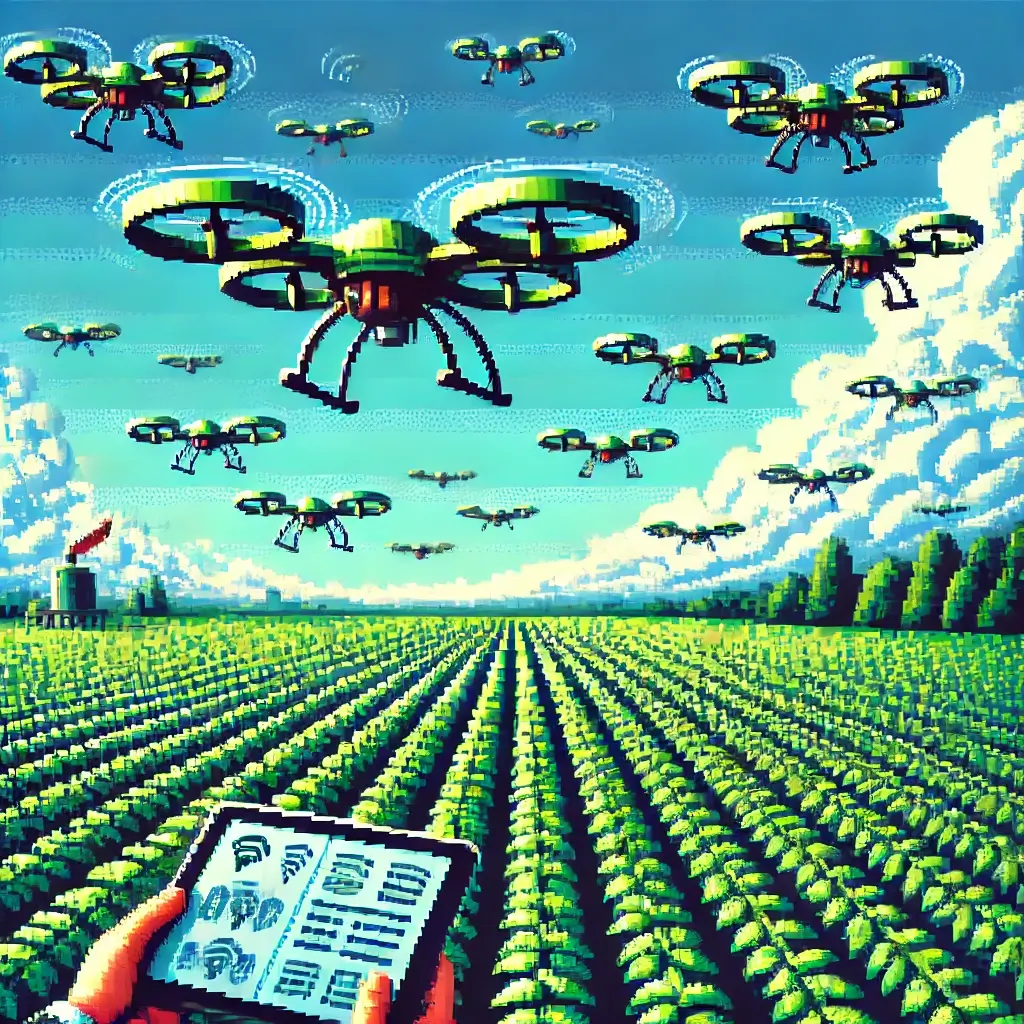
Revolutionizing Farms: 1000 Drones, Swarm Intelligence, and the Future of Agriculture!
Alright, folks, let’s talk about something truly game-changing in agriculture – and no, I’m not talking about a new super-fertilizer or a fancy tractor with satellite navigation. We’re diving deep into the world of **swarm intelligence for drone-based agricultural surveying**. It sounds like something out of a sci-fi movie, right? But trust me, it’s very real, and it’s poised to transform how we grow food on a scale we’ve never imagined.
As someone who’s spent years observing the pulse of agriculture, from the smallest family farms to vast industrial operations, I can tell you that farmers are some of the most innovative and adaptable people on the planet. They’re always looking for an edge, a way to do things better, faster, and more efficiently. And that’s exactly where drone swarms come into play. Imagine a future, not too far off, where a thousand drones, working in perfect harmony, can survey an entire farm in a fraction of the time it takes today. Sounds incredible, doesn’t it?
We’re on the cusp of a true agricultural revolution, and the driving force behind it? It’s that beautiful marriage of cutting-edge technology and the age-old need to feed the world. So, buckle up, because we’re about to explore how these buzzing little heroes are set to change everything. —
Table of Contents
—
What’s the Buzz About Drone Swarms?
Alright, let’s cut to the chase. When I say “drone swarm,” what do you picture? Is it a chaotic mess of flying robots? Or something more akin to a perfectly choreographed dance? If you’re picturing chaos, don’t worry, you’re not alone. But the reality is far more elegant and, frankly, astonishing. **Swarm intelligence** isn’t just about putting a bunch of drones in the air; it’s about making them work together, autonomously, like a colony of ants or a flock of birds.
Think about it. A single drone, while incredibly useful, can only cover so much ground at once. It’s like trying to paint a mural with a single tiny paintbrush. You’ll get there eventually, but it’ll take ages. Now, imagine if you had a hundred tiny paintbrushes, all working in concert, each knowing its role, adapting to the canvas, and communicating with the others to ensure every inch is covered efficiently. That’s the magic of a drone swarm.
These drones, equipped with advanced sensors – everything from multispectral cameras that can detect plant health issues long before the human eye can, to LiDAR for precise topographic mapping – are connected by sophisticated algorithms. They share information, coordinate their movements, and collectively build a comprehensive picture of the agricultural landscape. It’s like giving your farm its own high-tech, super-efficient survey team, available on demand. And the beauty of it is, they don’t complain about the heat or ask for coffee breaks!
The applications are mind-boggling: identifying areas of water stress, pinpointing nutrient deficiencies, tracking pest infestations, estimating crop yields, and even precisely applying pesticides or fertilizers. It’s all about getting incredibly granular data, quickly, so farmers can make informed decisions that save resources and boost productivity. This isn’t just about cool tech; it’s about smarter farming. —
Why Now? The Perfect Storm of Technology
So, why is **swarm intelligence for drone-based agricultural surveying** suddenly taking off? It’s not just one breakthrough, but a confluence of several technological advancements that have reached a tipping point. Think of it like a perfectly brewed pot of coffee – all the right ingredients, at the right temperature, coming together at the right time.
First, drones themselves have become incredibly sophisticated, affordable, and reliable. Gone are the days of clunky, difficult-to-fly contraptions. Modern agricultural drones are robust, can carry heavier payloads (like those fancy sensors), and boast impressive flight times. Battery technology has improved, and miniaturization of components means more power in smaller packages.
Second, the sensors are getting better and cheaper. Multispectral, hyperspectral, thermal, LiDAR – these once-exorbitant technologies are now becoming accessible. This means we can gather an unprecedented amount of data about the health and state of crops, soil, and water resources. It’s like giving farmers X-ray vision for their fields.
Third, and perhaps most crucially, is the exponential leap in artificial intelligence (AI) and machine learning. This is the “brain” behind the swarm. AI algorithms are what allow these drones to communicate, make collective decisions, navigate complex environments, and process the vast amounts of data they collect. Without powerful AI, a “swarm” would just be a group of individual drones flying around independently, which, while still useful, wouldn’t unlock the true power of collaborative intelligence.
Finally, connectivity – 5G and beyond – is playing a massive role. For drones to communicate seamlessly and share data in real-time, robust and high-speed networks are essential. This allows for instant processing and decision-making, turning raw data into actionable insights almost immediately. It’s all about speed and precision in a world where every second, and every drop of water, counts.
This isn’t just about having cool gadgets; it’s about having an integrated system that can deliver unprecedented levels of detail and efficiency to the agricultural sector. It’s a truly exciting time to be involved in this space! —
Benefits Galore: How Drone Swarms Are a Farmer’s Best Friend
Let’s get down to brass tacks: what’s in it for the farmer? Because at the end of the day, innovation has to solve real-world problems. And let me tell you, **swarm intelligence for drone-based agricultural surveying** offers a bounty of benefits that could make a significant difference to a farmer’s bottom line and their environmental footprint.
Unprecedented Efficiency and Speed
Imagine surveying thousands of acres in a matter of hours, not days. A single drone can only do so much, but a coordinated swarm can tackle vast areas simultaneously. This speed means farmers get critical information faster, allowing them to react to issues like disease outbreaks or water stress before they escalate. Time is money, and in farming, it’s also crop yield.
Precision Agriculture on Steroids
This isn’t just about seeing the farm; it’s about seeing it in exquisite detail. Multispectral cameras can reveal the subtle signs of plant stress long before they’re visible to the human eye. This means farmers can apply water, nutrients, or pesticides exactly where they’re needed, reducing waste and environmental impact. It’s like having a personal doctor for every single plant in your field.
Resource Optimization and Cost Savings
By pinpointing problems with incredible accuracy, farmers can significantly reduce their use of water, fertilizers, and pesticides. Less waste means lower costs, which directly impacts profitability. In an industry with tight margins, every penny saved is a penny earned. Plus, healthier plants mean higher yields and better quality produce. It’s a win-win-win!
Early Detection of Issues
Diseases, pests, and nutrient deficiencies can devastate a crop if not caught early. Drone swarms, with their constant, detailed monitoring, act as an early warning system. They can spot anomalies, track their spread, and alert farmers to potential problems before they become widespread catastrophes. This proactive approach can save entire harvests.
Improved Decision-Making with Data-Driven Insights
Farming has always been about making decisions based on experience and observation. Now, imagine having a constant stream of high-resolution data at your fingertips. Drone swarms provide actionable insights, transforming guesswork into informed strategies. This data can be used for everything from optimizing planting patterns to predicting harvest times with greater accuracy.
Reduced Human Labor and Safety Risks
Some agricultural tasks are arduous or even dangerous. Drones can take over tasks like inspecting difficult-to-reach areas or monitoring fields during extreme weather, reducing the need for human labor in potentially hazardous conditions. This frees up human workers for more skilled tasks and enhances overall safety on the farm. It’s about working smarter, not just harder.
It’s truly exciting to think about how these benefits will translate into a more sustainable, efficient, and profitable agricultural sector. The future of farming isn’t just about big machines; it’s about smart, collaborative technology. —
The Bumpy Road: Challenges and Solutions
Now, let’s be real. No revolutionary technology comes without its hurdles. While the promise of **swarm intelligence for drone-based agricultural surveying** is immense, there are definitely some bumps in the road we need to navigate. It’s like building a superhighway – you need to clear the land, lay the foundations, and address any unexpected sinkholes. But with smart planning and continued innovation, these are definitely solvable.
Regulatory Frameworks and Airspace Management
This is a big one. Imagine hundreds, or even thousands, of drones flying over vast agricultural areas. Who regulates them? How do we ensure they don’t interfere with manned aircraft or stray into restricted airspace? Current regulations often struggle to keep pace with rapid technological advancements. We need clear, concise, and adaptable legal frameworks that allow for the safe and efficient operation of drone swarms.
Solutions involve: Collaborative efforts between aviation authorities, agricultural bodies, and technology developers to establish clear guidelines. Geo-fencing technology to prevent drones from entering restricted zones, and robust air traffic management systems specifically designed for low-altitude drone operations.
Connectivity and Data Transfer
For a swarm to work effectively, constant and reliable communication between drones and a central control system is crucial. In rural agricultural areas, robust internet and cellular infrastructure can sometimes be lacking. Large data sets from high-resolution sensors also require significant bandwidth for transfer and processing.
Solutions involve: Development of dedicated mesh networks for drone-to-drone communication, utilizing satellite internet for remote areas, and edge computing to process data directly on the drones or nearby ground stations before sending only critical insights back to a central server.
Cost of Implementation and Accessibility
While drone technology is becoming more affordable, a full-fledged swarm system, including specialized sensors, AI software, and the drones themselves, represents a significant upfront investment. This can be a barrier for smaller farms or those in developing regions.
Solutions involve: Exploring “drone-as-a-service” models where farmers can lease or subscribe to swarm surveying services rather than owning the equipment outright. Government subsidies and incentives for adopting precision agriculture technologies can also help. Furthermore, modular systems that allow for gradual scaling up of operations could make it more accessible.
Cybersecurity and Data Privacy
As these systems become more interconnected and data-rich, they become potential targets for cyberattacks. Protecting sensitive agricultural data – crop yields, land values, specific vulnerabilities – is paramount. Ensuring data privacy for farmers is also a critical concern.
Solutions involve: Implementing robust encryption protocols for data transmission and storage, multi-factor authentication for system access, and regular cybersecurity audits. Legal frameworks around data ownership and usage rights must also be established to protect farmers’ interests.
Technical Complexity and Maintenance
Operating and maintaining a swarm of sophisticated drones requires technical expertise. Farmers and their staff will need training to effectively utilize these systems, interpret the data, and troubleshoot issues.
Solutions involve: User-friendly interfaces for control software, comprehensive training programs offered by manufacturers or agricultural extension services, and readily available technical support. Automated diagnostics and self-repairing capabilities in future drone designs could also simplify maintenance.
Despite these challenges, the trajectory is clear. Just like any new technology, there will be a learning curve and obstacles to overcome. But the potential rewards for global food security and environmental sustainability are too significant to ignore. The brilliant minds working on this are constantly innovating, and I’m confident we’ll see these hurdles overcome, paving the way for a truly transformed agricultural landscape. —
From Theory to Field: Real-World Impact
Enough with the theoretical talk! Let’s talk about how **swarm intelligence for drone-based agricultural surveying** is already making waves, or is very close to making waves, in the real world. This isn’t just a concept discussed in labs; it’s becoming a practical tool for farmers who are eager to embrace the future.
Picture this: a vast cornfield, miles of green stalks stretching to the horizon. Traditionally, a farmer might walk sections of it, or perhaps use a single drone to get a bird’s-eye view. But with a swarm, it’s a different ballgame. A farmer in Iowa could launch a fleet of 50 drones, each programmed to cover a specific grid section, communicating with its neighbors to ensure no overlap and no missed spots. These drones, armed with multispectral cameras, could detect early signs of a fungal infection in one corner of the field, or pinpoint areas where the irrigation system isn’t delivering enough water.
The real impact comes when that data is immediately processed and presented to the farmer in an easy-to-understand format – maybe a heat map on their tablet showing areas of concern. Based on this, they can then dispatch an autonomous ground vehicle, or even another drone, to precisely apply fungicide only to the affected area, or adjust the irrigation pivot in real-time. This saves untold amounts of chemicals, water, and most importantly, saves the crop itself from widespread damage.
Consider vineyards in California. Precision viticulture is already a thing, but a drone swarm could take it to the next level. They could map individual vine health, assess grape ripeness based on color and canopy density, and even monitor pest pressure on a vine-by-vine basis. This level of detail allows winemakers to optimize everything from pruning to harvesting, leading to higher quality wines and more efficient use of resources.
In rice paddies in Asia, where water management is critical, drone swarms could monitor water levels and detect leaks in irrigation channels with incredible accuracy, preventing water waste and ensuring optimal growing conditions. For fruit orchards, they could estimate yield by counting blossoms or developing fruits, giving growers precise data for planning harvest logistics and market supply.
These aren’t just hypotheticals. Pilot programs and research initiatives around the world are proving the immense value of this technology. Farmers who’ve participated in early trials are reporting significant improvements in efficiency and resource management. It’s a testament to human ingenuity, and it’s exciting to see this powerful technology moving from the drawing board directly into the fields where it can make a tangible difference. —
Looking Ahead: The Bright Future of Swarm Intelligence in Ag
So, what’s next for **swarm intelligence for drone-based agricultural surveying**? If you ask me, we’re just scratching the surface of what’s possible. The future looks incredibly bright, and it’s going to be packed with innovations that will make today’s solutions seem almost primitive. It’s like watching the first horseless carriages and trying to imagine a Tesla – the leap will be just as significant.
One major area of advancement will be even greater autonomy and AI integration. We’re talking about systems that can not only survey fields but also analyze the data, identify problems, and even propose solutions without constant human oversight. Imagine a swarm that detects a nutrient deficiency, cross-references it with weather data and soil analysis, and then automatically dispatches a ground robot to apply the precise amount of fertilizer needed. That’s truly next-level.
Another exciting development is multi-modal swarms. We’re not just talking about drones flying in the air. Imagine a coordinated effort between aerial drones, ground-based robots, and even subterranean sensors. The drones survey from above, the ground robots collect soil samples or apply targeted treatments, and underground sensors monitor root health and moisture levels. All of them communicating and working as one integrated system, providing an unprecedented 3D view of the farm.
We’ll also see further miniaturization and specialization of drones. Imagine tiny, almost insect-like drones that can navigate dense crop canopies to inspect individual plants up close, or even perform delicate tasks like pollination or targeted pest removal. The possibilities are truly endless.
Furthermore, the data collected by these swarms will feed into massive agricultural AI platforms, creating predictive models for crop growth, yield forecasting, and even market trends. This will allow farmers to make strategic decisions not just for the current season, but for years to come, optimizing their entire operation.
Ultimately, the goal is to create truly intelligent, self-optimizing farm ecosystems. Swarm intelligence is a cornerstone of this vision. It’s about leveraging technology to grow more food with fewer resources, ensuring food security for a growing global population, and making farming more sustainable and profitable. It’s an exciting journey, and I, for one, can’t wait to see it unfold. The fields of tomorrow will be buzzing with these incredible innovations! —
Looking to dive deeper into the world of smart agriculture and drone technology? Check out these fantastic resources:
Learn More About Agricultural Robotics
Explore Swarm Robotics Research
NASA’s View on Drones in Agriculture
Swarm Intelligence, Drone Surveying, Agricultural Technology, Precision Farming, Future of Agriculture