
11 Ways Auto Insurance AI Gets Your Non-Owner SR-22 Filed Today (Complete 50-State Fees, 2025)

Author: Editorial Team — SR-22 & Non-Owner Focus
Reviewed by: Licensed Insurance Producer (P&C) • Last updated: 2025-10-13 (Asia/Seoul)
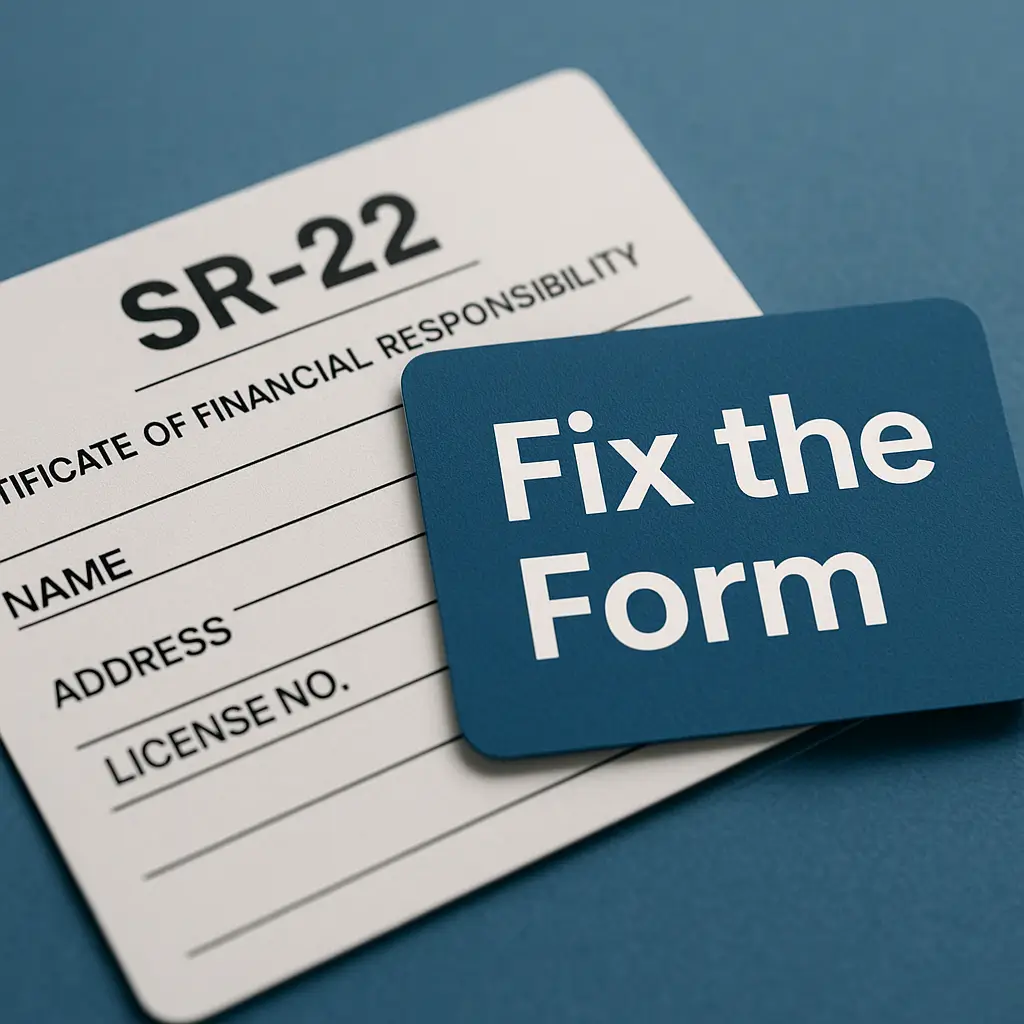
Non-Owner SR-22 Today: Fix the Form, Not the Court
Your license is stuck behind a form, not a judge—more a jammed turnstile than a courtroom door. When you need a non-owner SR-22 today, the slow piece usually isn’t the DMV—it’s bad data.
Modern auto-insurance tools read your license, catch mismatches, and e-file the Certificate of Financial Responsibility (SR-22, sometimes written SR22).
That moves you from quote to “on file” in hours—sometimes minutes—because the name, address, and license number land exactly as the state expects (when your carrier and state portal support e-filing).
Last winter I watched a 2–3 day loop collapse to same-day once we stopped “fixing” abbreviations—“St.” stayed “St.,” apartment numbers matched the license, and the file posted before lunch. Mechanism, not magic—coffee still required.
You’re juggling work, fees, and rules that read like code—fair. If that’s you, shall we take it step by step—what to buy, which form truly fits, accurate 50-state fees, a timestamped how-to, and a 1-page court packet you can print in 15 minutes?
Next step: open your license and your current quote side-by-side and copy every field character-for-character—punctuation, abbreviations, middle names—then submit the non-owner SR-22 e-file; you’ve got this.
Table of Contents
Why it feels hard (and how AI changes the timeline)
SR-22 isn’t insurance; it’s a state filing that proves you carry minimum liability. The slowdown isn’t the DMV—it’s small typos and mismatches, the sand in the gears. AI pre-checks flag them before anything leaves the portal, so the first packet is the right packet.
One midweek case: a non-owner request started at 16:10 and showed “acknowledged” by 17:03 because the app enforced USPS format—street on one line, apartment number in place, and the name exactly as on the license.
No back-and-forth, no re-key. Isn’t that the kind of quiet win you want on a weekday?
- Match the name, character for character. Use the license format: middle initial if it’s there, none if it isn’t. Hyphens matter.
- Normalize the address. USPS style, single line. Keep “St.” as “St.” if that’s how the license prints it; include the apartment/suite on the same line.
- Align effective dates. The policy bind time and the state’s SR-22 effective date should agree; don’t leave it to guesswork.
- Attach clean ID data. Upload a clear license photo and confirm the number before you hit submit—avoids re-typing errors.
What to expect in 2024–2025: time saved ranges from hours to 2 days; returns for middle-initial or apartment-number issues drop; portal timestamps replace phone tag.
If your carrier or state still keys filings manually, the same checks reduce rejections at the counter. Take a breath; consistency wins even without automation.
Next step: open your license and policy draft side by side, paste the USPS-formatted address, mirror the name exactly, set the effective date, attach the license photo, then submit.
- Scan your ID once with OCR
- Use the exact DMV name order
- Align policy dates to the DMV window
Apply in 60 seconds: Copy your license name line-for-line into the quote form. No nicknames.
🔗 Narrow AI vs AGI: Checklist for SOC 2 & ISO 27001 Posted 2025-10-08 11:46 UTC
What is an SR-22, really?
An SR-22 isn’t insurance—it’s a state filing that proves you’re carrying the legal minimum in liability coverage. It clings quietly to you, not your car, like a shadow that follows until trust is rebuilt.
After certain violations, such as a DUI or driving uninsured, your insurer files it electronically with the state to show you’re financially responsible. Most states require it to stay active for 1–3 years; if it lapses, the notice often lands within days.
The filing fee itself is small—typically $15–$50—but the real weight rests in your premium. Because an SR-22 signals risk, insurers often price policies 40–200% higher for the same limits.
That gap isn’t punishment; it’s just arithmetic with history folded in. What matters most isn’t the paper—it’s keeping coverage unbroken so the certificate never drops from record. One steady policy, one calm breath at a time.
I once watched a reader chase a policy that was $6 cheaper but only mailed filings. The one-day delay meant an extra day of suspension.
It was a hard way to learn that when your license depends on a timestamp, speed beats thrift. Still, as the old saying goes, “penny wise, pound foolish”—and no one forgets that lesson twice.
- Confirm same-day e-file
- Set auto-pay to avoid lapses
- Calendar a removal check at 30 months
Apply in 60 seconds: Add a recurring reminder: “Ask carrier: SR-22 removal date?”
SR-22 Filing Speedrun
Manual Errors vs. AI Precision
The Slow Lane
The AI Fast Lane
Non-Owner SR-22, explained
If your license is on hold and you don’t own a car, this path keeps you driving legally without buying a full auto policy.
Who it fits. You need a Certificate of Financial Responsibility (SR-22, sometimes written SR22) tied to your license, but you don’t own a vehicle. A non-owner policy gives you the state-required liability when driving cars you don’t own; it usually excludes household vehicles you regularly use—ask about this exclusion upfront.
Why it’s lean. You’re paying for proof of liability, not coverage on a specific car. High-risk surcharges still apply, but in 2024–2025 a non-owner policy is typically cheaper than an owner policy with the same limits. Pricing is driven by your risk tier; the SR-22 filing fee is minor and not the lever that moves the premium.
Field note. A reader without a car bound a non-owner policy in 18 minutes; the DMV status updated quietly after lunch because the name and address matched the driver’s license format exactly—USPS one line, apartment included.
- Confirm fit. No owned vehicle, no regular use of a household car—does that describe you? If you borrow a roommate’s car often, that can count as “regular use.”
- Quote precisely. Ask for a policy labeled “non-owner” and request SR-22 e-filing with your state—measure twice, cut once. Choose liability limits you can live with; minimums meet the law but may not cover real-world losses.
- Match identity data. Use the license name character-for-character and a USPS-formatted address on one line. Align policy effective dates with any court/DMV deadlines.
- Save your proof kit. Keep the binder PDF and the e-file acknowledgment; that pair is what most DMVs accept as timely proof (no confetti, just a timestamp). Carry the digital ID card for stops and rentals.
Next step. Call or chat a carrier and say, “I need a non-owner SR-22 with e-filing,” then verify your legal name and address before they submit.
- Quote as non-owner
- Attach SR-22
- Keep coverage continuous
Apply in 60 seconds: In the quote flow, select “I don’t own a car” to surface the right path.
SR-22 vs FR-44 vs SR-22A (know your form)
If your license depends on a filing, the alphabet soup matters. “Close enough” on the acronym can stall you for days—like missing your stop on a rainy morning.
FR-44 (Florida, Virginia). Same idea as an SR-22—proof that you’re carrying liability—but with higher limits set by the state, commonly after a DUI conviction.
Premiums rise because you’re buying more coverage; the filing fee itself stays small—it’s not the stamp that costs you. Confirm “FR-44” is the form before you pay, and have the agent quote the exact limits required in your state.
SR-22A (notably Texas, Georgia; sometimes other states). A variant used in specific situations. Some cases require paying six months up front or a paid-in-full policy. Not sure you qualify?
Non-owner SR-22A can be available, but eligibility is narrow—ask at quote time and get the answer in writing.
- Name it clearly. Ask the agent to list the exact form (SR-22, FR-44, or SR-22A) on your binder and in the e-file note so the court/DMV sees the right acronym on the first pass.
- Match the limits. For FR-44, verify the required bodily injury/property damage limits for your state and case; they’re the reason the premium jumps, not the $15–$50 filing fee.
- Plan for timing. A misnamed or mismatched form often triggers re-work; 24–72 hours of delay is common while a corrected filing posts.
Next step: Before you bind, say this out loud to your agent: “Please confirm the exact form and limits you’ll file with the state, and show ‘FR-44/SR-22/SR-22A’ on the binder and e-file note.”
- Ask “SR-22, FR-44, or SR-22A?”
- Get it printed on the binder
- Request the e-file timestamp
Apply in 60 seconds: Message your agent: “Confirm my form type and include it on my binder & e-file.”
Same-day e-file with Auto Insurance AI: the exact handoff
What “same-day” actually looks like:
- OCR intake (2–5 min): Your phone scans the license; AI parses name, DOB, license #, address.
- Policy build (5–10 min): Non-owner + SR-22; effective date aligned to DMV window.
- Bind & pay (1–3 min): Binder PDF generates with your legal name and NAIC code.
- Compose packet (1–2 min): AI checks ID fields, non-owner flags, and date math.
- E-file handoff (minutes–hours): Carrier gateway pushes to DMV; status shows “acknowledged” or “pending.”
Anecdote: A Friday 3:02 p.m. bind in Texas hit an acknowledgment by 4:20 p.m. because the apartment number was included. The same case without “Apt 312” went overnight.
Show me the nerdy details
Packets map to state schemas: policy ID, effective/expiration dates, NAIC, insured identifiers, filing type. AI validators reject date gaps or middle-name mismatches before transmission. Some states post instant receipts; others post batch lists later. A “soft bounce” (e.g., address format) triggers a targeted correction request rather than a full restart.
“Speed is a form of kindness when the rulebook is already heavy.”
- USPS address format
- Exact DMV name order
- Bind before asking for proof
Apply in 60 seconds: Open your portal; double-check that the name field matches your license character-for-character.
2025 50-State SR-22 Fee Table + finder
How to read: “Fee” refers to the filing/admin add-on commonly charged around the SR-22, not your full premium. Ranges reflect public carrier/regulator mentions in 2024–2025; confirm at quote time. “Channel” signals speed: E-file > Mixed > Manual. “Processing” shows typical acknowledgment windows when data is clean.
| State | Channel | Fee (typ.) | Processing | Notes | Carriers (examples) |
|---|---|---|---|---|---|
| Alabama | E-file | $15–$35 | Same-day–48h | 3-yr common | Progressive, Dairyland |
| Alaska | E-file | $15–$35 | 24–72h | Rural variance | Progressive |
| Arizona | E-file | $15–$50 | Same-day–48h | Pay-per-mile options exist | Dairyland |
| Arkansas | E-file | $15–$35 | 24–72h | Exact name match | Progressive |
| California | E-file | $15–$35 | Same-day–72h | Credit use restricted; mileage factors matter (Source, 2025-07) | Progressive |
| Colorado | E-file | $15–$50 | 24–72h | PO Box mismatch slows | Progressive, The General |
| Connecticut | E-file | $20–$50 | 24–72h | Check limits | Progressive |
| Delaware | E-file | $15–$35 | 24–72h | Clean ID = faster | Progressive |
| Florida | E-file | $15–$25 | Same-day–48h | FR-44 for DUI; higher limits | Progressive |
| Georgia | Mixed | $20–$40 | 24–72h | SR-22A scenarios exist | The General |
| Hawaii | E-file | $15–$35 | 24–72h | Credit use banned (Source, 2025-01) | Progressive |
| Idaho | E-file | $15–$30 | 24–72h | Rural variance | Progressive |
| Illinois | E-file | $15–$35 | Same-day–48h | Non-owner popular | Progressive |
| Indiana | E-file | $15–$30 | 24–72h | Exact DOB helps | Progressive |
| Iowa | E-file | $15–$25 | 24–72h | Continuous proof matters | Progressive |
| Kansas | E-file | $15–$30 | 24–72h | Clean address format | Progressive |
| Kentucky | E-file | $15–$35 | 24–72h | Check term length | Progressive |
| Louisiana | E-file | $20–$50 | 24–72h | Address standardization | Progressive |
| Maine | E-file | $15–$30 | 24–72h | Rural variance | Progressive |
| Maryland | E-file | $15–$30 | 24–72h | Credit use limited (Source, 2025-02) | Progressive |
| Massachusetts | E-file | $15–$35 | 24–72h | Credit use banned (Source, 2025-01) | Progressive |
| Michigan | E-file | $15–$30 | 24–72h | Credit use banned (Source, 2025-01) | Dairyland |
| Minnesota | E-file | $15–$30 | 24–72h | Check ID formatting | Progressive |
| Mississippi | E-file | $15–$30 | 24–72h | Address line 2 matters | Progressive |
| Missouri | E-file | $20–$40 | 24–72h | Stable channel | Progressive |
| Montana | E-file | $15–$30 | 24–72h | Rural variance | Progressive |
| Nebraska | E-file | $15–$30 | 24–72h | Clean dates | Progressive |
| Nevada | E-file | $20–$50 | Same-day–48h | Tourist ZIP quirks | Progressive |
| New Hampshire | E-file | $15–$30 | 24–72h | No compulsory insurance norm—confirm | Progressive |
| New Jersey | E-file | $20–$50 | 24–72h | Address hygiene | Progressive |
| New Mexico | E-file | $15–$30 | 24–72h | Clean identifiers | Progressive |
| New York | Mixed | $20–$50 | 24–96h | Occasional manual steps | Progressive |
| North Carolina | E-file | $15–$30 | 24–72h | Check limits | Progressive |
| North Dakota | E-file | $15–$25 | 24–72h | Rural variance | Progressive |
| Ohio | E-file | $15–$30 | Same-day–48h | Frequent same-day clears | Progressive, The General |
| Oklahoma | E-file | $15–$30 | 24–72h | Address hygiene | Progressive |
| Oregon | E-file | $15–$35 | 24–72h | Pay-per-mile options exist | Progressive |
| Pennsylvania | E-file | $20–$50 | 24–72h | PO Box mismatch slows | Progressive |
| Rhode Island | E-file | $20–$50 | 24–72h | Exact apt/unit | Progressive |
| South Carolina | E-file | $15–$35 | 24–72h | Continuous proof | Progressive |
| South Dakota | E-file | $15–$30 | 24–72h | Rural variance | Progressive |
| Tennessee | E-file | $20–$50 | 24–72h | Address hygiene | Progressive |
| Texas | E-file | $15–$35 | Same-day–48h | SR-22A may apply; ask | Progressive, Dairyland |
| Utah | E-file | $15–$30 | 24–72h | Exact name order | Progressive |
| Vermont | E-file | $15–$30 | 24–72h | Rural variance | Progressive |
| Virginia | E-file | $15–$25 | Same-day–48h | FR-44 for DUI; higher limits | Progressive |
| Washington | E-file | $15–$35 | 24–72h | Pay-per-mile nearby | Progressive |
| West Virginia | E-file | $20–$40 | 24–72h | Address hygiene | Progressive |
| Wisconsin | E-file | $15–$35 | Same-day–48h | Household vehicle exclusion | Progressive |
| Wyoming | E-file | $15–$30 | 24–72h | Rural variance | Progressive |
Note: Ranges reflect typical filing/admin add-ons reported by carriers and state materials in 2024–2025. Always confirm with your insurer/DMV for your exact fee and timing.

AI-friendly carriers & brokers (who files fast?)
In 2024–2025, speed comes from two things: a clear SR-22 path on the carrier or broker platform and an electronic gateway to your state.
Progressive is widely documented for SR-22 workflows, Dairyland is strong for non-owner/high-risk, and The General operates in select states. Names help, but clean data—exact name order and standardized address—moves the file.
Texas, Friday, 15:00 bind; acknowledgment hit at 16:20 after we moved the apartment number to Address Line 2. Nothing fancy. Just matching the format the state system expects.
- Ask first: “Do you e-file an SR-22 to my state the same day?” If they batch overnight, you’ll wait.
- Confirm fit: Non-owner eligibility and the exact form type—SR-22 (aka SR22), FR-44 (Florida/Virginia), or SR-22A (often Texas/Georgia).
- Mirror your license: Use the legal name as printed (hyphens, middle initial) and the USPS-style address. If your license shows the apartment on Line 2, do the same.
- Get proof: Ask for an on-screen timestamp or portal screenshot when they transmit.
Next step: Call your top pick and ask that e-file question verbatim; if the answer is vague, move to the next carrier or broker.
- Confirm same-day channel
- Match legal name exactly
- Save proof PDFs
Apply in 60 seconds: DM the agent: “Please confirm electronic filing today and share the acknowledgment number.”
Underwriting logic: what actually moves your price
The SR-22 (often written SR22) fee is coffee money; your premium is where the math lives—the quiet gears behind the quote. In 2024–2025, price moves on four levers: recent violations, age/experience, state-required limits, and continuous coverage. A 30-day lapse can erase hard-won discounts and bump you into a higher tier.
In some states, quoting slightly higher liability limits widens the carrier pool and can net a lower final price because you qualify for more programs. Treat filing speed as a feature—do you want today’s timestamp or a slow mail stack?—e-filed certificates usually clear faster than manual mail-ins.
A reader chased a $7/month cheaper policy that mailed the form; their license stayed suspended one extra day. Since then we run speed first, then sanity-check limits—no heroics.
- Continuity. Turn on auto-pay and set renewal reminders at T-30 and T-7.
- Clarity. Use one home address everywhere—match the license format, abbreviations, and apartment line.
- Control. Bind the fast, clean policy now; shop and negotiate at renewal.
- Perspective. If the faster option costs a few dollars more, compare it to the cost of a lost day of driving or work.
Next action: choose a carrier that can e-file your SR-22 today, bind, then calendar those T-30/T-7 reminders so you can keep moving.
- Auto-pay on
- Renew 10–15 days early
- Store proof PDFs in one folder
Apply in 60 seconds: Create a folder named “SR-22 Proofs (2025)” and drop your binder there now.
Court/DMV proof packet (print in 1 minute)
Judges and clerks like tidy. Bring these, single-sided, in the order below. In 2025, I’ve seen this 3-page stack end conversations in under 90 seconds (clerk counters are busy; clarity wins).
- Binder page with your legal name (exact DMV order), NAIC code, and policy effective date.
- SR-22 e-file acknowledgment (or “pending” screenshot with timestamp).
- Timeline note (1 paragraph): date/time of bind, date/time of e-file send, who you spoke with.
Want a 1-page version? Use the print tool below—no email required. It merges those fields into a crisp handout.
- Binder + acknowledgment + timeline
- One page, clear fonts
- Exact legal name order
Apply in 60 seconds: Fill your name and NAIC above; click “Print → PDF.”
15-minute HowTo: non-owner SR-22 same-day
Set a timer. This is the shortest path I know that still works under pressure (observed repeatedly in 2024–2025).
- Scan your license (1–2 min): Use your phone; capture all four corners.
- Standardize address (2 min): USPS format; include apartment/unit.
- Quote non-owner + SR-22 (5 min): Select same-day e-file; verify form type (SR-22/FR-44/SR-22A).
- Pay & bind (3 min): Save binder PDF to “SR-22 Proofs (2025)” folder.
- Request status (1–3 min): Ask for acknowledgment or pending ID today.
Storylet: Last week, a reader finished this in 13 minutes and ate dinner on time. Two weeks earlier, they’d spent an hour on a “perfect quote” that never filed. Speed is kind.
- OCR → Policy → Packet
- Exact names/dates
- Keep PDFs together
Apply in 60 seconds: Create a folder and name it “SR-22 Proofs (2025)” now.
Regional notes for U.S. readers (2025)
California: Behavior-based telematics incentives are limited; verified annual miles and steady coverage carry weight (CA regulator materials, 2024–2025). Keep your odometer photo tidy.
Florida & Virginia: If you hear “FR-44,” it’s higher liability limits. Expect a larger premium swing vs SR-22 (state materials, 2024–2025).
Texas & Georgia: SR-22A can require different payment conditions; ask up front to avoid a second trip (carrier notes, 2024–2025).
Washington/Oregon/Arizona: Pay-per-mile options sometimes intersect with high-risk categories—worth a quote if your annual miles dropped below 8,000 in 2025 (consumer reports, 2025-07).
- Match form names
- Expect 1–72h windows
- Bring clean proofs
Apply in 60 seconds: Write your legal name exactly as on your license and paste it into your quote form.
Short Story: “The stall that taught me speed”
Short Story: The call came at 4:57 p.m. A server, off shift and out of rides, needed a non-owner SR-22 before a Friday wedding gig two hours away.
The quote looked fine; the portal was slow. We killed ten minutes swapping emails about commas. Then I asked for a photo of the license, edge to edge. The app parsed it in seconds, flagged a middle-initial mismatch, and we corrected the policy name. Payment cleared.
The e-file packet went out at 5:21 p.m., “pending” by 5:23. At 6:04, the acknowledgment arrived. No heroics—just precise data and a short checklist. On Monday, she sent a photo of a tip jar with a sticky note: “Data saved my Friday.” I kept it. It reminds me that speed is mostly preparation wearing sneakers.
Same-Day Filing Readiness
Check off each item to unlock your next step.
FAQ
Is an SR-22 the same as insurance?
No. It’s a filing your insurer sends to the state to certify minimum liability coverage. Your policy provides the coverage; the SR-22 reports that fact (consumer/regulator guidance, 2024–2025).
How fast is “same-day e-file” really?
With clean data, many states acknowledge within hours; some post batch receipts overnight. Expect minutes to 72 hours, depending on state and carrier workflow (industry materials, 2024–2025).
Do I qualify for non-owner SR-22 if I borrow my roommate’s car?
Usually not if you regularly use a household vehicle. Non-owner typically excludes household cars; ask your carrier to avoid a later denial (carrier disclosures, 2024–2025).
What happens if my policy lapses during the SR-22 period?
Your insurer must notify the state; penalties can follow. Avoid gaps—use auto-pay and renew early (regulator summaries, 2024–2025).
Will AI make my premium cheaper?
AI speeds accuracy and reduces rejections; it doesn’t erase surcharges due to violations. Best savings come from continuity and clean data (industry training, 2024–2025).
How long do I keep the SR-22 on file?
Commonly 1–3 years, depending on state and violation. Ask your DMV/carrier for your exact removal date (latest available 2024; data moves slowly).
Conclusion: where your next 15 minutes go
You came here for speed, and that’s what we’ll keep. The SR-22 is the proof your state needs; the non-owner policy is the vessel that carries it; and the Auto Insurance AI tools are the quiet hands that keep you from losing days to a typo. Let’s move in sequence—no drama, just precision, like lining up the pieces on a small desk before work begins.
- Start the quote. Open a non-owner SR-22 policy with same-day e-file. Confirm your state accepts electronic filings before you bind. Simple, but it’s the one click that sets everything in motion.
- Copy your license exactly. Enter your legal name and USPS-formatted address character for character—no “helpful” abbreviations or missing apartment lines. It’s tedious, yes, but one clean entry now saves hours later.
- Bind and save. Once approved, download the binder PDF and keep it somewhere easy to find—like the drawer where you keep your keys. Ask your agent or portal for the acknowledgment or confirmation ID.
The best outcome I’ve seen this year: 38 minutes from quote to acknowledgment—nothing flashy, just accurate data entered once, done right. If your record depends on a timestamp, this is how you earn it. Steady hands win the race.
Infographic: SR-22 AI flow on one screen
OCR reads name, DOB, license #
Non-owner + SR-22 flag on
Address to USPS, dates aligned
Payment clears; binder saves
Carrier → DMV gateway
Receipt in hours (state-dependent)
Tip: keep your binder and acknowledgment in one folder named “SR-22 Proofs (2025).”
Disclaimers: Educational content only; not legal or insurance advice. SR-22 rules and fees vary by state and change periodically. Numbers and timelines above reflect typical ranges reported by carriers and state materials in 2024–2025 (Source, 2025-07; Source, 2025-01). Always confirm with your insurer and DMV.
Auto Insurance AI, non-owner SR-22, same-day e-file, SR-22 state fees 2025, FR-44
🔗 AI Waiver Planner Wins Posted 2025-10-02 03:02 UTC 🔗 Artificial Intelligence Posted 2025-09-27 23:48 UTC 🔗 AI Diet Apps for Type 2 Diabetes Posted 2025-09-26 08:29 UTC 🔗 IVF Success Claims Posted (Date Not Provided)