
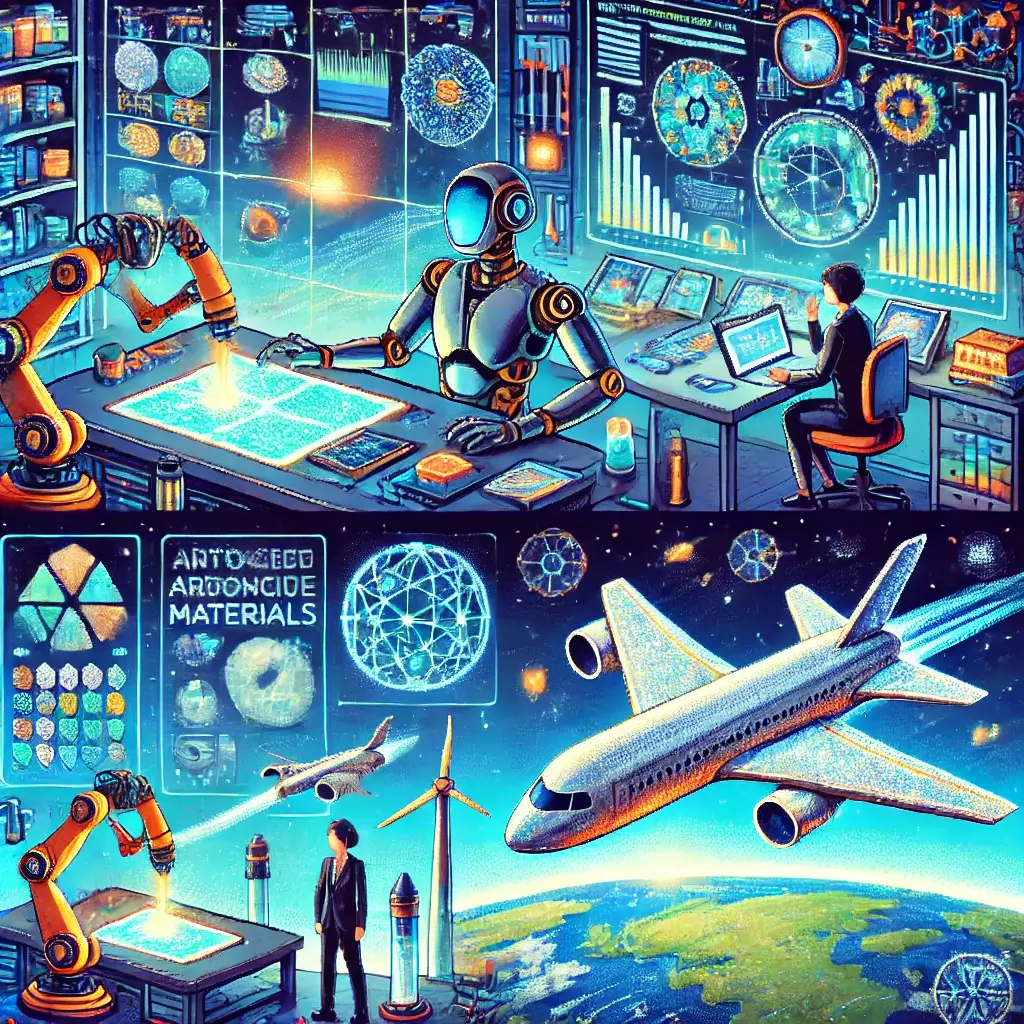
AI: The 1-Way Ticket to Aerospace Material Revolution!
Have you ever looked up at a plane soaring gracefully across the sky and wondered what marvels of engineering keep it up there?
It’s not just the engines or the wings; it’s also the very materials they’re made of.
For decades, aerospace engineers have been pushing the boundaries of what’s possible, painstakingly designing and testing materials to withstand extreme temperatures, immense pressures, and relentless fatigue.
But what if I told you there’s a new co-pilot in this design journey, one that’s accelerating innovation at an unprecedented pace?
Yes, you guessed it: Artificial Intelligence (AI) is here, and it’s not just flying the plane; it’s fundamentally changing how we design the very fabric of aerospace.
It’s like giving a seasoned alchemist a supercomputer – the results are truly mind-blowing! —
Table of Contents
—
The Old Way: A Tough Flight
Let’s take a quick trip down memory lane, shall we?
Before AI became the buzzword it is today, material design in aerospace was, to put it mildly, a marathon, not a sprint.
Imagine a team of brilliant engineers, hunched over their desks, poring over complex equations, performing countless simulations, and then, the moment of truth: physical testing.
This wasn’t just a quick trip to the lab; it involved creating prototypes, subjecting them to extreme conditions in specialized facilities, and meticulously analyzing every crack, every deformation, every stress point.
It was a process of trial and error, often taking years, sometimes even a decade, to bring a new, high-performance material from concept to flight-ready reality.
Think about it: the sheer cost, the time, the resources, all dedicated to finding that one perfect alloy or composite that could shave off a few pounds, withstand a few more degrees of heat, or last a few more thousand flight hours.
And then, once you found it, scaling up production was another beast entirely.
It’s like trying to find a needle in a haystack, blindfolded, while someone occasionally throws more hay at you.
Effective, yes, but incredibly slow and resource-intensive.
This traditional approach, while highly effective in producing the incredible aircraft we see today, had its inherent limitations.
The sheer volume of potential material combinations is astronomical – far too vast for human minds, even the most brilliant ones, to explore exhaustively.
This meant that often, engineers had to rely on intuition, experience, and incremental improvements, rather than truly revolutionary leaps.
They were often limited by the tools at their disposal, performing calculations by hand or with relatively simple computer models that couldn’t possibly account for every variable.
The material discovery process was more akin to an archaeological dig than a high-speed data analysis.
Each discovery was a treasure, but finding it was a painstaking effort.
This isn’t to say the old ways were bad – far from it!
They got us to where we are today, safely flying billions of passengers every year.
But like any good engineer, we’re always looking for ways to do things better, faster, and more efficiently.
And that, my friends, is where AI steps in, offering a whole new paradigm for material innovation. —
Why AI is the Secret Sauce for Aerospace Materials
So, why is AI suddenly the darling of aerospace material design?
It’s not magic, though sometimes it feels pretty close.
It’s about AI’s unparalleled ability to process, analyze, and learn from vast datasets at speeds and scales that would make any human engineer’s head spin.
Think of AI as the ultimate data scientist, but one that can also predict the future with remarkable accuracy, based on patterns it identifies from the past.
Here’s the breakdown of why AI is becoming indispensable in this high-stakes field:
1. Supercharged Data Analysis
Aerospace generates mountains of data – from experimental results and simulation outputs to manufacturing parameters and in-service performance.
Traditional methods struggle to connect all these dots effectively.
AI algorithms, particularly machine learning models, thrive on this complexity.
They can sift through terabytes of information, identify subtle correlations, and uncover hidden trends that would be impossible for humans to spot.
It’s like having a team of a thousand expert analysts working around the clock, never getting tired, and never missing a beat.
They can analyze how minor variations in a material’s composition affect its fatigue life, or how different manufacturing processes influence its strength-to-weight ratio.
2. Accelerated Design & Discovery Cycles
Remember those years of trial and error?
AI slashes that time dramatically.
Instead of physically testing hundreds or thousands of material variations, AI can simulate their properties with incredible precision.
This means engineers can rapidly explore a much wider design space, identifying promising candidates in a fraction of the time.
AI can predict how a new alloy will behave under extreme stress or at cryogenic temperatures even before it’s manufactured.
This predictive capability significantly reduces the need for costly and time-consuming physical experiments, accelerating the entire design-to-deployment pipeline.
It’s like having a crystal ball that actually works, showing you the optimal material before you even pour the first molten metal.
3. Optimized Material Performance
Aerospace materials need to be strong yet light, heat-resistant yet flexible, durable yet cost-effective.
These are often conflicting requirements, and finding the perfect balance is a monumental challenge.
AI uses advanced optimization algorithms to find that sweet spot.
It can suggest novel material compositions or microstructures that possess a combination of properties previously thought impossible.
For example, AI might propose a new composite layup that provides superior stiffness for a wing while simultaneously reducing its weight, leading to better fuel efficiency and lower emissions.
This isn’t just about incremental improvements; it’s about discovering entirely new classes of materials tailored precisely to the demands of aerospace.
4. Predictive Maintenance & Longevity
Beyond design, AI also plays a crucial role in the lifecycle management of materials.
By analyzing sensor data from in-service aircraft, AI can predict when a material might begin to degrade or fatigue.
This allows for proactive maintenance, preventing costly failures and significantly enhancing safety.
Imagine an AI system monitoring the health of an aircraft’s landing gear, detecting microscopic cracks invisible to the human eye, and alerting maintenance crews before any serious issue arises.
This extends the operational life of aircraft components, reducing downtime and maintenance costs, which is a massive win for airlines and passengers alike.
5. Generative Design and Novel Materials
Perhaps one of the most exciting aspects is AI’s ability to engage in “generative design.”
Instead of just analyzing existing data, AI can *generate* entirely new material structures or designs from scratch, based on specified performance criteria.
This can lead to materials with unprecedented properties, like ultra-lightweight lattice structures for fuselage components or new heat-shielding ceramics for hypersonic vehicles.
It’s like handing a blank canvas to an artistic genius, but instead of paint, they’re using atoms and molecules to create functional masterpieces.
This is where true breakthroughs happen, moving beyond incremental improvements to entirely new paradigms of material science.
The integration of AI isn’t just making existing processes faster; it’s enabling us to ask and answer questions that were previously out of reach, opening up a universe of possibilities for the future of flight. —
AI in Action: Real-World Wonders of AI for Aerospace
Alright, enough with the theoretical talk!
Let’s get down to the brass tacks and see how AI is actually making waves in the real world of aerospace material design.
These aren’t just futuristic pipe dreams; these are tangible, impactful applications that are shaping the next generation of aircraft.
1. Designing Next-Gen Alloys and Composites
One of the most significant areas where AI shines is in the discovery and optimization of new alloys and composite materials.
Traditional alloy design is notoriously complex due to the vast number of possible element combinations and processing parameters.
AI-driven computational materials design platforms can predict the properties of millions of hypothetical alloys, significantly narrowing down the candidates for experimental validation.
For instance, companies are using AI to design new lightweight aluminum alloys that retain strength at higher temperatures, or advanced titanium alloys with improved fatigue resistance.
In composites, AI helps engineers optimize fiber orientation, matrix composition, and curing processes to achieve maximum strength-to-weight ratios for components like wing spars and fuselage sections.
This is like having a super-chemist who can tell you the perfect recipe for a new material, right down to the atom.
2. Predictive Manufacturing Processes
It’s not enough to design a great material; you also need to manufacture it consistently and efficiently.
AI is proving invaluable in optimizing manufacturing processes, especially for advanced techniques like additive manufacturing (3D printing).
By analyzing data from printing parameters (laser power, powder bed temperature, scan speed), AI models can predict potential defects, optimize build strategies, and ensure the final printed part meets stringent aerospace quality standards.
This means less waste, faster production times, and higher reliability, which is critical when you’re building parts that will fly at 30,000 feet.
Think of it as having an intelligent quality control expert overseeing every single step of the production line.
3. Enhancing Material Characterization and Testing
Material testing is a cornerstone of aerospace safety, but it can be slow and expensive.
AI is streamlining this process.
For example, AI-powered image analysis can quickly and accurately detect microscopic flaws in materials from X-ray or ultrasonic scans, far surpassing the speed and consistency of human inspection.
Machine learning models can also be trained on experimental data to predict material behavior under various loading conditions, reducing the number of destructive tests required.
This not only saves time and money but also allows for a more comprehensive understanding of material performance under stress.
It’s like having a superhuman pair of eyes and an expert brain analyzing every single piece of material that goes into an aircraft.
4. Smart Structures and Self-Healing Materials
This is where things start to sound like science fiction, but it’s becoming science fact thanks to AI.
Researchers are exploring “smart structures” embedded with sensors that constantly monitor their own structural integrity.
AI algorithms process this sensor data, identifying potential damage or areas of high stress in real-time.
Even more fascinating is the concept of “self-healing materials.”
Imagine an aircraft wing that can automatically repair micro-cracks as they form, extending its lifespan and reducing maintenance needs.
AI is crucial in designing these materials and controlling the self-healing mechanisms, ensuring they activate precisely when and where needed.
This isn’t just about preventing failure; it’s about creating components that are inherently more resilient and autonomous.
It’s like giving an airplane a built-in doctor that can perform minor surgeries on itself in mid-air.
5. Sustainable Material Solutions
The aerospace industry is under increasing pressure to reduce its environmental footprint.
AI can contribute significantly to this goal by helping design more sustainable materials.
This includes optimizing materials for recyclability, reducing the use of hazardous substances, and finding ways to manufacture components with less energy consumption and waste.
For example, AI can analyze the life cycle assessment data of different materials and manufacturing processes to identify the most environmentally friendly options, from raw material extraction to end-of-life disposal.
This leads to greener aircraft and a more sustainable future for aviation.
It’s about making flight cleaner, not just faster or stronger.
These real-world applications demonstrate that AI isn’t just a fancy tool; it’s an essential partner in pushing the boundaries of what’s possible in aerospace material design.
The innovations we’re seeing today are just the tip of the iceberg, and the sky truly is the limit!
Want to dive deeper into some of these cutting-edge developments? Check out these resources:
—
The Future is Now: What to Expect from AI in Aerospace Materials
If you thought the current applications of AI in aerospace material design were impressive, just wait until you see what’s on the horizon.
The pace of innovation is accelerating, and AI is poised to unlock capabilities that were once confined to the wildest dreams of science fiction writers.
We’re not just talking about incremental improvements anymore; we’re talking about a paradigm shift that will redefine what’s possible in the skies above us.
1. Fully Autonomous Material Design Laboratories
Imagine a lab where AI isn’t just suggesting materials, but actually designing, synthesizing, and testing them with minimal human intervention.
We’re moving towards “self-driving” laboratories where robots, guided by AI, can conduct experiments, analyze results, and iteratively refine material compositions and processing parameters.
This would dramatically compress the material discovery timeline from years to mere weeks or even days.
Picture an AI agent setting up a 3D printer to create a novel alloy, then testing its tensile strength, and finally, based on those results, adjusting the alloy’s composition for the next iteration, all without a human pressing a single button.
It’s like having an entire research and development department running on autopilot, 24/7.
2. Materials Tailored for Extreme Environments
As we push the boundaries of flight – think hypersonic travel, reusable rockets, and even Mars missions – materials will need to withstand unprecedented conditions: unimaginable speeds, extreme temperatures, and intense radiation.
AI will be crucial in designing materials for these next-generation applications.
We’re talking about AI-designed ceramics that can survive reentry from orbit, alloys that maintain structural integrity at thousands of degrees Celsius, or composites that can resist the harsh radiation environment of deep space.
AI can explore the vast, complex design spaces of these ultra-performance materials, discovering combinations and structures that human intuition alone might never conceive.
This isn’t just about making stronger materials; it’s about creating materials that enable entirely new forms of transportation and exploration.
3. Hyper-Personalized Aerospace Components
While aircraft are mass-produced, each component still has specific requirements.
With AI and advanced manufacturing, we could see an era of hyper-personalized components.
Imagine an AI designing a specific bracket for a particular section of an aircraft, optimizing its geometry and material composition down to the molecular level, based on its exact load requirements, environmental exposure, and intended lifespan.
This would result in components that are not only lighter and stronger but also perfectly suited for their role, leading to further efficiency gains and reduced material waste.
It’s like having a master tailor create a custom-fitted suit for every single part of an aircraft.
4. Integrated Design Across Scales (Atom to Aircraft)
Currently, material design often happens somewhat separately from component design, and component design from full aircraft design.
AI promises to bridge these gaps, enabling truly integrated design.
Imagine an AI system that can optimize a material’s atomic structure, simulate how it will behave as part of a wing, and then analyze the performance of that wing as part of an entire aircraft – all within a single, interconnected digital environment.
This holistic approach will lead to breakthroughs in efficiency, safety, and performance that are simply not possible with current siloed design methodologies.
It’s like conducting a symphony where every instrument, every note, and every musician is perfectly harmonized for maximum impact.
5. Ethical AI and Transparent Design
As AI becomes more integral, ensuring its ethical use and transparency will be paramount.
Future developments will likely focus on “explainable AI” (XAI) models that can not only provide optimal material designs but also explain *why* they made those choices.
This is crucial for aerospace, where safety and certification require deep understanding and accountability.
Engineers will need to trust the AI’s recommendations, and XAI will provide the necessary insights to build that trust.
It’s about making sure that as AI gets smarter, it also gets more transparent and accountable, reinforcing human oversight rather than replacing it.
The future of aerospace materials, powered by AI, promises a world where aircraft are lighter, stronger, safer, and more sustainable than ever before.
We’re standing at the precipice of an exciting new era, and AI is definitely leading the charge. —
Challenges and The Human Touch in AI Aerospace Innovation
Now, I know what you might be thinking: Is AI going to take over everything?
Are engineers going to be out of a job?
Hold your horses!
While AI is an incredibly powerful tool, it’s not a magic bullet, and it certainly doesn’t mean the end of human ingenuity in aerospace.
In fact, it elevates the human role, shifting it from tedious calculation to strategic oversight and creative problem-solving.
However, like any groundbreaking technology, there are challenges we need to navigate.
1. Data, Data, Data (and Quality!)
AI models are only as good as the data they’re trained on.
For aerospace materials, this means needing massive, high-quality, and meticulously curated datasets.
Think about it: material properties vary subtly with manufacturing conditions, environmental factors, and test methods.
Collecting, cleaning, and standardizing this data from diverse sources – old lab notebooks, modern sensor readings, simulation outputs – is a monumental task.
A single bad data point can throw an AI model off track, leading to flawed predictions.
It’s like trying to teach a prodigy musician with out-of-tune instruments – they might still be brilliant, but their performance will suffer.
Ensuring data integrity and comprehensive coverage is a continuous challenge.
2. The “Black Box” Problem
Many powerful AI models, especially deep learning networks, can be opaque.
They might give you an excellent prediction, but it’s often difficult to understand *how* they arrived at that conclusion.
In aerospace, where safety is paramount and every design decision needs rigorous justification for certification, this “black box” problem is a significant hurdle.
Engineers need to understand the underlying physics and material science principles behind an AI’s recommendation, not just blindly accept it.
This is why research into explainable AI (XAI) is so crucial, allowing us to peek inside the AI’s thought process and build trust in its outputs.
It’s like trusting a highly intelligent, but incredibly secretive, chef with your five-star meal – you know it’s good, but you really want the recipe!
3. Integration with Existing Workflows
Aerospace engineering is a mature field with established design, simulation, and manufacturing workflows.
Integrating AI seamlessly into these complex ecosystems requires significant effort, investment, and a willingness to adapt.
It’s not just about plugging in a new software; it’s about rethinking entire processes, training personnel, and ensuring interoperability between different systems.
This transition takes time, resources, and a strong commitment from industry leaders.
It’s like trying to introduce a super-fast bullet train onto an old, existing railway network – you need to upgrade the tracks and signals first.
4. Validation and Certification
Before any new material or component can be used in an aircraft, it must undergo rigorous validation and certification processes by regulatory bodies.
Introducing AI into the design loop adds another layer of complexity to this already stringent process.
How do you certify an AI-designed material?
What level of human oversight is required?
These are questions that regulators, engineers, and AI developers are actively working to answer.
Establishing robust methodologies for validating AI’s output and building confidence in its predictions will be key to widespread adoption.
It’s a dance between innovation and regulation, ensuring that speed doesn’t compromise safety.
5. The Indispensable Human Element
Despite all its prowess, AI lacks human intuition, creativity, and the ability to handle truly novel, unforeseen situations without prior training.
Engineers provide the crucial context, define the problems, interpret the AI’s output, and make the ultimate decisions.
AI is a powerful assistant, not a replacement.
It takes away the mundane, repetitive tasks, freeing up engineers to focus on higher-level problem-solving, strategic thinking, and pushing the boundaries of what’s possible.
The future of aerospace material design is not about AI versus humans; it’s about AI *with* humans, forging a powerful partnership that drives unprecedented innovation.
It’s about amplifying human intelligence, not replacing it.
So, rest assured, the human touch, with its unique blend of experience, creativity, and critical thinking, remains absolutely indispensable in this exciting new era of AI-driven aerospace innovation. —
Beyond the Horizon: The Ultimate Impact of AI on Aerospace Engineering
As we gaze further into the future, the integration of AI into aerospace material design isn’t just about optimizing existing processes or creating slightly better parts.
It’s about fundamentally transforming the entire landscape of aerospace engineering.
The ripple effects will extend far beyond the materials lab, influencing everything from the very concept of an aircraft to how it’s manufactured, maintained, and ultimately, how it performs throughout its lifespan.
1. Redefining Aircraft Design Paradigms
Imagine a world where aircraft designs are not constrained by the limitations of existing materials.
Instead, AI co-designs the material *simultaneously* with the aircraft’s structure.
This means engineers could design a wing, for instance, and the AI would then generate the optimal material, tailored specifically for every stress point, thermal zone, and aerodynamic requirement of that particular wing.
This holistic, generative approach could lead to radically new aircraft architectures – designs that are lighter, more aerodynamic, and more fuel-efficient than anything we’ve seen before.
Think of a future where aircraft look vastly different, optimized not just for flight, but also for their very molecular composition.
It’s like moving from building with pre-made LEGOs to being able to invent new types of LEGOs tailored for each specific part of your creation.
2. Enhanced Safety and Reliability Beyond Current Standards
With AI-designed and monitored materials, the level of safety and reliability in aerospace will reach unprecedented heights.
AI’s ability to predict material degradation, identify micro-defects during manufacturing, and monitor structural health in real-time will dramatically reduce the risk of unforeseen failures.
This means safer flights for passengers and crews, and a significant reduction in costly, unscheduled maintenance events.
Imagine a world where major structural failures become a relic of the past, thanks to materials that essentially “tell” us when they need attention, or even “heal” themselves.
It’s about building in a new layer of resilience, an intelligent self-awareness for the aircraft itself.
3. Democratization of Advanced Material Development
While developing cutting-edge materials has traditionally been the domain of large corporations and well-funded research institutions, AI could help democratize this process.
By providing powerful simulation and prediction tools, AI can lower the barrier to entry for smaller companies and startups to innovate in material science.
This could foster a more diverse and dynamic ecosystem of material innovators, leading to an even faster pace of discovery and deployment.
It’s like giving a powerful telescope to every budding astronomer, allowing more eyes to discover new stars and galaxies.
4. A Greener, More Sustainable Aviation Future
The environmental impact of aviation is a critical global concern.
AI in material design offers a powerful pathway to a more sustainable future.
By optimizing for lightweight materials, AI directly contributes to fuel efficiency, reducing carbon emissions.
Furthermore, AI can facilitate the development of more recyclable materials, bio-composites, and manufacturing processes that minimize waste and energy consumption.
This isn’t just about making planes fly; it’s about making them fly responsibly, paving the way for truly eco-friendly air travel.
It’s about ensuring that the marvel of flight coexists harmoniously with the health of our planet.
5. Fueling the Space Race and Beyond
Beyond Earth’s atmosphere, the challenges are even more daunting.
AI-driven material design will be absolutely indispensable for the next frontiers of space exploration.
From materials for Mars habitats that can withstand extreme radiation and temperature fluctuations, to components for next-generation propulsion systems that enable faster, more efficient interplanetary travel, AI is the key.
It will empower us to build spacecraft and habitats that are truly resilient and capable of supporting humanity’s grand ambitions in the cosmos.
It’s not just about flying higher; it’s about flying further, into the vast unknown.
The journey has just begun, and the destination is an aerospace future that is safer, more efficient, more sustainable, and truly boundless.
AI is not just a tool; it’s a catalyst, accelerating us towards that incredible horizon.
Aerospace, Material Design, AI, Innovation, Future Flight