
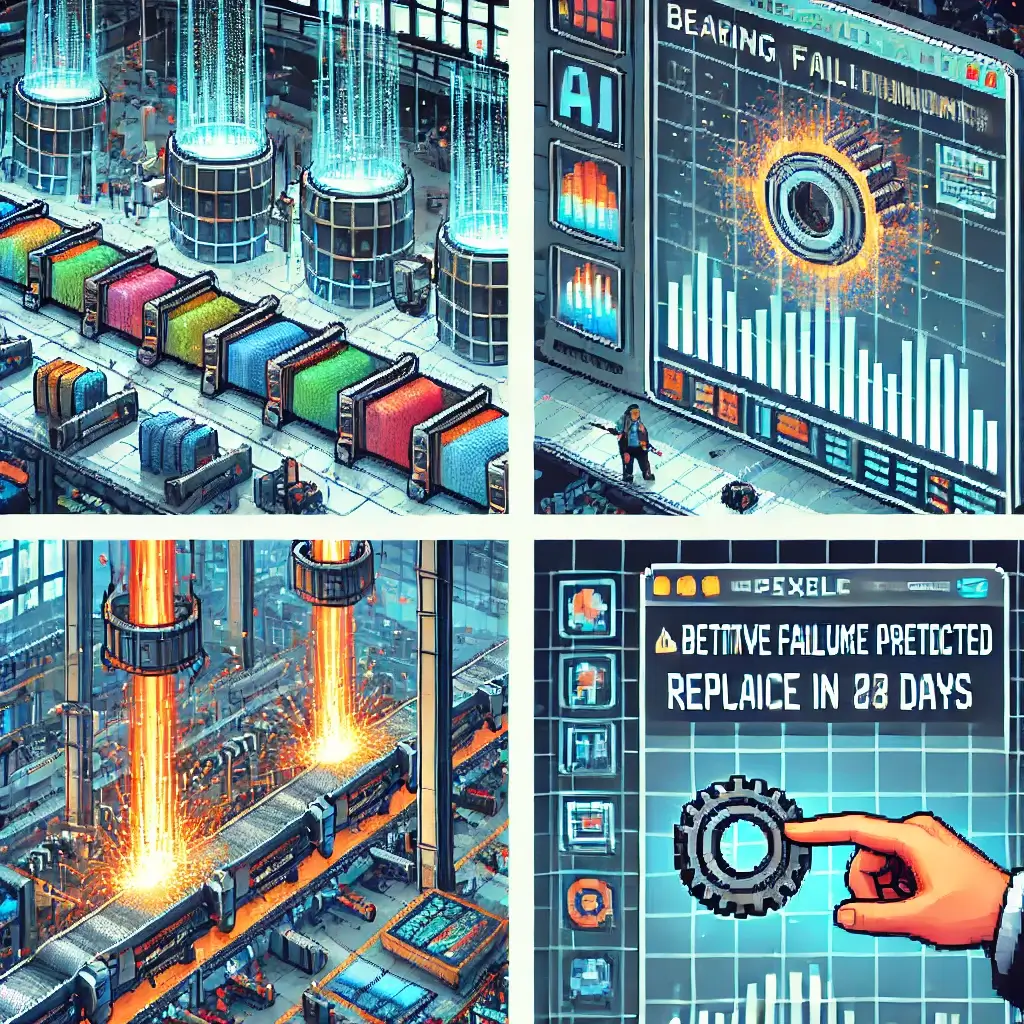
AI for Predictive Maintenance: 7 Jaw-Dropping Ways to Revive Your Textile Looms!
Hello there, fellow manufacturing warrior!
I know what you’re thinking.
Another blog post about AI?
Yawn.
But hear me out.
I’m not here to sell you on some vague, futuristic dream.
I’m here to talk about a very real, very painful problem that I’ve seen firsthand in factories all over the world.
The dreaded unexpected machine breakdown.
That moment when a critical piece of equipment, humming along perfectly just a second ago, suddenly grinds to a halt with a sickening clank.
The look of pure dread on the floor manager’s face is something you can’t forget.
And let’s be honest, for us in niche industries, like textile manufacturing, those moments sting even more.
That’s because our machines—those massive, intricate, and sometimes decades-old textile looms—aren’t just any piece of metal.
They’re the heart and soul of the operation.
When one goes down, it’s not just a hiccup; it’s a full-blown emergency.
It’s lost production, wasted raw materials, frantic calls to technicians, and a cascade of delays that can ruin a whole quarter.
But what if you could see it coming?
What if, a week or even a month before that bearing was about to fail, you got a friendly little heads-up?
“Hey, time to replace this part. It’s looking a little tired.”
That’s not science fiction anymore.
That’s AI for predictive maintenance, and it’s here to save your bacon.
Let’s dive into the nitty-gritty of how this works and why it’s not just for the mega-factories of the world.
It’s for you.
Table of Contents
The Old Way vs. The New Way: Why “Run-to-Failure” is a Recipe for Disaster
Okay, let’s be real for a second.
For decades, maintenance has largely fallen into two camps.
First, there’s the “run-to-failure” method.
This is when you simply wait for a machine to break down, and then you fix it.
It’s reactive, it’s chaotic, and it’s a strategy that’s as outdated as a dial-up modem.
I once worked with a small textile mill owner in South Carolina who swore by this method.
His reasoning?
“If it ain’t broke, don’t fix it.”
It sounds logical on the surface, but I saw what happened when one of his massive Jacquard looms went down in the middle of a big order.
The damage wasn’t just a simple gear replacement.
The failure of that one part caused a chain reaction, destroying several other components and bringing the whole line to a screeching halt for a week.
It cost him more in downtime and emergency repairs than he had saved in years of “running to failure.”
Then, you have the more sophisticated, but still imperfect, “preventive maintenance.”
This is where you follow a schedule.
You replace a bearing every six months, a belt every year, and so on, whether it’s showing signs of wear or not.
It’s better than nothing, sure, but it’s not perfect.
It’s like changing the oil in your car every 3,000 miles even if you only drive to the grocery store once a week.
You’re either replacing a perfectly good part too early, or, even worse, the part fails prematurely before its scheduled replacement date, and you’re back to square one.
This is where AI comes in, offering a third, far more intelligent path.
It’s the difference between guessing and knowing.
It’s the difference between hoping for the best and being prepared for the worst.
It’s the difference between frantic scrambling and calm, planned action.
Think of AI predictive maintenance as having a superhuman technician who can listen to the subtle whispers and vibrations of your machine and tell you exactly what’s going wrong, before it becomes a disaster.
It’s beautiful, really.
What Exactly is AI Predictive Maintenance and How Does it Work?
Alright, let’s demystify this.
At its core, AI predictive maintenance is about using data to predict the future.
Specifically, it uses machine learning algorithms to analyze real-time data from your equipment and predict when a component is likely to fail.
So, what kind of data are we talking about?
We’re talking about **sensor data**.
Imagine your textile loom, which is a marvel of engineering, covered in tiny, smart sensors.
These sensors are constantly measuring things like vibration, temperature, acoustic emissions (the sound the machine makes), motor current, and even pressure.
This isn’t some black magic; it’s just science.
Think of it like this.
When you get sick, your body gives off signals: a fever, a cough, a runny nose.
These are symptoms that tell a doctor something is wrong.
In the same way, a failing machine gives off its own symptoms.
A bearing that’s about to fail will start to vibrate just a little differently than it normally does.
An overheating motor will send a clear signal through its temperature sensor.
The sound of a worn-out belt will have a slightly different frequency than a new one.
Your technicians might be able to pick up on these subtle changes if they’re standing right there with a stethoscope, but they can’t be everywhere at once.
And even if they could, a human ear can’t compete with a super-sensitive microphone and a sophisticated algorithm.
The AI, or more accurately, the machine learning model, is trained on historical data.
It learns what “normal” looks and sounds like for your specific loom.
It also learns what “abnormal” looks like—the specific patterns of data that precede a breakdown.
When the real-time data streaming in from your factory floor starts to match a pattern it has identified as a precursor to failure, it raises a flag.
It’s not just saying, “Something’s wrong.”
It’s saying, “The vibration in motor A is spiking in a way that suggests bearing 7 will fail in approximately 34 days.”
That level of precision is a game-changer.
It shifts you from reactive or preventive maintenance to truly **predictive** maintenance.
You can schedule the repair for a time that minimizes disruption, order the part ahead of time, and avoid the catastrophic domino effect of a sudden failure.
This isn’t about replacing your maintenance team; it’s about giving them a superpower.
It allows them to focus on high-impact tasks instead of routine inspections or emergency firefighting.
The Secret Sauce: AI’s Role in Taming Your Textile Looms
So why is this so critical for textile looms in particular?
Because these aren’t simple machines.
They are complex ecosystems of gears, shuttles, warp beams, weft insertion systems, and electronic controls.
The tolerances are incredibly tight.
A tiny misalignment or a slightly worn part can have a huge impact on the quality of the fabric being produced.
Traditional maintenance methods often miss these subtle clues.
But AI doesn’t.
Here are just a few of the ways AI is specifically helping textile manufacturers:
1. **Vibration Analysis:** Looms vibrate a lot, but a healthy loom has a specific vibration signature.
When a bearing or gear starts to wear, the vibration changes.
An AI model can detect this change long before a human can hear or feel it.
2. **Temperature Monitoring:** Overheating can be a sign of a number of issues, from friction in a motor to a failing belt.
AI can monitor temperature sensors on a micro-level, spotting small, consistent rises that a human might never notice.
3. **Acoustic Signature Analysis:** This is one of the coolest parts.
Every machine has a unique sound profile.
When something is about to fail, the sound changes.
AI models can be trained to recognize the “sound of a sick loom” and alert you.
It’s like giving your machines a voice to tell you when they need help.
4. **Motor Current Analysis:** The amount of electrical current a motor draws can be a powerful diagnostic tool.
If a motor is working harder than it should to move a component, it’s a sign of a problem, like increased friction or a part that’s seizing up.
AI can track this over time and detect anomalies.
The beauty of this is that the AI gets smarter over time.
The more data it collects from your specific looms, the better it becomes at making accurate predictions.
It’s a continuous feedback loop that improves with every hour of operation.
You are not just buying a system; you are building an intelligent, self-improving brain for your factory.
Beyond the Hype: 3 Real-World Scenarios Where AI is Crushing It
It’s easy to talk about this in theory, but let’s talk about a few concrete examples.
These are the kinds of stories that get me fired up because they show the real impact.
**Scenario 1: The Bearing that Didn’t Fail**
I know of a mill that used to see a major loom breakdown every few months due to a specific type of spindle bearing failing.
It was always a mess.
They installed an AI predictive maintenance system.
After a few months of collecting data, the system flagged a loom, saying, “Hey, the vibration signature for this spindle bearing is starting to look suspicious.
It’s deviating from the norm.”
Instead of waiting for the inevitable catastrophic failure, the maintenance team scheduled a simple, 30-minute replacement during a planned shutdown.
They opened up the spindle, and sure enough, the bearing was visibly pitted and just days away from a total seizure.
What would have been a week of downtime was a single, planned, and painless task.
**Scenario 2: The Quality Control Master**
Sometimes, a failing part doesn’t cause a breakdown right away, but it silently degrades the quality of the product.
In textile weaving, a slightly misaligned shuttle or a worn-out component can lead to subtle defects in the fabric, like dropped stitches or uneven tension.
These defects can be hard for human inspectors to spot immediately, and they often aren’t found until the end of the line, which means an entire run of fabric is wasted.
An AI system, however, can connect the dots.
It can analyze sensor data from the loom and correlate it with quality control data at the end of the line.
It can learn, for example, that a specific vibration pattern corresponds to a specific type of fabric defect.
This allows the system to flag the loom the moment the quality begins to degrade, saving hundreds of yards of fabric and thousands of dollars.
It’s not just about preventing failure; it’s about maintaining excellence.
**Scenario 3: The Energy Saver**
This one is a great side benefit.
A machine that is wearing out often has to work harder, which means it draws more energy.
Friction from a worn bearing or a misaligned gear causes an increase in the motor’s power consumption.
An AI system can be set up to monitor energy consumption on a per-machine basis.
When it detects a sudden, unexplained spike in energy usage, it can flag a potential issue.
This not only helps you prevent a breakdown but also helps you reduce your energy costs.
It’s a double win.
Data: The Fuel for Your AI Engine (And How to Get It)
So, you’re sold on the idea, but you have a big question.
“Where do I get all this data from my old machines?”
That is a very valid and common concern.
Many people assume that you need to be running a brand-new, fully digital factory to even consider AI.
But that’s a myth.
You don’t need to replace your entire loom to make it “smart.”
The beauty of modern IoT (Internet of Things) technology is that it’s designed to be retrofitted.
You can add sensors to your existing equipment relatively easily and affordably.
These sensors are often wireless, battery-powered, and can be attached to key areas of the machine to monitor temperature, vibration, and other critical parameters.
Think of it as giving your old workhorse a new, high-tech brain.
You’re not rebuilding the whole horse; you’re just giving it a fancy new saddle with GPS and a heart rate monitor.
There are also companies that specialize in exactly this kind of retrofitting.
They can come in, assess your machinery, and set you up with the right sensors and a system to collect the data.
For those machines that have more modern controls, you can often connect directly to the machine’s control system (PLC) and pull data that way.
The data collection phase is the most critical part of the whole process.
Garbage in, garbage out, right?
You need clean, reliable, and consistent data to train a good AI model.
This is where it’s important to partner with a reputable provider who understands both the AI side and the industrial side of things.
A company that only knows software might give you a generic solution that doesn’t understand the nuances of a textile loom.
A company that understands both, however, can help you get the right data, from the right places, to build a model that is incredibly powerful for your specific operation.
And yes, this also means you’ll need to digitize your maintenance logs.
Your AI model needs to know what has failed in the past and what you did about it to learn how to predict it in the future.
So, if you’re still using paper logs, now is the time to start thinking about a digital solution.
It’s not as scary as it sounds, I promise.
Is It All Sunshine and Rainbows? The Challenges of AI Implementation
Okay, I’ve given you the good stuff.
Now for a dose of reality.
Implementing AI predictive maintenance isn’t a silver bullet.
It comes with its own set of challenges, and it’s important to go into this with your eyes wide open.
The biggest challenge I’ve seen? **Change management.**
Your maintenance team has been doing things a certain way for years, maybe even decades.
Suddenly, you’re telling them a computer algorithm is going to tell them when to do their job.
There can be a lot of skepticism, and even resistance.
My advice here is to involve your team from day one.
Don’t present this as a new boss; present it as a powerful new tool to help them do their jobs better, more efficiently, and with less stress.
Show them how it can eliminate the dreaded 2 a.m. emergency call and allow them to spend more time on strategic, high-value projects.
Another challenge is the **initial investment.**
While the cost has come down dramatically, it’s not free.
You’ll need to invest in sensors, software, and potentially some IT infrastructure.
However, and this is a big however, the ROI (Return on Investment) can be staggering.
When you prevent even a single catastrophic breakdown, the savings in downtime, emergency repair costs, and lost production can often pay for the entire system.
I’ve seen this happen time and time again.
Finally, there’s the **data challenge** that I mentioned earlier.
For AI to work its magic, it needs a good amount of historical data to learn from.
If you’re starting from scratch with brand new machines and no past failures, the system will need some time to learn what “normal” looks like before it can start making accurate predictions.
But don’t let these challenges deter you.
They are all manageable with the right approach and the right partner.
Think of it as a journey, not a single leap.
You can start small, with a pilot project on a few of your most critical looms, and then expand from there.
Getting Started: Your Step-by-Step Guide to a Smarter Factory
Ready to take the plunge?
Here’s a simple roadmap to get you started.
1. **Assess Your Pain Points:** Start by identifying your most critical machines.
Which loom, if it were to go down, would cause the most damage?
Which ones have the most frequent and costly failures?
This is where you should focus your initial efforts.
2. **Find a Partner:** Don’t try to build this from scratch yourself unless you have a dedicated data science team and a lot of free time.
Look for companies that specialize in industrial IoT and AI for manufacturing.
Find a partner who has experience with your specific type of machinery.
3. **Pilot Program:** Start with a small pilot project.
Install sensors on one or two of your critical looms.
Run the system for a few months, collect data, and see the results.
This will give you a chance to see the value firsthand without a massive upfront commitment.
4. **Train Your Team:** As I mentioned, get your maintenance team on board early.
Provide them with training on the new system and show them how it can make their lives easier.
Make them a part of the solution, not a victim of the change.
5. **Scale Up:** Once you’ve seen the success of your pilot project, you can start to expand the system to more of your machines.
The beauty of this technology is that once the framework is in place, adding more machines is often much simpler than the initial setup.
And then, you get to watch the magic happen as your factory floor becomes not just smarter, but more reliable and efficient.
The Future is Here: What’s Next for AI and Industrial Machinery?
The journey doesn’t stop at predictive maintenance.
This is just the first step on a much larger path toward a truly smart factory.
The same data streams that are feeding your predictive maintenance model can also be used for other applications.
Things like **prescriptive maintenance**, where the system not only tells you a part is going to fail but also tells you the exact steps to fix it and even orders the new part for you.
Or **process optimization**, where the AI analyzes data from across the entire factory to find inefficiencies and suggest changes to improve output or quality.
The possibilities are endless.
But it all starts with taking that first step.
By embracing AI for predictive maintenance today, you’re not just solving a problem; you’re building the foundation for a smarter, more resilient, and more profitable future for your business.
So, what are you waiting for?
The future of your textile looms is waiting.
Industrial AI, Predictive Maintenance, Textile Looms, Niche Machinery, IoT