
This post is for educational purposes only and should not be considered financial advice. Please consult with a qualified financial professional.
5 Jaw-Dropping Ways Machine Learning is Fixing Your Financial Future!
Hey there, and welcome! So, let me ask you a personal question. Have you ever felt like you’re just not “getting” personal finance?
You’ve read the books, you’ve listened to the podcasts, and maybe you’ve even tried a few budgeting apps, but it all feels… generic. Like a one-size-fits-all sweater that’s just a little too itchy and doesn’t quite fit your body.
You’re not alone. I’ve been there, and I know the frustration. The world of finance can feel like a secret club with its own language, and without a personalized guide, you’re just wandering around in the dark.
But what if there was a way to get a financial education that was built just for you? A system that learns your unique habits, your goals, and even your spending triggers, and then coaches you in a way that actually sticks?
That’s not science fiction anymore. It’s here, and it’s powered by **machine learning**. This isn’t just about another app; it’s a fundamental shift in how we learn to manage our money.
It’s about taking the power of data and turning it into a hyper-personalized roadmap to financial freedom. And let’s be honest, who doesn’t want that?
In this post, we’re going to dive deep into how machine learning is fundamentally changing financial literacy, making it more effective, more engaging, and less intimidating than ever before. We’ll explore the old ways, the new ways, and what this all means for your wallet, your peace of mind, and your future.
Ready to finally understand your money on your own terms? Let’s get started.
—
Table of Contents
—
The Old Ways vs. the Rise of Machine Learning: Why Generic Advice Fails
Let’s talk about the way things used to be. For decades, the path to financial wisdom was paved with generic, one-size-fits-all advice. We were told to “save 10% of every paycheck,” “avoid debt,” and “invest in a diversified portfolio.” And while that advice isn’t *wrong*, per se, it’s also incredibly unhelpful for most people.
Think about it. A generic budgeting tip is like a doctor prescribing a single, broad-spectrum antibiotic for every single illness. It might work for a few simple cases, but it’s completely useless for something complex and specific.
For example, if you’re a gig worker with an unpredictable income, telling you to “save 10% of every paycheck” is a joke. Some months you might make a killing, and others you might barely scrape by. Your needs are wildly different from someone with a steady, salaried job.
Similarly, a college student with five figures of student loan debt needs a different game plan than a 45-year-old with a family and a mortgage. The goals are different, the risk tolerance is different, and the emotional relationship with money is completely different.
This is where the traditional model falls apart. It assumes we’re all the same, with the same income, the same spending habits, and the same dreams. It’s impersonal, often intimidating, and frankly, a bit boring. It’s no wonder so many people feel like they’re failing at personal finance; the system was never designed to help *them* specifically.
And let’s not forget the sheer amount of information out there. It’s overwhelming! You read one blog post that says “pay off your debt aggressively,” and another says “prioritize investing.” You get conflicting advice, and you freeze. Analysis paralysis sets in, and you end up doing nothing at all, which is often the worst possible outcome.
This is the void that **machine learning** is stepping into. It’s not about giving you another list of tips to follow. It’s about building a dynamic, living financial roadmap that changes as you do. It’s a personal trainer for your money, a coach that understands your unique strengths and weaknesses, and guides you toward your goals with personalized, actionable steps.
Instead of a one-size-fits-all sweater, you get a custom-tailored suit. And let’s be honest, we all look better in a custom suit.
If you’re interested in understanding the basics of financial literacy, a great place to start is with the basics. Check out this link for more information:
—
Unlocking Your Financial DNA: How Machine Learning Actually Works
Alright, so we’ve established the problem. Now for the fun part: the solution. But before we get into the nitty-gritty examples, let’s peel back the curtain a little on how **machine learning** even does this magic.
Don’t worry, I’m not going to bore you with complex algorithms and code. Think of it like this: your personal finance is a puzzle. Traditional advice gives you a few puzzle pieces and says “good luck.” Machine learning, on the other hand, is a super-smart friend who looks at all your puzzle pieces, understands the picture you’re trying to create (your financial goals), and then gives you the exact pieces you need, in the right order.
It works by taking a massive amount of data—your spending history, income fluctuations, investment portfolio, even your stated goals—and finding patterns. These patterns are often things you might not even be aware of yourself. For instance, it might notice that you tend to overspend on Fridays, or that your cash flow is always tight in the first two weeks of the month. It can spot these trends with a precision that no human can match.
Once it understands these patterns, it doesn’t just judge you. Instead, it uses them to create a **predictive model**. This model can then forecast your future spending, saving, and investment potential. It can answer questions like, “If I stick to this budget, how much will I have saved in six months?” or “If I increase my 401(k) contribution by 1%, how will that affect my retirement date?”
The beauty of it is that it’s a continuous feedback loop. As you make new financial decisions, the machine learning model gets smarter. It’s constantly learning and adapting. Did you get a raise? The system will adjust your savings targets. Did you have an unexpected expense? It will help you find ways to get back on track without guilt or shame.
It’s like having a financial advisor in your pocket, 24/7, that knows you better than anyone else. This isn’t about just crunching numbers; it’s about creating a living, breathing financial plan that’s as unique as you are. It’s empowering, not intimidating. It’s a tool that takes the guesswork out of money management and replaces it with data-driven confidence.
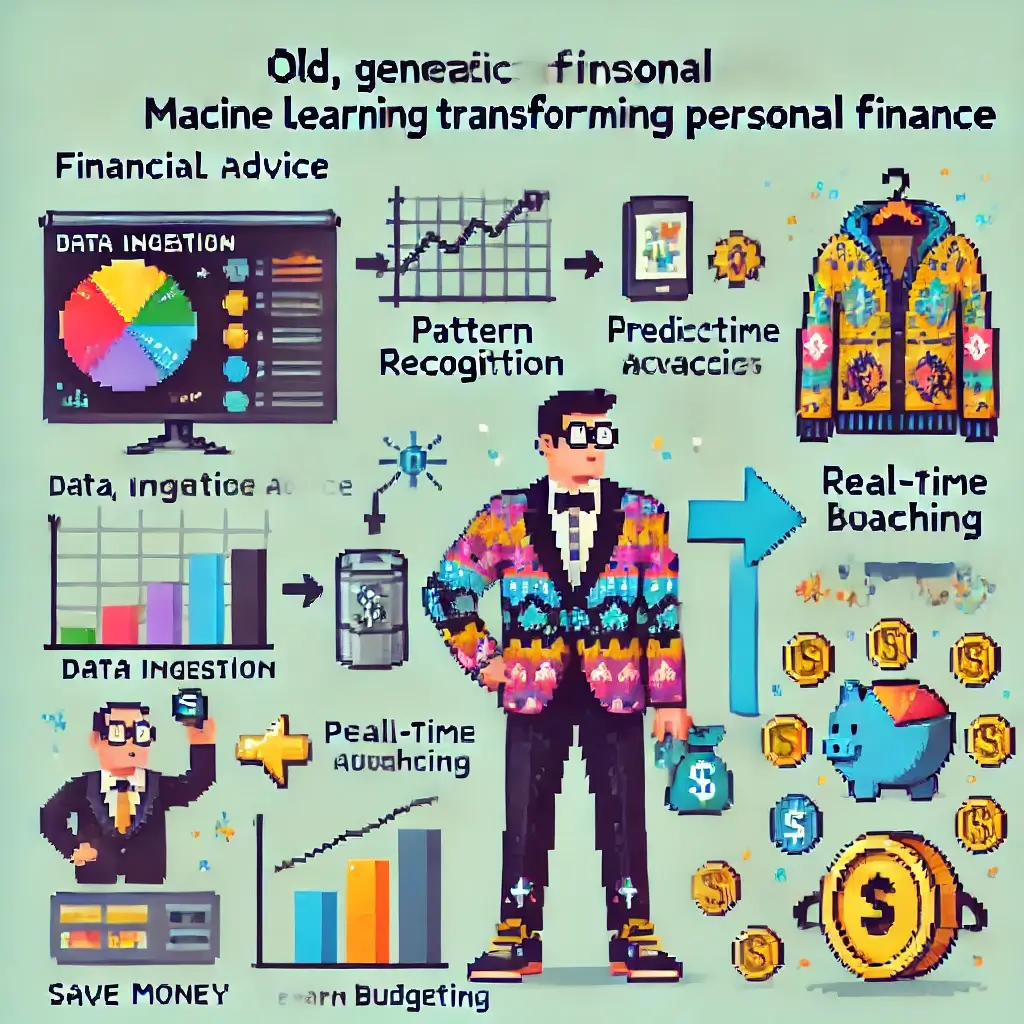
And what does this look like in a visual sense? Imagine the following infographic showing the flow of this process. It’s the journey from generic, confusing advice to a clear, personalized financial path.
The Machine Learning Financial Literacy Flow
1. Data Ingestion
Your spending, income, debt, and financial goals are collected.
➡️
2. Pattern Recognition
ML algorithms identify unique spending habits and trends.
➡️
3. Predictive Analysis
A personalized financial roadmap is created, forecasting outcomes.
➡️
4. Real-Time Coaching
You receive actionable, personalized advice and nudges.
The journey from raw data to personalized financial empowerment.
—
3 Mind-Blowing Examples of Machine Learning in Action
Okay, so now that we’ve covered the “what” and the “how,” let’s talk about the “what it looks like in real life.” These aren’t just theoretical ideas; these are things that are happening right now, making a tangible difference in people’s lives.
1. Predictive Budgeting that Feels Effortless
Forget the old way of budgeting—the tedious spreadsheet where you try to guess how much you’ll spend on groceries next month. It’s a chore, and most people give up after a week. Predictive budgeting is the opposite of that. It’s a system that analyzes your past spending and predicts your future spending with remarkable accuracy.
Imagine your financial app knows you typically spend about $150 on coffee each month, and you’ve got a goal to save for a down payment on a new car. The app doesn’t just show you that you’re “over budget.” Instead, it might send you a friendly little nudge: “Hey, you’ve already spent $120 on coffee this month. You’re on track to hit your goal by December if you keep it up, but if you cut back by just $30, you could get there even sooner. How about a week of making coffee at home?”
This isn’t about restriction; it’s about empowerment. It gives you the information you need, right when you need it, and frames it in a way that’s connected to your personal goals. It’s a proactive, not reactive, approach to budgeting that removes the guilt and replaces it with motivation.
2. Personalized Investment Guidance for the Everyday Person
For a long time, sophisticated investment advice was reserved for the wealthy. You needed to pay a human advisor thousands of dollars to get a personalized strategy. Not anymore. Machine learning is democratizing this expertise.
These systems can analyze your risk tolerance, your investment goals (are you saving for retirement or a new house?), and your current portfolio, and then recommend a strategy that is perfectly tailored to you. It’s not just a generic “buy a broad-market index fund” tip. It might suggest a specific mix of ETFs, mutual funds, and even individual stocks that align with your values and your risk comfort level. It can even help you understand why it’s making those recommendations, turning it into a learning experience.
It’s like having a team of analysts working for you, 24/7, constantly scanning the market and adjusting your plan to keep you on track. And it does all of this for a fraction of the cost of a human advisor.
This kind of technology has changed the game, making investing accessible and understandable for millions who were previously on the sidelines. If you’re curious about getting started with investing, here’s a good place to begin your research:
3. Gamified Financial Education that’s Actually Fun
Let’s be honest, most financial education is about as exciting as watching paint dry. It’s all lectures, spreadsheets, and dry, academic language. But machine learning can change that by making the learning process engaging and fun.
Imagine a financial literacy app that’s built like a video game. As you learn new concepts, you unlock achievements. When you reach a savings goal, your avatar gets a new outfit. The game adapts to your pace, so if you’re a whiz with budgeting but struggle with investing, it will present you with more investing challenges and lessons. It’s a truly personalized learning path.
This approach taps into human psychology, using rewards and progressive difficulty to keep you engaged. It makes the abstract concept of “long-term financial health” feel tangible and immediate. And when learning is fun, it doesn’t feel like a chore; it feels like a journey. This is a game you can’t lose, because even if you make a “mistake,” the system just helps you learn from it and get back on track.
It’s like a personalized Duolingo for your finances, and it’s an incredibly powerful way to close the financial literacy gap for people of all ages.
—
The Sweet Spot: What Personalized Financial Literacy Means for You
So, we’ve talked about the “how” and the “what.” Now let’s get to the most important part: the “so what?” What does all this mean for you, the individual trying to navigate the choppy waters of personal finance?
It means a few really beautiful things. First, it means **less stress**. The anxiety of not knowing if you’re doing the “right” thing with your money is a heavy burden. Personalized, data-driven advice removes that guesswork. You have a clear plan, and you have a coach that’s constantly helping you stick to it. It’s like having a safety net for your financial decisions.
Second, it means **more confidence**. When you start seeing tangible results—your savings account growing, your debt shrinking, your investments performing—you start to feel a sense of control. This confidence spills over into other areas of your life. You feel more secure in your job, more empowered to pursue your dreams, and less worried about the future. It’s a virtuous cycle.
Third, it means **better outcomes**. This is the bottom line, isn’t it? Personalized financial literacy leads to better financial decisions. You’re not just following generic advice; you’re following a plan that’s optimized for your specific situation. This leads to higher savings rates, faster debt reduction, and smarter investment choices. It’s the difference between hoping for the best and actively building a brighter future.
This technology is leveling the playing field. It’s taking the expertise that was once exclusive and making it available to anyone with a smartphone. It’s giving people the tools they need to succeed, regardless of their background or income level. It’s a true revolution in financial empowerment.
For more insights on how technology is changing financial services, this is a must-read:
—
The Road Ahead: What to Expect Next from This Tech
We’ve talked about the present, but what about the future? This is just the beginning. The capabilities of **machine learning** are growing exponentially, and the next few years are going to be wild.
One of the biggest areas of growth will be in **proactive, seamless integration**. Right now, you often have to open an app to get financial insights. In the future, this technology will be woven into the fabric of your life. Imagine getting a gentle reminder about a bill that’s due as you’re leaving a store, or a small investment being made for you automatically when you get a bonus at work. It will be less about managing your money and more about the technology managing it *for* you, based on your pre-set goals and preferences.
Another exciting development is the potential for **peer-to-peer financial education**. Imagine a system that connects you with other people who have similar financial goals and habits, allowing you to learn from their successes and failures (anonymously, of course). It’s about building a community of financially savvy individuals, all powered by a system that understands your unique position.
And let’s not forget the ethical side of things. As this technology becomes more powerful, discussions around data privacy, algorithmic bias, and security will become more important than ever. We need to ensure that these tools are built responsibly and that they serve everyone, not just a select few. The future of personalized financial literacy is not just about technology; it’s about trust.
—
Wrapping It All Up
So, there you have it. The future of financial literacy isn’t about memorizing complex formulas or listening to generic, boring advice. It’s about empowering you with a personalized, dynamic, and engaging system that’s built for *you* and only you.
The rise of **machine learning** in financial education is a game-changer. It’s a revolution that’s making financial confidence accessible to everyone, and it’s a journey I’m incredibly excited to be on. So, ditch the old, dusty books and embrace the future. Your financial health will thank you for it.
What are your thoughts? Have you used any of these tools before? I’d love to hear about your experience in the comments below!
Financial Literacy, Machine Learning, Personalized Finance, Fintech, Budgeting
🔗 AI-Powered Packaging Innovations Posted 2025-08-10 07:48 UTC 🔗 AI’s Forensic Accounting Posted 2025-08-11 09:46 UTC 🔗 AI is Predicting Geological Disasters Posted 2025-08-12 08:29 UTC 🔗 Conversational AI Posted 2025-08-13 09:10 UTC 🔗 Waste Management and Recycling Posted 🔗 7 Mind-Blowing Ways Conversational AI is Changing Our World Posted 2025-08