
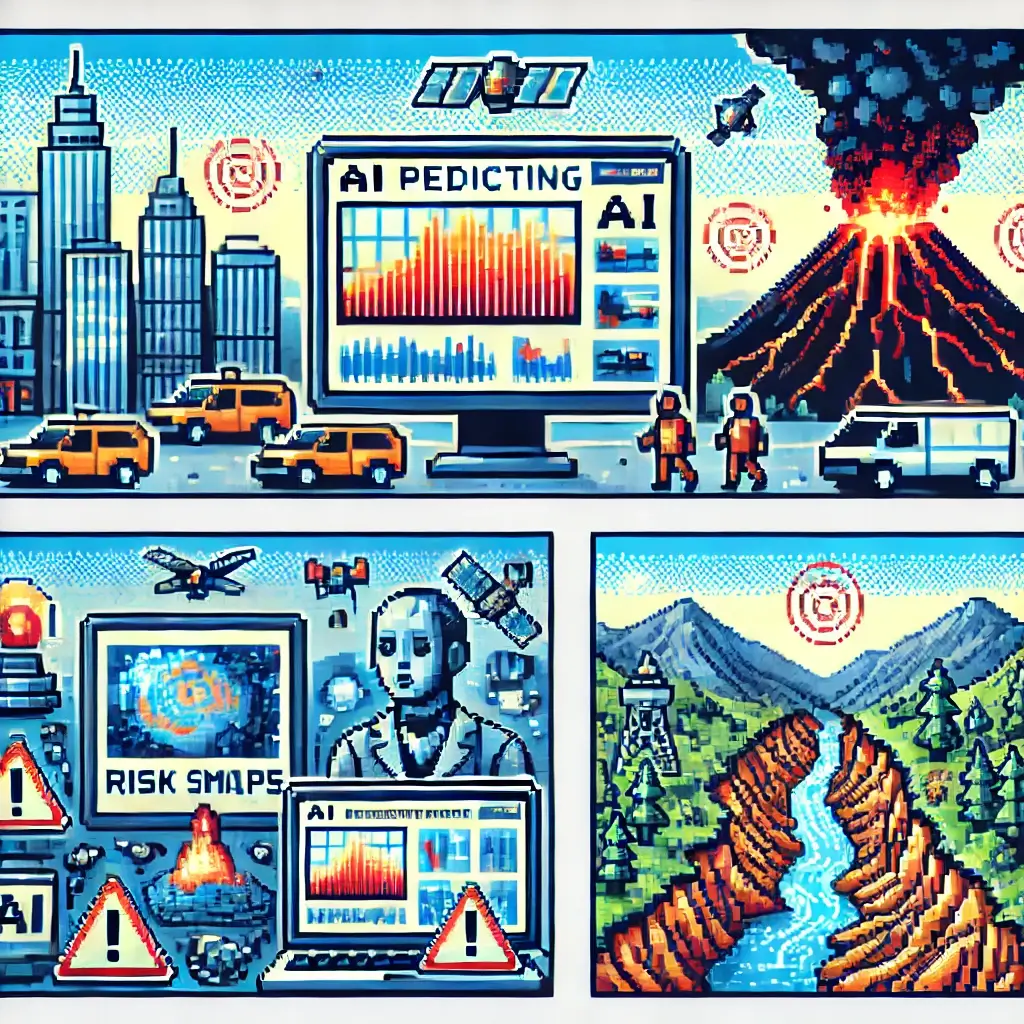
The Earth is Screaming, and AI is Finally Listening: 3 Ways AI is Predicting Geological Disasters
Ever get that feeling in your gut that something’s about to happen? A weird stillness in the air, an odd quietness from the birds? For centuries, humans have looked for signs, omens, anything to warn us when the very ground beneath our feet is about to betray us. We’ve relied on folklore, animal behavior, and our own intuition. But let’s be honest, it’s been a bit of a crapshoot. The Earth doesn’t exactly send a text message before it decides to throw a tectonic tantrum.
But what if it did? What if the planet is constantly whispering, humming, and groaning, sending out subtle signals before it unleashes its fury? And what if we just didn’t have the right ears to hear it? Well, grab a seat, because technology has just handed us a hearing aid of planetary proportions. We’re talking about Artificial Intelligence (AI), and it’s poised to become our planet’s ultimate interpreter, a digital seismologist that never sleeps. This isn’t science fiction anymore. This is the new reality of disaster prediction, and it’s about to change everything.
Table of Contents
1. The Silent Scream: Why We’ve Been Getting it Wrong
For as long as we’ve built cities, we’ve lived under the shadow of natural disasters. Earthquakes, volcanoes, landslides… they’re the planet’s brutal, unpredictable house-cleaning sessions. Our traditional methods of prediction have been, to put it kindly, a little hit-or-miss. We plant seismometers, we measure ground deformation, we look for gas emissions. These are all vital pieces of the puzzle, don’t get me wrong. It’s like being a doctor trying to diagnose a patient. You take their temperature, you listen to their breathing, you check their blood pressure.
But what if the illness is incredibly complex, with thousands of symptoms that are all interconnected in ways you can’t possibly see? That’s the problem with predicting geological shifts. The amount of data involved is astronomical. We’re talking about petabytes of seismic data, satellite imagery, GPS coordinates, historical records, and geological surveys. A human brain, or even a team of brilliant human brains, simply cannot process that much information in real-time. We’re trying to find a single, specific needle in a haystack the size of a continent.
We see patterns after the fact. “Ah, of course,” a seismologist might say, looking back at the data after a major quake, “you can see the foreshocks here, and the ground swelling there.” Hindsight is always 20/20. The challenge has always been to see those patterns before disaster strikes. This is where our new digital hero, AI, strides onto the stage.
AI, specifically machine learning, is designed to do exactly what we can’t. It can sift through those monumental haystacks of data and find the needles. It can recognize patterns that are far too subtle for human perception. Think of it like this: you might listen to a piece of music and hear a beautiful melody. An AI can listen to the same piece and not only hear the melody but also analyze the precise frequency of every single note, the timing down to the microsecond, the subtle harmonics, and compare it all to a library of every piece of music ever created, all in an instant. It hears a symphony where we just hear a song. That’s the power we’re now applying to the deep, chaotic music of our planet.
2. Cracking the Code of Chaos: AI and the Enigma of Earthquakes
The holy grail of geology is, without a doubt, reliable earthquake prediction. For decades, it’s been considered impossible. The U.S. Geological Survey (USGS) itself is very clear: they do not predict earthquakes. They provide probabilities, yes, but not predictions. The sheer number of variables and the chaotic nature of fault lines make it a maddeningly complex problem.
But “impossible” is a word that AI doesn’t really understand. Researchers are now feeding machine learning models decades of seismic data. These AI systems are learning to identify the faint, almost imperceptible “precursor” signals that hint at a coming rupture. It’s not just about looking for bigger foreshocks; it’s about analyzing the ‘sound’ the fault makes as stress builds up. A recent study, for example, adapted an AI originally designed for speech recognition to listen to the seismic data from a volcanic collapse. The AI learned to detect the distinct acoustic signatures of fault slips, essentially learning the language of a stressed-out fault line.
Imagine a tectonic plate as a giant, rusty bolt. As you tighten it, it groans and creaks. At first, the sounds are random. But just before it’s about to snap, the pattern of those sounds might change in a subtle, but measurable, way. Humans can’t hear that change against the background noise. But an AI can.
Researchers at The University of Texas at Austin developed an AI that, in a seven-month trial in China, correctly predicted 70% of earthquakes a week in advance. Let that sink in. 70 percent. It forecasted 14 earthquakes within about 200 miles of their epicenters and with surprisingly accurate magnitudes. Now, it wasn’t perfect. It missed one, and it had eight false alarms. But as a first step? That’s not just a step, it’s a giant leap. It’s the difference between having no warning at all and having a crucial window to prepare, evacuate, and save lives.
The secret is in the training. These models are fed with a massive diet of historical data – every recorded tremor, every GPS measurement showing the slow creep of the earth’s crust. The AI learns the complex dance of stress and strain. It doesn’t rely on a single ‘smoking gun’ signal, but on the confluence of thousands of tiny, interacting data points. It’s building a statistical picture of what a fault line “looks like” in the hours and days before it gives way.
This isn’t about one magic algorithm. It’s about a new approach. We’re moving from a physics-based model (where we try to understand every single force involved) to a data-driven one (where we let the data itself reveal the hidden patterns). It’s a paradigm shift that could finally give us the edge in this long and deadly battle with the earth’s most destructive force.
3. When Mountains Roar: AI’s Role in Forecasting Volcanic Fury
Volcanoes are, in some ways, a little more polite than earthquakes. They tend to give more warnings. A volcano might swell up like a loaf of bread, start burping out strange gases, or experience swarms of tiny earthquakes. The problem is, every volcano has its own personality. What signals a major eruption at Mount St. Helens might just be a normal Tuesday for Kīlauea. This individuality makes creating a universal “eruption alert” system incredibly difficult.
Again, this is a perfect job for AI. Scientists are now creating “generalized” machine learning models. Instead of just studying one volcano, they feed the AI seismic data from dozens of volcanoes around the world. The goal is for the AI to learn the fundamental precursors to an eruption that are common across different types of volcanoes, while also being able to recognize the unique quirks of each one.
One fascinating study trained a machine learning model on data from 24 different volcanoes. They then tested it by asking it to forecast eruptions on volcanoes whose data it had never seen during training. The results were astounding. The AI performed almost as well as models that had the advantage of being specifically trained on that target volcano. This suggests that there are, in fact, universal “tells” for volcanic eruptions, and AI is uniquely capable of finding them. These models were 50-70% more accurate than traditional methods that just look at the average seismic amplitude.
Think of a veteran volcanologist. After decades of experience, they develop an intuition. They can look at a set of data and just “feel” that something is wrong. What is that intuition? It’s a subconscious recognition of complex patterns based on years of experience. An AI is essentially doing the same thing, but on a superhuman scale. It can “experience” the life cycles of thousands of volcanoes simultaneously and distill that experience into a predictive forecast.
This is a game-changer, especially for monitoring volcanoes in remote locations or in developing countries where extensive monitoring networks might not be feasible. An AI model, trained on a global dataset, could provide life-saving probabilistic forecasts for a volcano that has limited or no historical eruption data. It democratizes safety, moving us toward a world where your location doesn’t determine your vulnerability to a mountain’s fiery rage.
4. The Slippery Slope: Predicting Landslides with Machine Learning
Landslides might not have the epic, ground-shaking terror of an earthquake or a volcano, but they are frequent, deadly, and devastatingly destructive. They are the silent assassins of the natural world. Predicting them involves a complex cocktail of ingredients: rainfall intensity, soil type, slope angle, vegetation cover, geological faults, and human activity like deforestation or construction.
Trying to manually map high-risk zones using all these factors is a monumental task. But for a machine learning algorithm, it’s just another day at the office. AI models are now being used to create incredibly precise landslide susceptibility maps. Scientists feed these models vast amounts of geospatial data – satellite imagery, rainfall records, geological maps, and data on land use. The AI then correlates this information with a history of where landslides have occurred in the past.
In doing so, it learns the specific combination of factors that make a hillside likely to fail. It’s like a detective building a profile of a suspect. Does the area have steep slopes? Check. Does it have a history of intense rainfall? Check. Has there been recent deforestation? Check. When enough of these factors line up, the AI flags the area as high-risk.
The accuracy is frankly stunning. A new framework developed by German researchers, which combines six different machine learning methods, achieved a 95.6% accuracy in predicting landslide risks in the Sub-Himalayan region of India. The model can analyze huge amounts of data in a fraction of the time it would take a human team, producing maps that can pinpoint danger zones with uncanny precision.
One of the most powerful techniques being used is called XGBoost (eXtreme Gradient Boosting). It’s a powerful algorithm that is exceptionally good at finding complex, non-linear relationships in data. Combined with explainable AI (XAI) methods like SHAP, scientists can not only predict where a landslide is likely to happen but also understand why. The AI can tell them which factors are the most significant contributors to the risk in a specific area – is it the rainfall, the soil, or the slope? This is crucial information for land-use planners and emergency services. It allows them to take targeted preventative action, like reinforcing slopes or restricting construction in the most vulnerable areas.
5. The Digital Crystal Ball: Limitations and Ethical Headaches
So, we’re on the cusp of a new age of safety, right? Well, let’s not get ahead of ourselves. While the potential of AI is immense, it’s not a magical crystal ball. There are significant hurdles and some serious ethical questions we need to wrestle with.
First and foremost, the old computer science adage holds true: garbage in, garbage out. The performance of any AI model is utterly dependent on the quality and quantity of the data it’s trained on. For many parts of the world, detailed, long-term geological data simply doesn’t exist. An AI trained primarily on data from California and Japan might not be very effective at predicting earthquakes in Iran. We need a global effort to collect and share high-quality data to make these systems truly equitable and effective worldwide.
Then there’s the “black box” problem. Some of the most powerful AI models, particularly deep neural networks, are incredibly complex. They can give you a highly accurate prediction, but they can’t always explain how they reached that conclusion. For scientists and public officials, this is a problem. If you’re going to issue an evacuation order that will displace thousands of people and cost millions of dollars, you need to be able to justify that decision. The rise of Explainable AI (XAI) is helping, but we’re not there yet. We need models that are not just accurate, but also transparent and interpretable.
And that leads us to the biggest headache of all: the ethics of prediction. What do you do with a prediction? Let’s say an AI gives you a 70% probability of a major earthquake in a specific city in the next week. Do you announce it? What if you’re wrong? The economic disruption and panic could be devastating. What if you’re right, but you trigger a chaotic, uncontrolled evacuation that leads to accidents and fatalities? How accurate does a prediction need to be before you act on it? 60%? 80%? 95%?
There are no easy answers. Developing this technology is only half the battle. The other half is developing the social and political frameworks to use it responsibly. It will require a massive public education effort and the creation of clear, internationally agreed-upon protocols for issuing warnings. The goal is to save lives, not to cause panic or be paralyzed by indecision.
6. The Dawn of a Safer Tomorrow: The Future of AI in Disaster Prediction
Despite the challenges, the future is undeniably exciting. We are at the very beginning of this revolution. The AI models of today will seem primitive in a decade. As we collect more data, as our algorithms become more sophisticated, and as our computing power increases, the accuracy of these predictions will only improve.
The future lies in integration. We’ll see AI combined with the Internet of Things (IoT), with millions of tiny sensors deployed across fault lines, volcanoes, and unstable slopes, all feeding data into a central AI brain in real-time. We’ll see hybrid models that combine the raw pattern-recognition power of AI with the deep physical understanding of traditional, physics-based models.
Companies like Google are already working with agencies like the National Hurricane Center, using AI to improve hurricane track and intensity forecasts. NASA is using AI to scan satellite imagery to assess disaster damage in real-time. This isn’t a niche academic pursuit; it’s rapidly becoming a core component of global disaster management.
We may never be able to tame the Earth. The planet will always have its violent outbursts. But for the first time in human history, we are on the verge of being able to anticipate them. We are learning to listen to the planet’s silent screams. AI is giving us the hearing aids, the universal translator, that will allow us to move from being helpless victims of the planet’s whims to informed inhabitants who can prepare for its fury. The road ahead is long and complex, but it leads to a future where we can save thousands, if not millions, of lives. And that is a future worth fighting for.
Keywords: AI for predicting geological shifts, natural disaster prediction, earthquake prediction, machine learning, volcanic eruption
🔗 AI’s Role in Forensic Accounting Posted 2025-08-11 09:46 UTC 🔗 AI-Powered Packaging Innovations Posted 2025-08-10 07:48 UTC 🔗 How AI Wearable Tech Will Change Your Fitness Posted 2025-08-09 04:41 UTC 🔗 Machine Learning Models for Niche Markets Posted 2025-08-08 07:16 UTC 🔗 Transport Revolution and Slashing Costs Posted (No Date Provided) 🔗 5 AI Tools That Will Absolutely Change Your Life Posted 2025-08 (Exact Date Not Provided)