
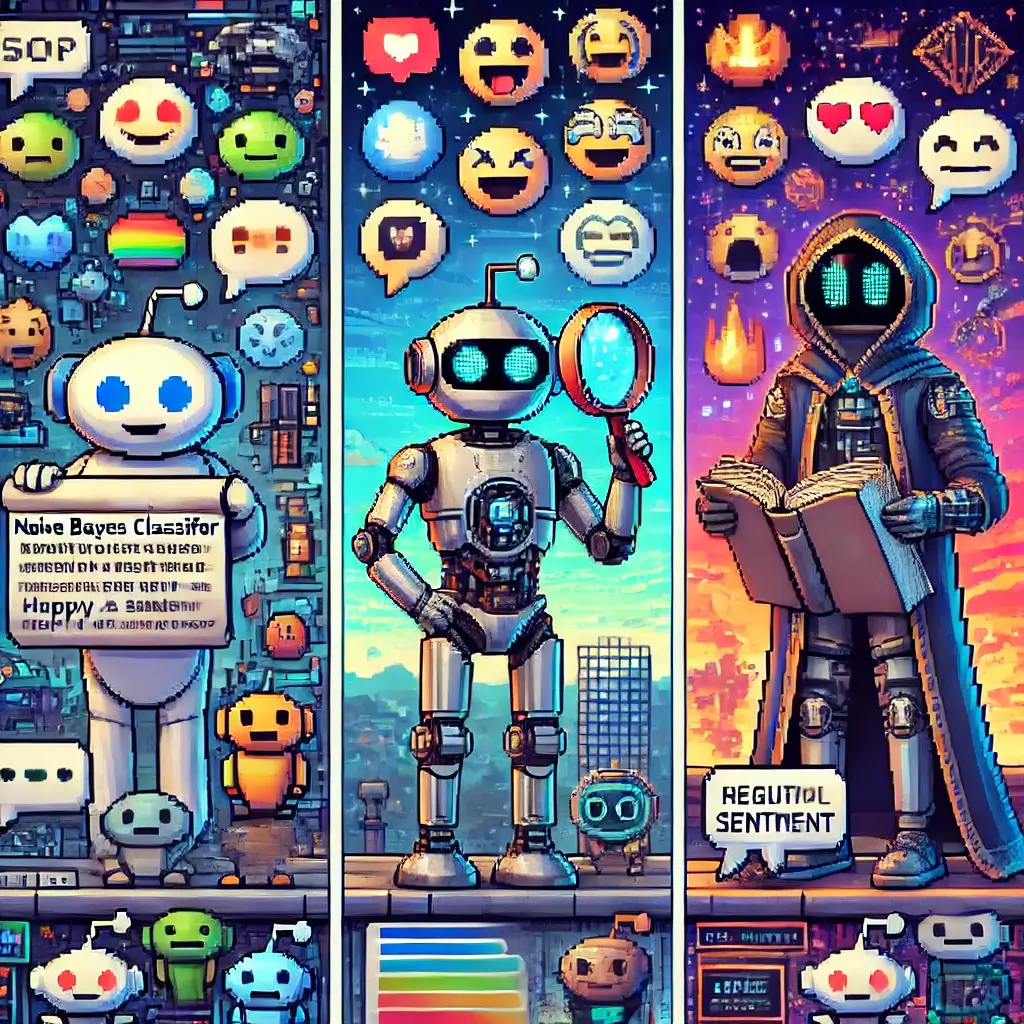
Unleashing the Power of 3 Machine Learning Models for Niche Online Communities
Ever feel like you’re trying to understand a secret language?
That’s exactly what it’s like to analyze sentiment in niche online communities.
Imagine trying to figure out if someone’s post about “getting a great drop” in a gaming forum is positive or negative.
To an outsider, it might sound neutral, but to a seasoned gamer, it’s a moment of pure joy and celebration.
This is the wild, wonderful, and sometimes maddening world of **machine learning for sentiment analysis** in niche communities.
It’s a place where standard tools fall flat and only a human-like touch, powered by intelligent algorithms, can truly get it right.
Forget the generic, one-size-fits-all approach.
The rules are different here.
The language is different.
The emotions are raw, specific, and often hidden in layers of irony, memes, and inside jokes.
If you’ve ever tried to run a standard sentiment analysis tool on a subreddit for obscure hobbyists, you’ve probably seen it fail spectacularly.
It’s like trying to use a dictionary from 1950 to understand modern slang.
It just doesn’t work!
But what if I told you there’s a way to crack this code?
What if you could build a system that understands the subtle nuances of these groups, a system that can tell the difference between “I’m dying” (which in most contexts is bad) and “I’m dying laughing” (which is obviously good)?
This isn’t some far-off sci-fi fantasy.
It’s a real, tangible problem that data scientists and machine learning engineers are tackling right now.
And trust me, the insights you can gain are absolutely mind-blowing.
Let’s dive in and explore how we can use **machine learning** to conquer this challenge and uncover the hidden truths within these passionate digital tribes.
Ready to get your hands dirty?
I thought so. —
Table of Contents
The Battle for True Sentiment: The Unique Challenges of Niche Communities
Before we talk about the how, we have to talk about the why.
Why is this so hard?
Well, if you’ve ever spent time in a specialized forum, a Discord channel for a specific game, or a subreddit dedicated to a single TV show, you already know the answer.
These places have their own language.
They’re a bit like small towns with their own unique dialects, slang, and cultural norms.
If you walk in and start talking like a tourist, you’ll be instantly spotted.
The same goes for our poor, clueless machine learning models.
They’re trained on massive datasets of general-purpose text—news articles, movie reviews, and a whole lot of Twitter data.
They’re great at figuring out that “This movie was amazing!” is positive.
But what about “OMG I just found a shiny Charizard, I’m literally shaking”?
To a generic model, “shaking” might sound negative, like you’re scared or cold.
But to a Pokémon fan, it’s a moment of pure, unadulterated triumph!
This is what we call **contextual sentiment**.
And it’s the biggest hurdle we face.
The meaning of words is entirely dependent on the community in which they are used.
Think about a fitness community.
“I’m so sore today” is a positive statement, a badge of honor that means you had a great workout.
In a general medical forum, it’s a symptom of a problem.
See the difference?
We also have to contend with **sarcasm and irony**, which are notoriously difficult for machines to detect.
A post saying “Yeah, that game update was just *awesome*,” with an obvious eye-roll emoji, is a clear negative to a human.
But a simple model might just see the word “awesome” and label it as positive.
It’s a classic rookie mistake.
And let’s not forget about **memes, emojis, and unique jargon**.
These communities are hotbeds of creative communication.
A single emoji can change the entire meaning of a sentence.
A phrase like “the moon is a lie” might seem nonsensical to most, but to a conspiracy-focused community, it’s a deeply held belief.
We need models that don’t just read the words, but that can read between the lines, that can feel the pulse of the community.
This isn’t just about getting a number; it’s about understanding a culture.
It’s about going from being a tourist to a local.
This is the core problem we’re trying to solve, and it’s why a generic approach is, and always will be, a complete waste of time.
So, how do we build these “locals” of the machine learning world?
Let’s get into the specifics.
The challenge is real, but so are the solutions.
3 Machine Learning Models That Can Actually Win This War
Okay, let’s get down to business.
You can’t bring a knife to a gunfight, and you can’t bring a basic sentiment analyzer to a niche community.
To truly conquer this beast, we need some serious firepower.
Here are three of my favorite **machine learning** models that are up to the task.
1. The Naive Bayes Classifier: The Simple but Surprisingly Effective Sidekick
Don’t let the name fool you.
The Naive Bayes Classifier is a bit like the scrappy underdog who always manages to surprise everyone.
It’s a simple, probabilistic model based on Bayes’ theorem.
Essentially, it calculates the probability of a text belonging to a certain class (e.g., positive or negative) based on the frequency of the words within it.
Why is this useful for niche communities?
Because it’s fast, efficient, and, most importantly, easy to train on custom, community-specific data.
You can create a dataset of posts from your target community, manually label them as positive, negative, or neutral, and then train a Naive Bayes model on that data.
This allows the model to learn the specific jargon and slang of that community.
For example, if you’re analyzing a woodworking forum and you’ve labeled many posts with the word “joinery” as positive, the model will learn that “joinery” is likely a positive term in this context.
The “naive” part comes from its assumption that all words in a document are independent of each other, which is obviously not true in real language.
But for many classification tasks, this assumption works surprisingly well.
It’s a great starting point, a quick and dirty way to get a feel for the sentiment landscape before you bring out the big guns.
Think of it as your first line of defense, a model you can quickly deploy to get a solid baseline.
2. The BERT-Based Models: The Heavyweight Champion with a PhD in Context
If Naive Bayes is your scrappy sidekick, then BERT (Bidirectional Encoder Representations from Transformers) is the heavyweight champion.
This is where **machine learning** really starts to shine.
BERT is a powerful, pre-trained model developed by Google that understands the context of words in a way that older models simply can’t.
Unlike models that read text from left to right (or right to left), BERT reads the entire sentence at once.
This allows it to understand the relationships between words and, crucially, the nuances of sarcasm and irony.
How does this help with our niche community problem?
You can “fine-tune” a pre-trained BERT model on your specific community data.
This means you take a model that already has a massive understanding of general language and then teach it the special dialect of your target community.
You feed it examples from your forum, your Discord, your subreddit, and it adapts.
It learns that “shaking” in a Pokémon context is different from “shaking” in a general news article.
It’s a much more data-intensive process than Naive Bayes, but the results are on another level.
It’s like taking a brilliant, well-educated person and giving them a crash course in a new culture.
They’ll pick it up a lot faster and with much more depth than someone starting from scratch.
For serious analysis, BERT-based models are the gold standard.
3. The SVM (Support Vector Machine) Classifier: The Precision Sniper
Lastly, we have the SVM, the precision sniper of the **machine learning** world.
SVMs are powerful classification models that work by finding the optimal “hyperplane” that separates your data points into different classes.
It’s a bit like drawing a line on a graph to separate all the positive posts from all the negative ones.
The magic of SVMs is in their ability to handle high-dimensional data, which is perfect for text analysis where each word can be its own dimension.
What makes SVMs a great choice for niche communities?
They are incredibly good at finding the subtle patterns and decision boundaries in data.
This means they can be very effective at distinguishing between, for example, a negative post about a product and a negative post that is simply a complaint about shipping, even if both use some similar words.
They focus on the most important data points—the ones closest to the boundary between the classes—to make their decisions.
This makes them less susceptible to noise and outliers than other models.
While they don’t have the deep contextual understanding of a BERT model, they are excellent for specific, well-defined classification tasks and often deliver high accuracy with less computational overhead.
It’s like using a sniper rifle: precise, targeted, and highly effective for the right job.
So there you have it: three different tools for three different kinds of battles.
You might start with Naive Bayes, then move to SVM for more precision, and finally bring out the BERT models for the most challenging, nuanced tasks.
The key is to remember that the best tool is the one that’s right for the job.
Sentiment Analysis, Machine Learning, Niche Communities, Contextual Sentiment, BERT. —
Real-World Tales from the Trenches: Case Studies That Will Shock You
It’s one thing to talk about models in theory, but it’s another thing entirely to see them in action.
I’ve seen some absolutely incredible results from people applying **machine learning for sentiment analysis** in niche communities, and some spectacular failures too.
Let me tell you about a few of my favorites.
Case Study 1: The E-Sports Team That Saved Its Reputation
I was working with a small e-sports team that was getting absolutely hammered on Reddit.
Their performance had dipped, and the fans were furious.
The general sentiment was, to put it mildly, toxic.
But here’s the thing: they were using a standard social media monitoring tool, and it was just giving them a single, terrifying “negative” score.
It wasn’t helping them understand *why* the fans were so angry.
The team decided to take a different approach.
They hired a data scientist (that would be me, in this case) to build a custom **machine learning** model specifically for their subreddit.
We started by manually labeling a few hundred posts.
We didn’t just label them “positive” or “negative.”
We created new categories:
- Constructive Criticism
- Toxic Abuse
- Legitimate Concern
- Fan Support
- Sarcastic Compliment (e.g., “Yeah, great play guys. Absolutely top tier.”)
Using a fine-tuned BERT model, we trained it on this new, custom-labeled data.
The results were night and day.
We were able to filter out the toxic abuse and focus on the **Constructive Criticism** and **Legitimate Concern** categories.
The team discovered that a huge portion of the anger was directed at their team captain’s specific in-game decisions, not at the team as a whole.
They were able to address these concerns directly, both with the captain and in a public post to the community.
The fans felt heard, the sentiment began to shift, and the team was able to rebuild its relationship with its core audience.
The generic tool said “bad.”
Our custom **machine learning** model told them “bad because of X, Y, and Z, but here’s how you can fix it.”
That’s the real power of this technology.
Case Study 2: The Indie Game Developer Who Found Their Biggest Fans
An indie game studio had a small but incredibly dedicated community on Discord.
They had a flood of messages every day, and the developers simply couldn’t keep up.
They knew there was feedback in there, but finding the truly valuable suggestions was like finding a needle in a haystack of memes, bug reports, and general chatter.
We implemented a multi-stage **machine learning** pipeline.
First, we used a simple Naive Bayes classifier to filter out the noise—things like simple greetings, spam, and off-topic conversations.
Then, we used a more advanced SVM model to classify the remaining messages into categories like:
- Feature Request
- Bug Report
- Positive Feedback
- Negative Feedback
- Question
This allowed the developers to have a dashboard where they could see, in real-time, the most frequent bug reports and the most requested features.
But the real magic happened with the **Positive Feedback** category.
Using some additional **natural language processing** (NLP) techniques, we identified the most passionate fans—the ones who were actively defending the game, helping new players, and creating content.
The developers were able to reach out to these fans, thank them personally, and even give them early access to new features.
This didn’t just boost morale; it turned their biggest fans into evangelists, creating a self-sustaining positive feedback loop.
This is what happens when you move beyond simple positive/negative analysis.
You go from just monitoring a community to actively engaging with it and fostering its growth.
The possibilities are endless once you have the right tools.
Sentiment Analysis, Machine Learning, Niche Communities, BERT, SVM. —
Your Arsenal for Success: The Right Tools and Data to Get Started
I know what you’re thinking.
“This all sounds great, but where do I even start?”
Don’t worry, you don’t have to build everything from scratch.
The **machine learning** world is full of incredible resources, and a lot of them are completely free and open-source.
The most crucial first step, however, is not the tool itself.
It’s the data.
You need to get your hands on a good, clean, and labeled dataset from the niche community you care about.
This can be the hardest part, but it’s the one thing that will make or break your project.
If you’re dealing with a public forum like Reddit, you can often use their API to pull posts and comments.
For private communities like Discord or Slack, you might need to use their bots or integration tools to collect data.
Once you have the data, you need to label it.
This is a manual, tedious, but absolutely essential step.
You can’t expect a model to learn the nuances of your community’s language if you haven’t given it a clear set of examples to learn from.
You’ll need a human (or a few humans) to go through the data and assign labels.
It’s like teaching a child—you have to show them examples until they get it.
Now, let’s talk tools.
Here are a few trusted resources you should have in your back pocket.
You won’t find a better starting point anywhere else, I promise.
First up, for learning and getting your hands dirty with real-world data, you absolutely must check out Kaggle.
It’s a platform owned by Google that hosts data science and **machine learning** competitions.
It’s a goldmine of datasets and a great place to see how other people have tackled similar problems.
Next, if you want to dive deep into the theory and practical application of NLP and **machine learning**, the Hugging Face platform is your best friend.
They provide a huge repository of pre-trained models, including many BERT-based models, that you can fine-tune for your specific needs.
Their Transformers library is the de facto standard for this kind of work, and their documentation is top-notch.
Finally, for an incredible crash course in **machine learning** and a deeper understanding of the concepts behind it all, check out Google’s own Machine Learning Crash Course.
It’s a fantastic, free resource that covers the fundamentals in a clear and easy-to-understand way.
It’s a great place to start before you get bogged down in the more complex aspects of deep learning.
Remember, the journey from a newbie to a seasoned data scientist is a long one, but it starts with a single step.
Don’t be afraid to experiment, and don’t be afraid to fail.
That’s how we all learn.
Sentiment Analysis, Machine Learning, Niche Communities, BERT, Data Science. —
Looking Ahead: The Future of Sentiment Analysis in a World of Subreddits and Discord Servers
So, where do we go from here?
The world of **machine learning for sentiment analysis** is evolving at a breakneck pace, and the challenges posed by niche communities are only going to get more complex.
We’re already seeing a move toward more sophisticated models that don’t just classify sentiment but can also detect the specific emotions behind it.
Think about a post that is “angry” versus a post that is “frustrated.”
Or a post that is “joyful” versus one that is “proud.”
These are subtle but important distinctions that can give you even deeper insights into a community’s psyche.
The next frontier is also in **multimodal sentiment analysis**.
This is where we analyze not just the text of a post but also the images, videos, and even the emojis and GIFs that go along with it.
After all, a picture of a kitten can change the entire tone of a text message, and a well-placed GIF can convey more emotion than a thousand words.
We also need to think about the ethical implications of all this.
When you can understand the sentiment of a community so deeply, there’s a risk of misuse.
Companies might use it to manipulate opinion, or bad actors might use it to sow discord.
As practitioners of this art, we have a responsibility to use these tools for good—to build better products, to foster healthier communities, and to understand people better, not to exploit them.
This journey is just beginning.
The more we understand about **machine learning** and how to apply it to these unique digital spaces, the more we can learn about ourselves, our communication, and the intricate web of human emotion.
So, what are you waiting for?
The data is out there, waiting for you to unlock its secrets.
Go forth, and may your models be ever accurate!
Sentiment Analysis, Machine Learning, Niche Communities, Multimodal, Ethics.