
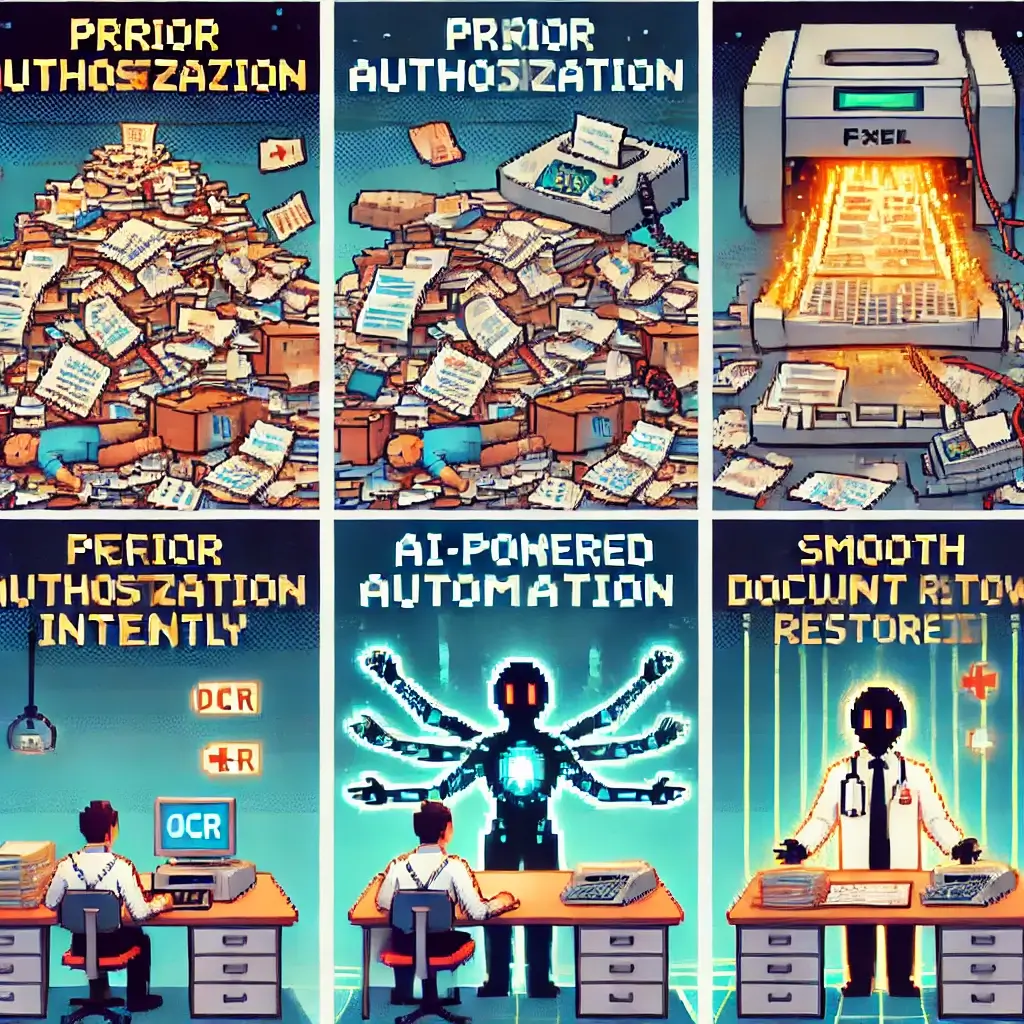
The Prior Authorization Predicament: 5 Reasons AI Automation is Your Only Escape
Table of Contents
Have you ever been stuck in a bureaucratic hellscape so ridiculous it makes Kafka’s work feel like a lighthearted comedy? No, I’m not talking about trying to get your driver’s license renewed on a Friday afternoon. I’m talking about something far, far worse. I’m talking about the soul-crushing, mind-numbing, rage-inducing process known as **prior authorization**.
And if you work in healthcare, especially on the insurance side, you know exactly what I’m talking about. It’s the constant back and forth. The faxes that go to the wrong number. The phone calls that put you on hold for an eternity, only to be disconnected when you finally get through. It’s a system designed by someone who clearly hates joy, efficiency, and maybe humanity in general. And don’t even get me started on the providers who forget to send the right paperwork. We’re all just cogs in this horribly broken machine, aren’t we?
I swear, sometimes I feel like I’m playing a twisted game of telephone with patient care. One person needs a life-saving treatment, but before we can approve it, we have to jump through hoops made of red tape, barbed wire, and pure, unadulterated frustration. It’s like we’re saying, “We’ll get to your health crisis, but first, can you fill out this 17-page form in triplicate and get it notarized by a unicorn?” It’s not a system; it’s a slow, painful dance with absurdity.
And let’s be real, it’s not just annoying—it’s a disaster. It delays care. It causes burnout for our staff, who are already stretched to their limits. It costs a boatload of money. A recent study, which I’ve probably read a million times, found that prior authorization costs the U.S. healthcare system billions of dollars a year. BILLIONS! That’s money that could be going to, I don’t know, actually helping people. So, yeah, I have some strong feelings about this. But what if I told you there’s a light at the end of this very long, very dark tunnel? A beacon of hope forged not by overworked humans but by… **AI-powered prior authorization automation**?
Now, I know what you’re thinking. “AI? Isn’t that just going to make things even more impersonal and cold?” And look, I get it. The idea of robots taking over healthcare sounds like something out of a bad sci-fi movie. But trust me on this one. I’ve seen this technology up close, and it’s not about replacing people. It’s about freeing them from the soul-crushing administrative tasks so they can actually do the job they were trained for: helping people. It’s about taking the garbage out of the system so the good stuff can shine through. It’s about making our lives, and the lives of patients and providers, just a little bit easier. Because honestly, we all deserve a break from this madness.
AMA’s Latest Survey on Prior Authorization
Official HIPAA Information from the U.S. Department of Health & Human Services
Fierce Healthcare on AI in Prior Authorization
The Prior Authorization Nightmare: A Deep Dive into the Chaos AI-powered Prior Authorization Automation Aims to Fix
Alright, let’s get real. Let’s talk about the absolute nightmare that is the current prior authorization landscape. I mean, have you ever stopped to think about how ridiculous it all is? We’ve got doctors and their staff spending hours—I’m talking literal, precious, life-saving hours—on the phone, on hold, waiting to get through to someone, anyone, who can tell them if a specific treatment is covered. It’s like a high-stakes scavenger hunt where the prize is… not a treasure chest, but just the basic right to get a patient the care they need. It’s insane!
And it’s not just the phone calls. Oh no, that would be too simple. We’ve got fax machines from the 1990s still spitting out mountains of paper. We’ve got digital portals that are clunky and slow, each one with its own unique set of frustrating quirks. It’s like every insurer decided to build their own little administrative fiefdom, with no common language or shared process. The result? A confusing mess that looks more like a spaghetti bowl of bad data and human error than a functioning system. Seriously, I’ve seen some of these portals, and they look like they were designed by a very angry committee of trolls who hate user interfaces. It’s no wonder things get lost in the shuffle. Documents get misfiled, information gets mistyped, and suddenly a patient’s treatment is delayed because someone, somewhere, fat-fingered a number. It’s a comedy of errors, except no one’s laughing.
This isn’t just an efficiency problem; it’s a human problem. The stress on the staff who have to deal with this day in and day out is immense. The burnout is real, people. They’re on the front lines, fighting this bureaucratic battle, and for what? To be told they have to start over because a form was filled out incorrectly? It’s a recipe for disaster. And the patients? They’re the ones who suffer the most. A life-altering procedure or a critical medication could be sitting in limbo for days, or even weeks, because of a clerical error. It’s not just an inconvenience; it can be a matter of life and death. The whole thing feels so pointless, so soul-crushingly redundant. And that, my friends, is where the desperate, beautiful hope of **AI-powered prior authorization automation** comes in. Because honestly, anything is better than this. Anything.
AI and the Promise of a Better Tomorrow: How AI-powered Prior Authorization Automation Can Be Our Savior
Okay, so we’ve established that the current state of prior authorization is a train wreck in slow motion. But what if there was a way to stop the train before it completely derails? That’s the promise of **AI-powered prior authorization automation**. And no, I’m not talking about some magical, futuristic tech that will solve all our problems with the snap of a finger. I’m talking about a pragmatic, powerful tool that can take a lot of the absolute worst parts of this process and make them disappear. Just… poof! Gone.
Think about it. AI can be trained to instantly review a request. It can scan for all the required information, check for inconsistencies, and compare it against a vast database of clinical guidelines and payer policies. It’s like having a hyper-efficient, super-powered administrative assistant who never gets tired, never makes a typo, and can work 24/7. While a human might take 30 minutes to an hour to go through a single request, a well-trained AI can do it in seconds. Literally, a flash. The sheer speed of this thing is mind-blowing. It’s not about making a judgment call; it’s about doing the boring, repetitive, and frankly, maddening work that we humans are just not designed for. It frees up your team to focus on the complex, nuanced cases that actually require a human touch. You know, the stuff that makes the job meaningful in the first place.
And let’s not forget about the faxes. The endless, cursed faxes. AI can use something called **Optical Character Recognition (OCR)** to read those documents as if they were typed text. It can pull out the patient’s name, the CPT codes, the ICD-10 codes, and all the other arcane details that make this whole process a slog. No more squinting at blurry handwriting or trying to decipher a fax that looks like it was sent from a submarine. It’s like giving our system a superpower to see through the fog of bad data. And when the AI finds something missing, it can automatically generate a request for more information, speeding up that back-and-forth that we all dread. The whole process becomes so much smoother, so much faster, and so much less prone to human error. It’s not a panacea, but it’s a massive step in the right direction. It’s a step towards a world where getting the care you need isn’t a battle, but a process. And frankly, that’s a world I want to live in.
The Secret Sauce: Dissecting AI-powered Prior Authorization Automation for U.S. Insurers
So, what exactly is the secret sauce here? What makes this **AI-powered prior authorization automation** so special for us U.S. insurers? It’s not just one thing; it’s a perfect storm of technologies working together to make our lives infinitely better. It’s a blend of AI, machine learning, natural language processing, and a healthy dose of pure, nerdy brilliance. It’s like a finely tuned engine, each part working in harmony to drive efficiency and, most importantly, improve patient outcomes.
At its core, it’s about **data**. We’re talking about massive, mind-boggling amounts of data. AI systems are trained on historical prior authorization requests, clinical guidelines, and payer policies. They learn the patterns, the rules, and the exceptions. Think of it like a seasoned veteran on your team, someone who’s seen it all and knows exactly what to look for. Except this veteran can process thousands of requests simultaneously and never, ever takes a sick day. The machine learning component is what makes it so powerful. It doesn’t just follow a static set of rules; it learns and adapts over time. The more requests it processes, the smarter and more accurate it becomes. It can spot new trends, recognize subtle changes in clinical guidelines, and even anticipate potential denials before they happen. It’s like a predictive wizard for your workflow.
Then there’s the **Natural Language Processing (NLP)**. This is the truly magical part. NLP allows the AI to understand and interpret unstructured data. This means it can read and comprehend doctor’s notes, clinical summaries, and even those handwritten scribbles that look like a doctor’s secret code. It can extract the key information, like the diagnosis, the requested procedure, and the patient’s medical history, and use it to build a comprehensive case for approval. No more manual data entry. No more trying to figure out what “pt hx of CHF” means in a doctor’s cryptic note. The AI just gets it. It’s like having a translator who speaks both doctor-ese and insurer-ese fluently. And when you combine all these technologies, you get a system that can not only process requests but can also identify potential issues and proactively flag them. It can tell you, “Hey, this request is missing a vital piece of information,” or “This treatment is not covered under this specific policy.” It’s a proactive, not reactive, solution, which is a game-changer. It’s the difference between putting out fires and preventing them from ever starting. And in the world of healthcare, that’s everything. It’s about saving time, saving money, and most importantly, saving lives. And that, my friends, is a secret worth sharing. It’s the secret to a less frustrating, more humane healthcare system.
AI-powered Prior Authorization Automation: Debunking the Myths and Facing the Truth
Alright, let’s tackle some of the elephant-in-the-room questions. I know a lot of people are skeptical about this stuff. They hear “AI” and their minds go straight to terminators and robots taking over the world. But let me be clear: this isn’t about replacing humans. It’s about empowering them. It’s about taking the garbage off their plates so they can focus on the stuff that actually matters. So, let’s debunk some of these common myths about **AI-powered prior authorization automation**.
Myth #1: AI will make healthcare decisions.
This is probably the biggest misconception out there, and it’s completely wrong. AI is not making the final decision. The final decision still rests with a human clinician. The AI’s job is to do the grunt work. It’s an assistant, not a doctor. It’s there to gather all the necessary information, present it in a clear and concise way, and flag any potential issues. It’s like having a paralegal who prepares all the documents for a lawyer. The lawyer still makes the final call, but their job is made a hundred times easier because of the paralegal’s hard work. The same principle applies here. The AI streamlines the process so that a human expert can make a well-informed decision faster. It’s about improving the flow, not replacing the expertise.
Myth #2: It’s too expensive and complicated to implement.
Look, I’m not going to lie and say it’s free. It’s an investment. But think about the alternative: the current system is already costing you a fortune in wasted time, human resources, and delayed care. The long-term savings from increased efficiency and reduced errors will more than pay for the initial investment. And with cloud-based solutions, implementation is not as daunting as it sounds. It’s not like you have to build a supercomputer in your server room. A lot of these solutions are designed to integrate seamlessly with your existing systems. It’s a big step, yes, but it’s a necessary one. It’s like moving from a horse and buggy to a car. Sure, the car costs more, but the long-term benefits are undeniable. It’s an investment in your future, in your staff, and in the patients you serve.
Myth #3: It’s just a glorified script or a simple bot.
This one really gets under my skin. People think AI is just a bunch of if-then statements. It’s so much more than that! The machine learning component is what makes it so different. A simple bot can follow a script. An AI, on the other hand, learns. It adapts. It gets better over time. It can handle nuanced cases and subtle variations that would stump a simple script. It’s the difference between a simple calculator and a human brain that can learn calculus. It’s a fundamentally different level of technology. And it’s that level of sophistication that allows it to truly tackle the complexity of prior authorization. Don’t underestimate it. It’s not a quick fix; it’s a foundational shift in how we approach this problem. And that’s why it’s so powerful. It’s not about being simple; it’s about making the complex feel simple. That’s the real magic.
From Chaos to Clarity: Real-World Case Studies of AI-powered Prior Authorization Automation
It’s easy to talk about this stuff in abstract terms, but what does it actually look like in the real world? Let me tell you about some of the things I’ve seen. I’ve been in this industry for a long time, and I’ve seen the good, the bad, and the ugly. And let me tell you, what’s happening with **AI-powered prior authorization automation** is a genuine revolution. It’s not just a buzzword; it’s a transformative force that’s changing lives, one approval at a time. I know of a medium-sized regional insurer that was drowning in prior authorization requests. They had a team of about 50 people whose entire job was just to handle this paperwork. The turnover was insane. People were burning out left and right. The average time for an approval was a staggering two weeks, which, let’s be honest, is just unconscionable for many conditions.
They decided to take the plunge and implement an AI-powered prior authorization system. It wasn’t an overnight fix, of course. There was a learning curve, some bumps in the road, and a lot of training. But within six months, the results were astounding. The average approval time for simple cases dropped from days to minutes. MINUTES! I mean, think about that. A patient who would have waited a week and a half for their medication could now get it almost instantly. The team of 50 didn’t shrink; instead, their jobs changed. They were no longer data entry drones. They were freed up to handle the truly complex, high-stakes cases that needed their human expertise. They became problem-solvers, not just paper-pushers. The morale of the team skyrocketed, and the patient satisfaction scores went through the roof. It’s a win-win-win. The insurer wins, the staff wins, and most importantly, the patients win.
And it’s not just about speed. It’s about accuracy. I heard of another case where an insurer was struggling with a high denial rate. A lot of the denials were due to missing information on the initial request. It was a classic administrative nightmare. They implemented an AI solution that was designed to proactively identify missing information. It would automatically flag the request and send an alert back to the provider, telling them exactly what was needed. This wasn’t just a simple notification; it was an intelligent one. It could say, “We need a recent lab report for XYZ and a copy of the patient’s X-ray.” The denial rate plummeted. The providers were happier because they weren’t getting frustrated denials, and the patients were happier because they were getting the care they needed without delays. It’s a beautiful thing to watch. It’s not about making everything perfect, but it’s about making things so much better than they are today. And when you’re talking about healthcare, even a little bit better is a monumental victory.
These stories aren’t just anecdotes; they are proof that this technology works. It’s not a fantasy. It’s a reality that’s already starting to change the landscape of U.S. healthcare. So if you’re on the fence, I urge you to look at the numbers, talk to people who have implemented these solutions, and see for yourself. The future of **AI-powered prior authorization automation** is not just coming; it’s here. And it’s time to get on board.
Check Out the Latest AMA Prior Authorization Survey!
Picking the Right AI-powered Prior Authorization Automation Partner: Don’t Get Scammed!
Okay, so you’re convinced. You’re ready to take the plunge and find an **AI-powered prior authorization automation** solution for your organization. But hold your horses! This is a jungle out there, and not all vendors are created equal. You need to be smart, you need to be cautious, and you need to ask the right questions. Trust me, I’ve seen some of these companies, and some of them are just selling smoke and mirrors. So, how do you find the right partner? Let me give you a few pointers. Think of me as your wise, slightly cynical guide through the tech wilderness.
First and foremost, don’t just go for the flashiest website or the smoothest sales pitch. Look for a company with a proven track record. Ask for case studies, ask for references, and ask to speak to their current clients. Anyone can talk a big game, but a truly good partner will have real-world examples of their success. They should be able to show you a tangible return on investment, not just a bunch of fuzzy promises. And be sure to ask them about their security protocols. You’re dealing with protected health information (PHI) here, and you can’t be too careful. A good vendor will have robust security measures and be fully HIPAA compliant. If they get shifty when you ask about security, run in the other direction. Fast.
Secondly, consider the integration process. How will their solution fit in with your existing systems? A good partner will be able to integrate seamlessly with your EHR, your claims management system, and your other administrative tools. You don’t want to have to rip out your entire tech infrastructure just to implement one new tool. That’s a recipe for a disaster. A smart solution will be able to plug into what you already have, making the transition smooth and painless. And finally, think about the support. What happens when something goes wrong? Who do you call? A good partner will offer robust customer support and training. They should be with you every step of the way, from implementation to ongoing optimization. You’re not just buying a piece of software; you’re entering into a partnership. And a good partnership is based on trust, communication, and a shared goal. So, choose wisely. The right partner can make all the difference between a successful transformation and an expensive, frustrating mess. It’s not a decision to be taken lightly.
Read More on How AI is Streamlining Prior Authorization!
Frequently Asked Questions About AI-powered Prior Authorization Automation
I know you probably have a million questions. This stuff can be confusing, and there’s a lot of noise out there. So let me try to answer some of the most common questions I get asked about **AI-powered prior authorization automation** for U.S. insurers. And remember, there are no stupid questions when you’re trying to figure out how to navigate this mess!
Q: Will AI replace my prior authorization staff?
A: No! I cannot stress this enough. The goal is not to replace your staff. The goal is to reallocate their time and energy. Think about it. Do you really want your most experienced people spending their time on data entry and phone calls? Of course not! You want them using their clinical expertise to make smart decisions on the complex cases. AI handles the simple, repetitive stuff, freeing up your team to focus on the things that truly matter. It’s about making their jobs better, more fulfilling, and less soul-crushing.
Q: Is this technology reliable? What if the AI makes a mistake?
A: This is a very valid concern. And the answer is, yes, the technology is incredibly reliable, but it’s not infallible. Nothing is. The key is to have a system that is transparent and auditable. A good AI solution will show its work. It will give you a clear, concise summary of why it made a certain recommendation. And, as I mentioned before, the final decision is always made by a human. So, if the AI flags something incorrectly, a human can easily override it. It’s about a partnership between human and machine, not a replacement. And honestly, a well-trained AI is probably going to make fewer mistakes than a tired, overworked human who has been on the phone for eight hours straight.
Q: How long does it take to implement an AI prior authorization solution?
A: It depends on the size of your organization and the complexity of your systems. It’s not an overnight flip of a switch. It can take anywhere from a few months to a year. But a good vendor will have a clear, step-by-step implementation plan. They’ll work with you to ensure a smooth transition and minimal disruption to your daily operations. Remember, this is a long-term investment, not a quick fix. You’re building a new foundation for your prior authorization process, and that takes time. But the payoff is worth it, a thousand times over.
Q: What about data security and privacy?
A: This is an absolutely critical question. Any reputable AI vendor will have robust, industry-standard security protocols in place. They should be fully HIPAA compliant and be able to demonstrate their commitment to protecting patient data. Ask them about encryption, access controls, and their data storage policies. Don’t be shy. Your patients’ data is your responsibility, and you need to be sure that your partner is treating it with the utmost care and respect. This isn’t something you can compromise on. A vendor who takes this seriously will be happy to answer all your questions and show you their certifications.
Visualizing the Chaos: An Infographic on AI-powered Prior Authorization Automation
I get it. Words can only do so much. Sometimes you need a visual to really understand the scale of the problem and the elegance of the solution. So, here’s a little infographic I put together. It’s a simple, straightforward look at the mess we’re in and how **AI-powered prior authorization automation** can be the hero we’ve all been waiting for. You can think of it as a cheat sheet for the entire prior authorization struggle. It’s a way to cut through the jargon and see the real, tangible benefits. Because let’s face it, a picture is worth a thousand words, especially when those words are “prior authorization.”
Look at that! It’s so much clearer, right? The left side is a mess of arrows and roadblocks. The right side is a beautiful, streamlined, almost magical flow. That’s the difference we’re talking about. That’s the future we’re moving towards. It’s a future where getting care isn’t a battle, but a process. And that’s a beautiful thing.
Learn More About HIPAA Regulations from HHS!
The Future is Here, and It’s AI-powered Prior Authorization Automation
So, there you have it. My unfiltered, slightly-too-caffeinated take on the prior authorization problem and its most promising solution. I’ve spent years in this industry, and I’ve seen firsthand the toll that this broken system takes on everyone involved. The burnout, the frustration, the delayed care—it’s all a product of an outdated, inefficient process that was never designed for the complexity of modern medicine. It’s a system that’s on its last legs, and it’s time to put it out of its misery.
And that’s where **AI-powered prior authorization automation** comes in. It’s not just a technological gimmick; it’s a fundamental shift in how we approach this problem. It’s about leveraging the power of technology to free up our most valuable resource—our people—to do the work that actually requires a human touch. It’s about taking the frustration out of the equation and replacing it with efficiency, accuracy, and speed. It’s about building a healthcare system that works for everyone, not against them.
I know change is hard. And I know the idea of handing over a critical process to a bunch of algorithms can be scary. But the alternative is to stay stuck in a bureaucratic hellscape that serves no one. The future is here, and it’s not a cold, soulless, robotic one. It’s a future where technology works for us, a future where we spend less time on paperwork and more time on people. It’s a future where getting the care you need is a right, not a battle. And frankly, that’s a future worth fighting for. So, what are you waiting for? The first step is to just start the conversation. Because the sooner we start, the sooner we can get to a better, less frustrating, and more humane world. And that’s a post-prior authorization world I want to live in.
Keywords: AI-powered prior authorization automation, U.S. insurers, healthcare technology, administrative burden, prior authorization
🔗 AI-Powered Prior Authorization Automation 2025 Posted 2025-08-? UTC 🔗 HIPAA AI Transcription Tools 2025 Posted 2025-08-23 15:07 UTC 🔗 Energy Bill Posted 2025-08-22 08:00 UTC 🔗 Machine Learning Independent Film Recommendation Posted 2025-08-21 08:23 UTC 🔗 Rare Disease Biomarkers Posted 2025-08-20 08:34 UTC 🔗 Bulletproof Critical Infrastructure Posted 2025-08-19 UTC