
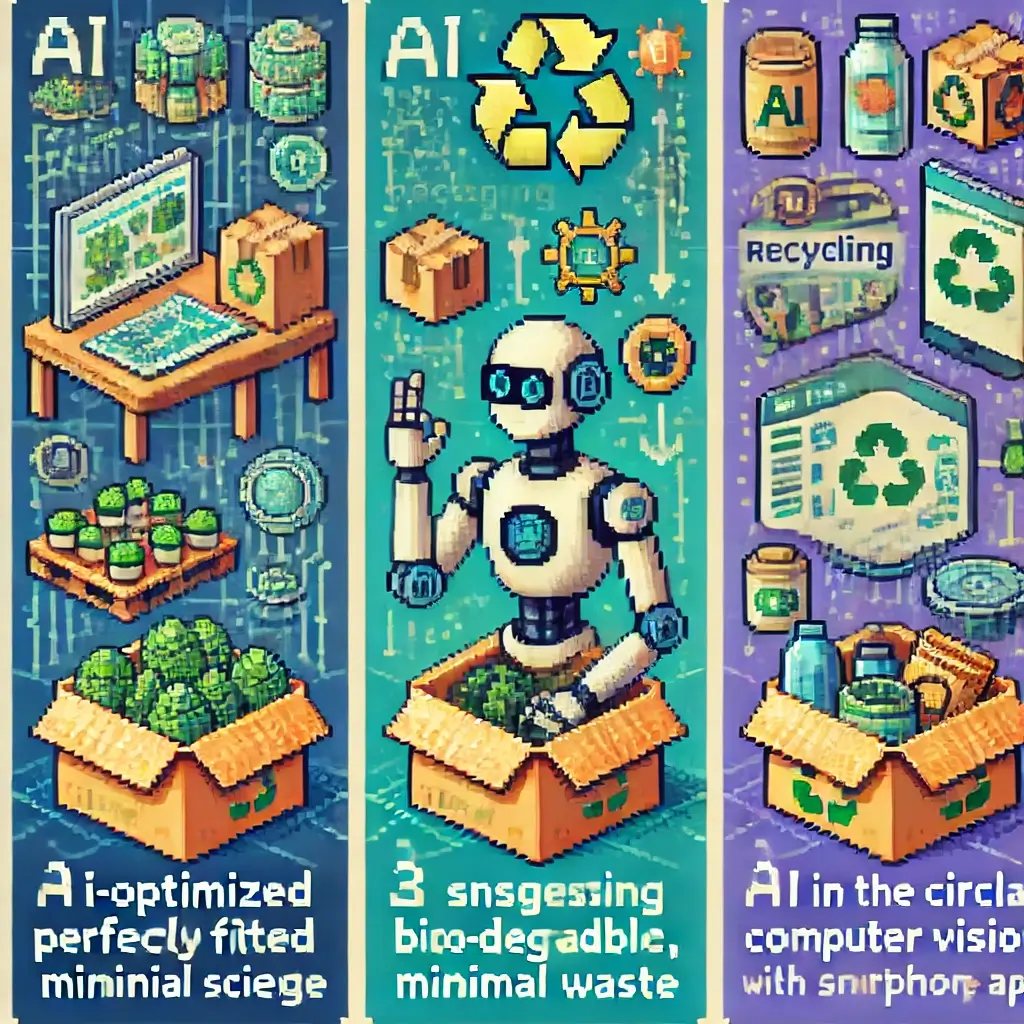
3 AI-Powered Packaging Innovations That Will Blow Your Mind!
I’ve been in the packaging game for over two decades, and let me tell you, things have changed.
The old ways of doing things—relying on guesswork, manual prototyping, and a whole lot of trial and error—are, frankly, obsolete.
We’re standing at a crossroads, and one path is leading us toward a future where a box isn’t just a box, but a smart, sustainable piece of a larger, more responsible system.
And the engine driving this incredible transformation?
Artificial Intelligence.
AI isn’t just for sci-fi movies anymore. It’s in our everyday lives, from the songs Spotify recommends to the routes Google Maps suggests.
Now, it’s shaking up the packaging industry in ways I never thought possible, and the best part is, it’s making everything greener and more efficient.
I’m not just talking about some futuristic fantasy here; this is happening right now, in real time.
Today, I want to pull back the curtain and show you exactly how AI is not only designing sustainable packaging solutions but also completely rewriting the rulebook on how we think about waste, materials, and the circular economy.
So grab a coffee, get comfortable, and let’s dive into a topic that’s not just about boxes, but about the future of our planet.
It’s an exciting, mind-bending ride, and you’re going to love what you see.
I’ll be honest, when I first heard about AI in packaging, I was skeptical.
I thought, “How can a computer possibly understand the nuances of a great unboxing experience, or the tactile feel of a high-quality material?”
But I was wrong.
AI doesn’t just replicate; it optimizes, innovates, and creates new possibilities that a human designer, no matter how brilliant, simply couldn’t on their own.
It’s a partnership, a super-powered collaboration that is giving us some truly incredible results.
And I’m going to share with you three of the most revolutionary ways I’ve seen AI applied to sustainable packaging.
Trust me, these aren’t just minor tweaks; they are fundamental shifts that are changing everything.
It’s all about making packaging smarter, more efficient, and, most importantly, environmentally responsible.
Let’s get into it. —
Table of Contents
The First Revolution: Hyper-Optimized AI Packaging Design
Remember the days of giant boxes filled with endless packing peanuts?
Yeah, those days are on their way out, and thank goodness for that.
The first, and in my opinion, most immediate impact of AI is in the design phase.
AI-powered generative design software is like having an army of brilliant designers working on your project 24/7.
Instead of a designer creating a few concepts, an AI can generate thousands of potential designs in a fraction of the time.
But it’s not just about speed.
The magic is in the data.
You feed the AI parameters—the product’s dimensions, its fragility, the material you want to use (like cardboard or a bioplastic), and crucially, your sustainability goals.
The AI then uses algorithms to create a design that is perfectly optimized for everything you asked for.
It can create a box that uses the absolute minimum amount of material while still providing maximum protection.
It’s a delicate balancing act, and AI performs it with a precision a human simply can’t match.
Think of it this way: a human designer might create a box that’s 90% efficient.
An AI can push that to 98% or even 99%.
That small percentage might not sound like a lot, but when you’re producing millions of packages, it translates into a massive reduction in material use, lower transportation costs (lighter packages are cheaper to ship!), and a huge cut in your carbon footprint.
It’s a game changer, no doubt about it.
I’ve seen this firsthand with a client who used AI to redesign their shipping boxes for a line of electronics.
Their previous boxes were standard fare—a bit of empty space, some bubble wrap—you know the drill.
The AI came back with a new design that was so perfectly form-fitting it looked like a custom-molded case, all made from a single sheet of recycled corrugated cardboard.
They cut their material use by 30% and their shipping costs by 15%.
It was a win-win-win situation: better for the planet, better for their bottom line, and a much better unboxing experience for the customer.
It’s like the AI is a master puzzle solver, finding the one perfect configuration out of an infinite number of possibilities.
The results are designs that are not just sustainable, but smarter in every way.
It’s truly a beautiful thing to witness.
And this is just the beginning.
This kind of AI-driven design optimization is becoming the new standard.
It’s not a niche thing anymore; it’s a necessary tool for any company serious about reducing waste and staying competitive. —
The Second Revolution: AI-Powered Material Science & Selection
Choosing the right material for packaging used to be a headache.
You had to balance cost, durability, and a host of other factors.
Now, with the push for sustainability, you have to add recyclability, compostability, and carbon footprint into the mix.
It’s a dizzying array of variables.
This is where AI comes in like a hero in a cape.
AI models are being trained on vast datasets of material properties, lifecycle assessments, and supply chain data.
This allows them to analyze and recommend materials that are not only fit for purpose but also have the lowest possible environmental impact.
I remember a time when a brand would just say, “Let’s use plastic, it’s cheap.”
Now, that same brand can use an AI tool to explore a whole universe of options.
The AI can recommend a new type of bioplastic made from seaweed, or a recycled paper composite that’s stronger than the virgin material they were using before.
It’s not just about picking from a list; it’s about discovering entirely new possibilities.
Companies like Nestlé and IBM are already on this path, using AI and deep tech to find new packaging solutions that meet strict food safety, quality, and sustainability requirements all at once.
The AI models, trained on mountains of materials data, can propose high-barrier materials that are not only eco-friendly but also do a better job of protecting the product from moisture and oxygen.
This isn’t just good for the planet; it’s good business.
Extended shelf life means less food waste, which is a huge sustainability win in its own right.
It’s a perfect example of how AI isn’t just an “add-on” for sustainability, but a core driver of both environmental and business success.
Another huge part of this is the ability of AI to model and simulate how different materials will behave.
Instead of making dozens of physical prototypes, a company can run a virtual simulation to see how a new material will hold up under stress, temperature changes, and impact.
This saves a tremendous amount of time, money, and, of course, material waste.
It’s like having a crystal ball for your packaging.
This is the kind of stuff that makes me excited to get up in the morning.
It’s the perfect marriage of cutting-edge technology and environmental responsibility. —
The Third Revolution: AI and the Circular Economy
For too long, packaging has been part of a linear economy: take, make, waste.
You use a product, toss the packaging, and it ends up in a landfill.
The circular economy is all about closing that loop, keeping materials in use for as long as possible.
And guess what?
AI is the key to making this a reality.
From the moment a package is created to the moment it’s recycled or composted, AI is providing unprecedented visibility and efficiency.
Think of those smart recycling systems.
AI-powered computer vision systems can identify different types of plastics, paper, and glass with incredible accuracy, far beyond what a human sorter can do.
This ensures that materials are properly sorted and prepared for recycling, leading to higher-quality recycled materials and a truly closed loop.
It’s a simple idea with a massive impact on waste reduction and material recovery.
But it goes even further than that.
What if every package could tell you how to recycle it?
A Swedish company called Bower has an app that uses AI to identify packaging materials.
Users can scan a barcode or a photo of an item, and the app tells them where the nearest recycling point is, and even rewards them for doing it!
It’s a perfect example of how AI can drive consumer behavior toward sustainability.
It’s not just a brand telling you to recycle; it’s a personalized, rewarding experience that makes doing the right thing easy.
But the circular economy isn’t just about recycling; it’s also about reducing waste at the source.
AI is helping with this too, through predictive analytics in the supply chain.
By analyzing demand patterns, AI can help companies produce the exact right amount of packaging, preventing overproduction and the mountain of waste that comes with it.
It’s a holistic approach, a complete rethink of the entire lifecycle of a product and its packaging.
AI is not just a tool for designing a single box; it’s the brain that connects the dots across the entire system, from design and production to consumer use and eventual disposal.
It’s the foundation of a new, more sustainable way of doing business.
And it’s a future I’m incredibly optimistic about.
These three revolutions—optimized design, smarter material selection, and circular economy integration—are just a taste of what’s possible.
The pace of innovation is staggering, and every day brings new breakthroughs.
It’s a new chapter for packaging, and AI is the author.
Are you ready to be a part of it?
AI, sustainable packaging, circular economy, waste reduction, generative design —
Learn More and Get Involved!
Want to dive deeper into how AI is changing the game and how you can be a part of the sustainable packaging revolution? Check out these incredible resources!
Sustainable Packaging: The What & How
The Sustainable Packaging Coalition
McKinsey on AI & Circular Economy
AI, sustainable packaging, circular economy, waste reduction, generative design